


Trenchless sewer line replacement is a method of installing a new sewer pipe along the path of the old one, using small access pits instead of a long open trench. For homeowners across west-central Minnesota, from Willmar to Hutchinson, it means a failing line under a driveway, foundation, or frozen yard can often be replaced in one to three days without heavy excavation.
It is not the right fit for every situation. A pipe that has fully collapsed, shifted out of alignment, or sits under difficult soil and high water-table conditions may still call for a traditional dig. The only reliable way to know is a camera inspection of the line. Below, we walk through how the process works, what it typically costs, and the questions worth asking before you sign a contract.
How Trenchless Sewer Replacement Works
Trenchless is an umbrella term for a few related methods. Two of them do the heavy lifting for residential sewer laterals: pipe bursting and cured-in-place pipe lining. Both replace or rehabilitate the line from a couple of small access points rather than a trench running the length of your yard.
Pipe bursting
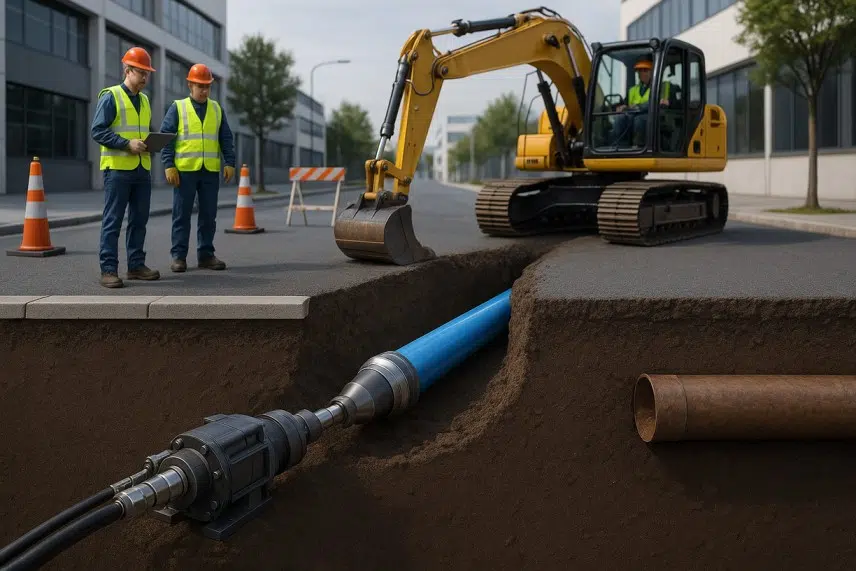
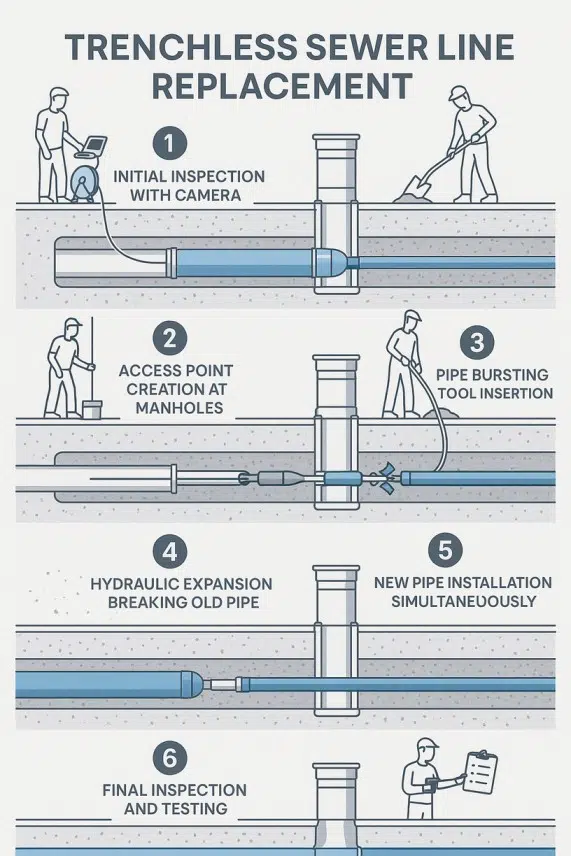
With pipe bursting, a crew digs two small pits, usually one near the house and one out at the connection to the city main or a downstream cleanout. A cable is threaded through the old pipe, and a cone-shaped bursting head is pulled back through it. The head fractures the old clay tile, cast iron, or Orangeburg pipe outward into the surrounding soil while pulling a new seamless high-density polyethylene (HDPE) pipe into place right behind it. Because HDPE has heat-fused, watertight joints, there is nothing for tree roots to work into later. Pipe bursting can also upsize the line, say from a tired 4-inch lateral to a larger pipe, without widening the dig.
Cured-in-place pipe (CIPP) lining
Lining is a strong option when the existing pipe still holds its shape and grade. A felt or fiberglass liner saturated with resin is pulled or inverted into the old pipe, inflated against the walls, and cured in place with hot water, steam, or UV light. The result is a smooth, jointless pipe formed inside the old one. Lining often needs only one access point, and it restores flow without disturbing the pipe’s bedding. The trade-off is that a liner slightly reduces the inside diameter, and it cannot fix a pipe that has collapsed or lost its slope.
When Trenchless Is the Right Call – and When a Dig Still Wins
Every honest answer starts with a camera. A licensed plumber runs a sewer camera down the line to confirm the pipe material, find its depth, and locate the breaks, root masses, offsets, or bellies, meaning low spots that hold water. That video is what tells us whether the line is a candidate for bursting, lining, or neither.
Trenchless usually works well when:
- The line has cracks, root intrusion, or corrosion but still follows a consistent grade.
- There are clear entry and exit points at each end of the run.
- The pipe runs under something you would rather not tear up, such as a driveway, sidewalk, garage slab, mature landscaping, or an established boulevard tree.
A traditional excavation may still be the better choice when:
- The pipe has fully collapsed or shifted so far out of line that a bursting head or liner cannot pass through it.
- The line has a significant belly that needs to be re-graded, not simply relined.
- Only one short section has failed, and a single spot dig is cheaper than lining the entire run.
What Trenchless Sewer Replacement Costs in Minnesota
There is no single sticker price for trenchless sewer work, and any contractor who quotes one sight-unseen is guessing. The total tracks a handful of real factors: the length of the run, how deep the pipe sits below the frost line, how many access pits are needed, the condition of the existing pipe, and whether the crew has to work around a finished driveway or foundation.

Priced by the foot, cured-in-place lining is often the most economical option, pipe bursting sits in the middle, and a full open-cut dig tends to cost the most once you add in the concrete, sod, and landscaping it destroys along the way. That restoration bill is where trenchless earns its keep. Understanding the true cost of sewer work means looking past the per-foot line item to the total picture for your property. For a fuller look at the decision, see our companion guide on whether trenchless is the right fit for your Minnesota home.
For a typical residential lateral in our service area, trenchless work commonly runs from several thousand dollars for a short, straightforward line up into the five figures for a long or deep run. The only number worth acting on is a written quote that follows a camera inspection of your specific pipe.
Why Trenchless Fits West-Central Minnesota
Our winters do real damage underground. Sewer laterals here are buried well below the frost line, often 5 feet down or more, and decades of freeze-thaw cycling, ground shifting, and settling take a toll on older clay tile and cast iron. By spring, when snowmelt raises the water table around Olivia, Litchfield, and Redwood Falls, a cracked line can start pulling in groundwater and backing up into basements.
Trenchless makes particular sense in these conditions. When the ground is frozen solid from December through March, opening a long trench is slow, expensive, and hard on a lawn that will not recover until summer. Bursting or lining lets a crew work from two small pits instead. The region’s heavy clay soils also grip fractured pipe fragments well during bursting, and the seamless HDPE pipe that goes in resists the root intrusion that plagues the mature elms and maples lining so many older streets in Willmar and Hutchinson.
How to Prepare and What to Ask Your Contractor
- Ask for the camera inspection video and a written report, not just a verbal summary.
- Confirm the contractor is a licensed Minnesota plumber and pulls the proper permit with your city or utility.
- Get the method in writing, bursting or lining, and ask why it fits your particular line.
- Ask what the warranty covers on both the new pipe and the workmanship.
- Ask how the crew will handle the connection to the city main and any required inspection.
Frequently Asked Questions
How long does a trenchless sewer replacement take?
Most residential jobs are finished in one to three days. Lining a straightforward run can sometimes wrap up in a single day, while bursting a long or deep line takes longer, especially if frozen ground slows the access-pit digging.
Can trenchless work be done in a Minnesota winter?
Yes. The line itself sits below the frost line year-round, so the pipe work is not the problem, the access pits are. Crews can dig through frozen ground, but it adds time and cost, so many homeowners with a non-emergency line choose to schedule the work for the shoulder seasons.
How long will the new pipe last?
Manufacturers typically rate HDPE burst-in pipe and cured-in-place liners for 50 years or more. Because both are seamless and jointless, they resist the root intrusion and joint failures that shorten the life of older clay and cast iron lines.
Is trenchless always cheaper than digging?
Not on every line item. The per-foot price can be similar, but the total often comes out lower once you factor in restoring a driveway, sidewalk, or landscaping that a full trench would destroy. A camera inspection and written quote are the only way to compare the two for your property.
Talk to Northern Services Today
If your drains are backing up, gurgling, or draining slowly, or you simply want to know the condition of an aging sewer line before it fails, Northern Services Today can put a camera down the line and tell you honestly whether trenchless is an option. Our licensed team serves Olivia, Willmar, Hutchinson, Litchfield, Redwood Falls, and the surrounding west-central Minnesota communities. Call us at (320) 523-5862 to schedule a sewer inspection or get a straight answer on your repair options.