


Key Takeaways
- Find the rating plate and EnergyGuide label first to identify model and serial numbers, fuel type, capacity, UEF, and estimated yearly energy costs for quick comparison and warranty checks.
- Use the model and serial number to verify the manufacture date, warranty, and suitable replacement parts. Keep track of the production order for recalls or service history.
- Match tank capacity and first-hour rating to household size and peak demand. Use the Uniform Energy Factor and estimated costs to compare long-term operating expenses for gas, electric, or heat pump options.
- Check safety and compliance marks, pressure relief specifications, and warning symbols to confirm safe installation, local code compliance, and rebate or incentive eligibility.
- Use label instructions for maintenance prompts like anode rod replacement, routine inspections, and log keeping to safeguard warranty coverage and maximize lifespan.
- So, look past your water heater label for local water quality, altitude and smart factors, and manufacturer resources to customize installation, maintenance and model selection.
How to read your water heater label uncovers what the key information is about capacity, energy usage and safety ratings.
Labels indicate tank size in liters, recovery, manufacturer date, and required pressure limits. They provide efficiency ratings and estimated yearly energy consumption in kilowatt-hours.
Understanding these numbers makes maintenance and refund claims easier and selecting replacements that align with household hot water demand.
The piece explains each label component and what to look at initially.
Decoding The Label
A water heater’s rating plate and accompanying EnergyGuide label contain the essential details required to determine fit, safety, and operating cost. Read them together: the rating plate gives technical and safety data while the EnergyGuide summarizes estimated annual energy cost and efficiency.
Here’s a quick-hit numbered guide to the most crucial information on the rating plate and label, with notes on where to locate follow-up specifics.
- Model and serial numbers — jot down both for parts, warranty searches and service history. The model presents precise arrangement. The serial typically encodes the manufacture year, month, and a production sequence number for recalls.
- Capacity and first-hour rating indicate tank volume in gallons. First-hour rating indicates how much hot water the unit can provide in an hour, which is more important for peak consumption.
- Fuel type and input rating — manufacturer label indicates fuel (electric, natural gas, propane) and input BTU or kW. Use this to double-check fit with your supply and venting.
- EnergyGuide data — the yellow label provides estimated yearly energy cost, UEF or EF’s, usage bins (very small, low, medium, high), and the average rate assumptions used for that estimate.
- Safety and compliance marks — check for UL, CSA, ASME or other marks and any state compliance notes. These verify the unit adheres to industry safety and efficiency standards.
- Maximum working pressure and temperature limits are important for safe installation and for coordinating with local code or expansion tank requirements.
- Warranty and manufacturing info — warranty duration and initiation details are printed on the label. The serial or production sequence is provided when checking coverage.
1. Model & Serial
Model number to order correct replacement parts and match performance specs when comparing units. The serial number frequently employs a letter-digit code to indicate year and month, and many manufacturers post decoding charts online.
If it’s a recall or batch issue, the production sequence within the serial number points us to the exact tank. Use serials when you call manufacturer support and for warranty claims.
2. Capacity
Gallons is the stored volume. Select based on household size and peak usage. A 30 to 40 gallon tank fits one to two, a 40 to 50 gallon tank fits three to four, and a 60 to 80 gallon tank fits larger homes.
Note the first-hour rate. It may be higher than tank volume due to recovery rate. This helps forecast morning or evening performance.
3. Energy Guide
The EnergyGuide is calculated using national average energy rates and the latest unit rates for electricity, gas, and propane. It’s a comparative measure, not an exact bill predictor.
It provides UEF (or EF), energy-use bins, and the basis of cost estimates. Refer to those numbers for model-to-model comparisons and to select lower-cost options.
4. Manufacturing Date
Decode manufacture date from serial to know age and plan replacement before failure. Warranty windows and service eligibility are determined by that date.
Record age for yearly service and estimate failure probability as the device approaches average life expectancy.
5. Safety Certifications
Check for UL, CSA, ASME stamps and any local compliance notes. These certify that it has been tested to safety and efficiency standards.
Check the service plate for mandatory warnings and installation limits.
Energy Efficiency
Energy efficiency on a water heater label, such as the energyguide label, explains how much of the fuel or electricity becomes useful hot water and what it means for operating costs and long-term value. First, consult the label to understand the yearly energy cost, then look at price or size. The subsections that follow parse the key metrics you will encounter and how to utilize them when you compare models, estimate bills, and select fuel types.
Energy Factor
To find the UEF or older EF on the energyguide label, it’s essential to understand that it’s the main efficiency factor. The higher the UEF, the more efficiently a unit converts a share of input energy into hot water, thus reducing your energy costs. UEF figures are only directly comparable within the same DOE FHR bin, so make sure to compare like with like, such as tanks sized for a family of four versus other similar tanks in that FHR bracket, or tankless water heater models within the same flow-rate class.
When considering your options, it’s wise to choose high-performing heat pump water heaters or condensing tankless brands. These energy-efficient models can be up to around 30% more efficient than conventional ones, significantly impacting your yearly energy cost. Routine maintenance, such as annual inspection and flushing of the tank, will help maintain the UEF edge for the long haul.
Estimated Costs
The EnergyGuide label includes an estimated annual energy cost. Use that for rough budgeting. Compare that figure between models to identify possible monthly and yearly savings. For a more realistic projection, modify the estimate with your regional energy prices and fuel type — electricity, natural gas, or propane — as the label employs a national average.
Factor in higher upfront costs for efficient units. They may cost more to buy but often pay back through lower bills. A heat pump water heater, for instance, can save a household of four about USD 600 per year. Take the label cost and your anticipated years of ownership to determine payback. Include maintenance costs. Inspecting the anode rod and flushing the tank reduce corrosion and preserve efficiency, improving long-term value.
First Hour Rating
Locate the FHR to determine peak hour hot water output. FHR assists you in aligning capacity with household demand and steering clear of depletion during peak periods. Either the label or manual might indicate how FHR is calculated. It is about tank capacity multiplied by 70 percent plus recovery rate.
Select an FHR unit that matches your peak hourly consumption. Showers, dishwasher, and laundry all running together require this. Choose one that bins together with the same UEF rating for an apples-to-apples efficiency comparison. For northern climates, keep in mind that heat pump models can lose efficiency in very cold temperatures.
Safety & Compliance
Studying the safety and compliance section of your water heater label informs you how to use the unit without causing hazards and how to maintain it within code and warranty margins. Begin with the rating plate for mandated warnings and certification marks, pressure information, and a safety features list.
These things inform installation decisions, servicing requirements, and regular inspections that minimize hazards like scalds, leaks, carbon monoxide, or overpressure.
Warning Symbols
Search for icons depicting electrical shock, gas leak, flame or hot-surface risks. There is typically a brief instruction adjacent to each icon, and you must carefully follow those instructions in order to reduce injury risk.
A high-temp icon typically rests next to the thermostat scale. Keep in mind that water kept at 140°F can burn within seconds and scald injuries increase above 120°F.
Identify pressure indicators that indicate potential for burst or relief-valve discharge. Use the symbols to check off during installation or maintenance or when a technician comes by to verify that clearances, venting, and labels are still readable and intact.
Certification Marks
Look for the marks from respected agencies—ENERGY STAR, AHRI, or accredited test labs. Manufacturer badges alone do not substitute third-party certification, which can impact rebates, incentives, and code acceptance.
Make sure marks on the label align with local building officials’ or your utility company’s requirements. Some areas require certain certifications in order to qualify for incentives.
For international readers, consider these seals as confirmation the unit adheres to stipulated performance and safety claims and as leverage when requesting rebates or warranty service.
Pressure Relief
Locate the maximum working pressure and the T&P relief valve rating on the data plate. Verify installed relief valve size and set point match label specs. Discrepancies raise the risk of over-pressurization or blocked discharge.
Leverage this pressure data to design secure routing of discharge lines and to validate drain pan necessities where leakage may result in damage. Schedule checks at least once a year.
Test the relief valve according to the manufacturer’s recommendations and check discharge piping for proper termination. Consistent inspections catch drips and prevent Legionella bacteria from growing in tepid, still water between 77˚F and 113˚F.
Test CO detectors monthly, swap batteries annually, and strategize water heater refresh in 5 to 7 years based on manufacturer guidance.
Maintenance Clues
Maintenance tips and general upkeep can be inferred directly from the energyguide label reading. Labels indicate parts, service instructions, and schedules, helping consumers establish a realistic maintenance schedule that maintains unit efficiency and warranty rights.
Anode Rod
The label or manual usually indicates where the anode rod is located, either on top or through a threaded port. Spot check with every service visit and log in your maintenance book. Check the anode rod whenever you flush the tank.
A significantly corroded or used-up rod needs replacement to avoid tank rusting. Change the anode rod at the labeled interval or earlier if it is more than 50% consumed. That, my friends, slows internal rusting and can add years to the tank’s life.
Use the rod’s condition as a quick health check: excessive degradation signals higher corrosion risk and a greater chance of leaks. Plan anode inspections for annual maintenance. Get Maintenance Clues.
Have a technician check the rod and report on its condition and remaining life. This maintains warranty terms transparently and schedules replacements before issues begin.
Warranty Period
Labels provide warranty periods for the tank and parts, typically in years. Pay attention to the tank warranty and whether there is separate coverage for components. Write down the model and serial number for your file.
You will need them to verify coverage with the manufacturer. Read exclusions carefully. Incorrect installation, failure to perform regular flushing or use outside of recommended water conditions can void coverage.
Maintenance Clues – Save receipts, service logs, etc. To prove that required maintenance was done and any claims still qualify. If the unit exhibits premature signs of distress, call the manufacturer with your model and serial number.
If repairs are covered under warranty, don’t pay out of pocket. Schedule fixes or replacement long before the warranty end date and you’ll avoid surprises.
Replacement Timeline
Create a checklist to watch for replacement triggers: age, sediment buildup, noisy operation, discolored or foul-smelling water, reduced hot water supply, or repeated leaks. Standard tank units tend to ultimately wear out about 8 to 12 years, though excessive mineral deposits can reduce that.
Maintenance Clues — Flush the tank every six months, particularly in hard-water regions. Sediment flush: A sediment flush agitates and eliminates minerals that settle at your heater’s base and diminish heating performance.
Maintenance clue: Have the temperature and pressure relief valve checked during service. A defective valve can be an indication of other problems. Follow escalating energy bills or constant fixes as hints to trade up.
Maintain a shortlist of newer models with improved efficiency and features, so you’re poised to act quickly if replacement becomes necessary. Keep an obvious track of maintenance, service calls and part changes for warranty validation and long-term planning.
Gas Versus Electric
Gas and electric water heaters have different fuel sources and engineering, and the energyguide label is the easiest way to verify which water heater model you have and what your yearly energy cost might be.
- Fuel source: natural gas, propane, or electricity listed on the model or data plate.
- Upfront cost: gas units typically range from $1,400 to $2,800. Electric units range from about $1,000 to $1,700.
- Monthly energy cost: Gas often costs around $20 per month. Electric costs $35 per month.
- Lifespan: electric about 10–15 years; gas about 8–12 years.
- Maintenance: electric roughly $150–$300/year; gas $120–$500/year.
- Total life-cycle cost: electric ranges from $15,250 to $19,700 over 25 years, while gas ranges from $8,600 to $17,600 over 20 years.
- Installation and venting: Gas needs proper venting and sometimes gas-line work. Electric requires appropriate electrical circuit and breaker capacity.
- Best fit: gas for homes with existing gas lines, lower monthly bills, or high hot-water demand. Electric is better for easier installations and an extended lifespan.
Input Rating
Look for the input BTU rating on a gas unit or wattage on an electric. The label will show this clearly. Scale that with your input to estimate how much fuel or electricity the heater consumes when firing.
For instance, a 40,000 BTU gas heater will burn much more fuel every hour than a 20,000 BTU unit. A 4,500 W electric tank pulls about 4.5 kW while heating. Compare those numbers between models to align with household demand and to size the home’s gas line or electrical circuit.
Installers use the input rating to determine venting size for gas appliances or to verify breaker and wire size for electric installs.
Recovery Rate
Find the recovery rate, most commonly in litres or gallons per hour, on the label to see how quickly the heater can reheat a full tank. Recovery rate is how quickly you can replenish your hot water, and gas heaters generally have more robust recovery rates than single-element electrics.
Match recovery to peak usage. Multiple showers and a washer equal a higher recovery needed. With heat pump, gas, and electric tanks, compare recovery to guess if two back-to-back showers will cool the tank or not.
Factor in recovery when making replacement decisions so you don’t undersize performance against your daily routine.
Venting Information
Check venting type and requirements on the label: atmospheric, direct vent, or power vent. Vent data impact unit placement and whether you require roof or sidewall terminations and condensate handling.
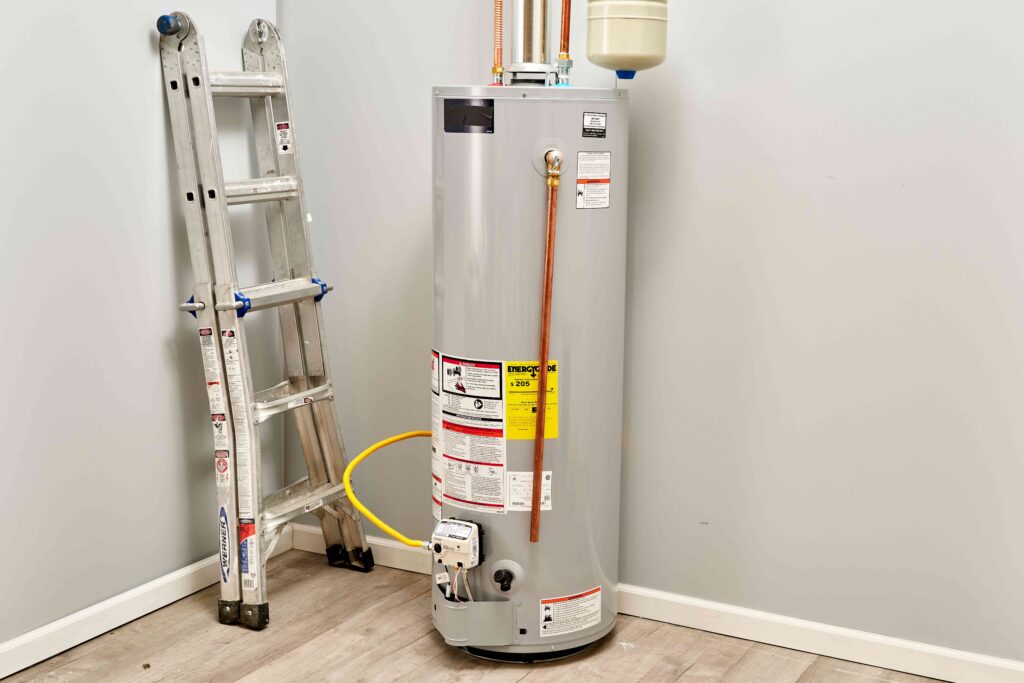
Validate that the venting actually fits your home’s layout. Retrofitting a gas vent could add a lot of cost and complexity. If switching from gas to electric, venting can be eliminated.
Switching to gas might require new vents and code approvals, so anticipate that work.
Beyond The Label
A water heater label provides fundamental specs, but other factors can shift how a unit performs in the real world. Consider things that the label omits: water chemistry, elevation, and whether the model supports digital monitoring. They influence durability, power consumption, and TCO.
Consider the label a baseline and overlay local data, manufacturer technical notes, and independent energy guides before you commit.
Water Quality
Consider your local water quality. Municipal reports or a basic testing kit will tell you hardness, pH, and mineral content. High hardness leads to scale buildup, which reduces heat transfer and reduces the FHR earlier than labels indicate.
For water hardness over 180 mg per liter as CaCO3, consider a water softener or more regular descaling. Tailor maintenance schedules to test results. Change the sacrificial anode rod more frequently in corrosive or soft water to prevent tank failure.
Hard water can need to be checked every year, whereas “softer” water can go longer. Maintain records so warranty or service visits are based on reality. Go by water quality between models. Some tanks utilize glass-lined steel that is better suited to certain chemistries.
Others boast scale-reduction treatments. Mark these on the label and manufacturer recommendation. Don’t get your warranty claim denied. Include water chemistry info!
Altitude Impact
High altitude decreases ambient air pressure and may alter combustion efficiency for gas models, decreasing BTU output and causing the heater to work harder. Consult the manual for elevation derating tables and scale input ratings accordingly.
A unit rated at sea level might require venting or burner modifications above 1,500 meters. Choose certified or factory pre-set models for your height. Some labels or spec sheets specify derating factors.
If not, call the manufacturer. Installation notes may indicate modified vent lengths, combustion air requirements, or special orifices for altitude usage. Ignoring these can make you less efficient and more polluting.
Digital Integration
Seek out labels or spec sheets that mention Wi-Fi, app control, or smart-home compatibility. These features allow you to track energy consumption and see projected annual energy costs live, which assists in adjusting behavior to reduce bills.
Efficiency-minded consumers can leverage its remote temperature control features to skip heating empty hot water and save energy. Remote diagnostics can alert leaks, abnormal cycles, or failed components to enable swifter service and reduced downtime.
Compare models on software support and data privacy, and whether the app displays FHR, energy consumption, and trend reports. For the optimal value in the long run, select the model that aligns with your networking and control needs.
Conclusion
Here’s how to read your water heater label. Model and serial tell age and size. First-hour rating and capacity indicate your hot water quantity. The energy factor and standby loss indicate fuel usage of the unit. Check for safety marks and local code numbers to verify safe fit for your home. For gas units, check burner specs and venting type. For electric models, record element watts and circuit requirements. Use maintenance notes and manufacturer tips to schedule inspections and component replacements. LABELS – READ ‘EM WITH A TAPE AND PHONE PHOTO If you’re unsure, call a licensed tech for help or get a second opinion from a local plumber.
Frequently Asked Questions
How do I find the model and serial number on my water heater label?
The model and serial numbers, essential for warranty and service calls, are typically located towards the top of the energyguide label. They are labeled as ‘Model’, ‘M/N’, ‘Serial’, or ‘S/N’.
What does the UEF or EF rating mean?
The UEF (Uniform Energy Factor) or EF indicates efficiency, directly influencing the yearly energy cost. The higher the number, the better the energy efficiency and the lower the energy costs to operate.
Where is the manufacture date on the label?
The manufacture date can be explicit or encoded in the serial number; refer to the manufacturer’s serial number guide online for details on energy costs.
How can the label tell me the tank capacity?
Capacity is noted in liters or gallons, usually under ‘Capacity’ or ‘Volume.’ This information indicates how much hot water the tank contains and helps consumers align home demands with their water heater model.
What safety and compliance marks should I look for?
Check for national marks such as CE, CSA, or other local approvals on the energyguide label. They indicate the water heater complies with safety and regulatory requirements for your area.
Does the label indicate fuel type and venting requirements?
Yes. The energyguide label includes important details such as fuel type (Gas, Electric, Propane) and potentially venting or clearance instructions, which are crucial for safe installation and operation.
How does the label help with maintenance scheduling?
Labels frequently list suggested inspection or service intervals and part numbers. Read your water heater energyguide label and then use this info to schedule flushing, anode checks, and pro service.