


The heating, ventilation, and air conditioning (HVAC) industry relies on precision, safety, and efficiency—qualities that begin with the right hand tools. According to the U.S. Environmental Protection Agency, over 15,000 certified HVAC technicians work with refrigerant-containing equipment daily, requiring specialized tools that meet strict regulatory standards[1]. Industry analysis from ServiceTitan reveals that technicians using properly selected hand tools complete service calls 23% faster while maintaining higher safety compliance rates[2].
Professional HVAC work demands more than basic hand tools. Modern systems integrate complex electrical components, pressurized refrigerant lines, and sophisticated control systems that require specialized equipment for safe and effective service. The selection of appropriate tools directly impacts technician safety, work quality, regulatory compliance, and business profitability.
Why HVAC Hand Tool Selection Matters in 2025
The HVAC industry has undergone significant transformation in recent years, driven by evolving refrigerant regulations, advanced system technologies, and heightened safety requirements. The Environmental Protection Agency’s Section 608 regulations mandate that technicians use certified recovery and recycling equipment when servicing systems containing regulated refrigerants[1]. This regulatory framework extends beyond specialized equipment to encompass the entire toolkit that technicians rely upon daily.
Contemporary HVAC systems present unique challenges that distinguish them from traditional mechanical systems. Modern residential and commercial installations incorporate variable-speed motors, electronic expansion valves, smart thermostats, and integrated building management systems. These technologies require technicians to possess both traditional mechanical skills and modern electrical diagnostic capabilities, necessitating a comprehensive toolkit that bridges both domains.
The economic implications of proper tool selection extend throughout the service chain. Fluke Corporation’s research indicates that technicians equipped with appropriate diagnostic tools reduce troubleshooting time by an average of 35%, directly translating to improved customer satisfaction and increased service capacity[3]. Furthermore, the use of safety-rated tools and personal protective equipment significantly reduces workplace injury rates, protecting both technicians and employers from costly incidents and regulatory violations.
Industry stakeholders—from individual technicians to large service organizations—must navigate an increasingly complex landscape of tool requirements. Residential HVAC technicians focus primarily on comfort and energy efficiency applications, while commercial and industrial specialists work with high-capacity systems that demand more robust diagnostic and safety equipment. Understanding these distinctions enables informed tool selection that matches capability requirements with practical applications.
Essential HVAC Hand Tool Categories
Professional HVAC service requires a systematic approach to tool organization, with equipment categorized by function and application. Industry standards recognize five primary categories of hand tools that form the foundation of every technician’s toolkit. Each category serves specific purposes while contributing to overall service capability and safety compliance.
Basic Hand Tools: The Foundation of HVAC Work
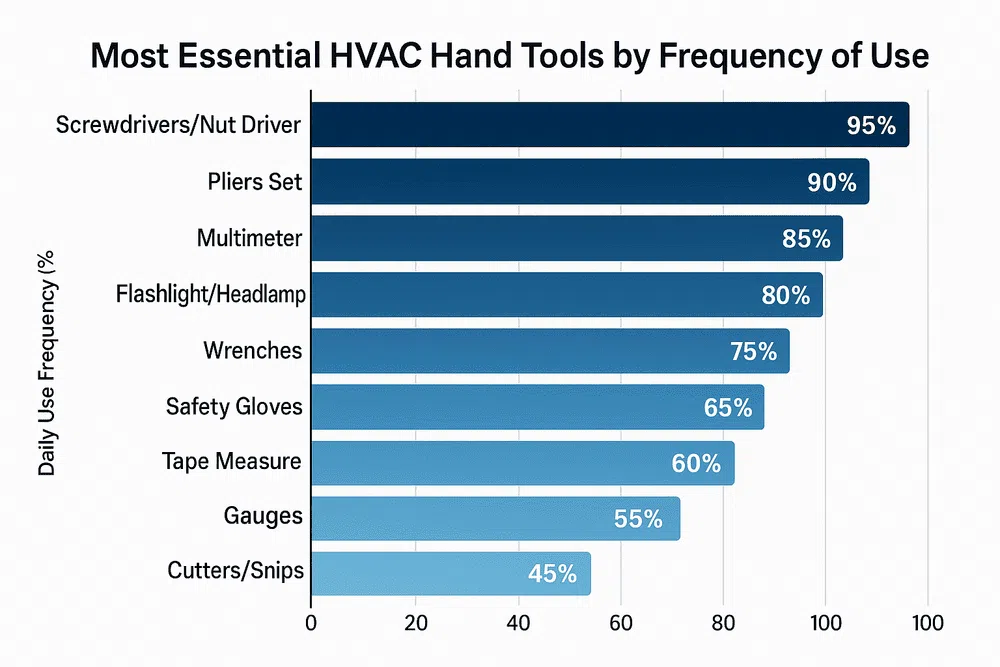
Basic hand tools constitute the most frequently used equipment in any HVAC technician’s arsenal. ServiceTitan’s analysis of over 50,000 service calls reveals that screwdrivers and nut drivers are utilized in 95% of all HVAC service interactions, making them indispensable for daily operations[2]. These tools must accommodate the diverse fastener types found in modern HVAC equipment, from standard Phillips and flathead screws to specialized hex and Torx fasteners used in premium equipment lines.
Professional-grade screwdriver sets typically range from $10 to $70, with premium options featuring magnetic tips, ergonomic handles, and interchangeable bits that enhance efficiency in tight spaces. Leading manufacturers such as Klein Tools, Craftsman, and Milwaukee offer sets specifically designed for HVAC applications, incorporating features like insulated handles for electrical safety and extended shafts for accessing recessed components.
Pliers represent another fundamental tool category, with HVAC technicians requiring multiple specialized types to handle various materials and applications. A comprehensive pliers set includes needle-nose pliers for precision work, linesman’s pliers for electrical connections, diagonal cutters for wire management, and channel-lock pliers for pipe and fitting manipulation. Industry professionals recommend investing in insulated pliers sets that provide protection against electrical hazards while maintaining the dexterity required for detailed work.
| Tool Type | Primary Applications | Cost Range | Key Features |
|---|---|---|---|
| Screwdriver Set | Panel access, component mounting, electrical connections | $10-$70 | Magnetic tips, insulated handles, multiple sizes |
| Pliers Set | Wire management, pipe fittings, component manipulation | $15-$70 | Insulated grips, multiple jaw configurations |
| Wrenches | Pipe connections, valve operation, mounting hardware | $10-$50 | Adjustable, fixed sizes, pipe-specific designs |
| Cutters | Ductwork modification, tubing preparation, wire stripping | $10-$40 | Sharp blades, ergonomic design, safety features |
Wrenches serve critical functions in HVAC applications, particularly for pipe connections, valve operations, and mounting hardware. Technicians require both adjustable wrenches for general applications and pipe wrenches specifically designed for threaded connections. The investment in quality wrenches pays dividends through improved grip, reduced slippage, and enhanced durability under the demanding conditions typical of HVAC service environments.
Electrical Testing and Safety Verification Tools
Every HVAC system incorporates electrical components that require specialized testing and diagnostic equipment. Fluke Corporation, a leading manufacturer of electrical test equipment, emphasizes that proper electrical testing tools are essential for both safety and diagnostic accuracy in HVAC applications[3]. The complexity of modern HVAC electrical systems, which may include variable-frequency drives, electronic expansion valves, and sophisticated control circuits, demands tools capable of accurate measurement and safe operation in potentially hazardous environments.
Multimeters represent the cornerstone of HVAC electrical diagnostics, with specialized HVAC models offering features tailored to industry-specific requirements. The Fluke 116 HVAC Multimeter, priced at approximately $275, includes specialized functions for flame sensor testing, temperature measurement, and ghost voltage detection—common challenges in HVAC electrical systems[3]. These instruments must meet appropriate CAT (Category) safety ratings to ensure technician protection when working with potentially dangerous electrical systems.
Clamp meters provide non-invasive current measurement capabilities essential for motor diagnostics and system performance analysis. Advanced models like the Fluke 902 FC True-RMS HVAC Clamp Meter offer wireless data logging capabilities, enabling technicians to monitor system performance over time and identify intermittent issues that might otherwise go undetected. The ability to measure motor current draw without disconnecting wiring significantly improves diagnostic efficiency while maintaining system integrity.
Safety verification tools, including non-contact voltage testers and GFCI socket testers, provide essential protection against electrical hazards. The Fluke 1AC II Non-Contact Voltage Tester enables safe verification of de-energized circuits before beginning work, while GFCI socket testers ensure proper grounding and safety compliance in electrical installations. These tools, typically costing between $15 and $50, represent minimal investments that provide maximum safety benefits.
Safety Equipment and Personal Protective Equipment
Safety considerations in HVAC work extend beyond tool selection to encompass comprehensive personal protective equipment (PPE) that safeguards technicians against multiple hazards. The Occupational Safety and Health Administration (OSHA) recognizes HVAC work as involving exposure to electrical hazards, chemical refrigerants, sharp metal edges, and confined spaces—each requiring specific protective measures[4]. Modern safety protocols demand that technicians maintain and utilize appropriate PPE as an integral component of their professional toolkit.
Safety gloves represent the most frequently used protective equipment, with HVAC applications requiring gloves that balance protection with dexterity. Professional-grade work gloves must provide cut resistance for handling sharp metal ductwork, electrical insulation for working near energized components, and sufficient tactile sensitivity for manipulating small fasteners and controls. Leading manufacturers such as Mechanix Wear and Milwaukee offer HVAC-specific gloves priced between $15 and $30 that incorporate these essential features.
Eye protection assumes critical importance when working with pressurized refrigerant systems, metal cutting operations, and chemical cleaning agents. Safety goggles and glasses must meet ANSI Z87.1 standards for impact resistance while providing adequate coverage against chemical splashes and debris. Some models incorporate magnification features that enhance visibility when working with small components, improving both safety and work quality.
Respiratory protection becomes essential when working in environments with potential refrigerant leaks, cleaning chemical exposure, or dusty conditions common in older HVAC systems. While not technically hand tools, portable respirators and dust masks form an integral part of the safety toolkit that technicians must maintain and deploy appropriately. The relatively modest cost of quality respiratory protection—typically $10 to $30—provides substantial protection against both acute exposure incidents and long-term health risks.
Specialized HVAC Tools and Diagnostic Equipment
Advanced HVAC service requires specialized tools designed specifically for refrigeration and air conditioning applications. These tools address the unique requirements of pressurized refrigerant systems, precision temperature and pressure measurements, and system performance diagnostics that distinguish HVAC work from general mechanical service.
Refrigeration gauges, also known as manifold gauges, serve as the primary diagnostic tool for refrigerant system analysis. These instruments measure both high and low-side pressures while providing connections for refrigerant recovery, evacuation, and charging operations. Professional-grade gauge sets from manufacturers like Fieldpiece and Mastercool typically cost between $40 and $100, with digital models offering enhanced accuracy and data logging capabilities that support advanced diagnostic procedures.
Temperature measurement tools specifically designed for HVAC applications provide the precision required for system performance analysis and troubleshooting. Digital thermometers with probe attachments enable accurate measurement of air temperatures, refrigerant line temperatures, and component surface temperatures. Advanced models incorporate differential temperature measurement capabilities that simplify system efficiency calculations and performance verification procedures.
Airflow measurement represents a critical diagnostic capability that requires specialized instrumentation. Poor airflow constitutes one of the most common HVAC problems, leading to reduced efficiency, uneven temperature distribution, and customer complaints[3]. Professional airflow meters and micromanometers, such as the Fluke 922, provide accurate measurement of static pressure, differential pressure, and air velocity—essential parameters for system optimization and troubleshooting.
Regulatory Requirements and Compliance Standards
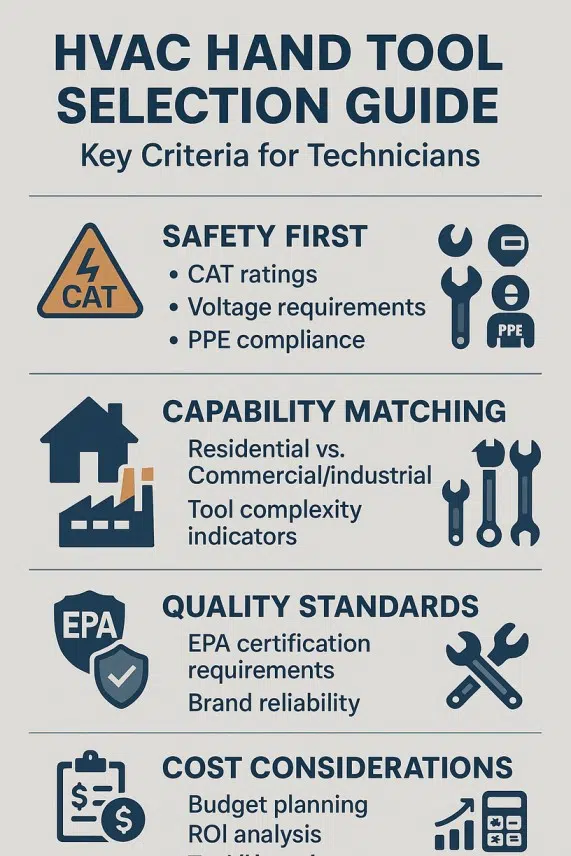
HVAC tool selection cannot be separated from the regulatory framework that governs refrigerant handling, electrical safety, and environmental protection. The Environmental Protection Agency’s Section 608 regulations establish comprehensive requirements for technicians working with refrigerant-containing equipment, including specific mandates for tool certification and usage protocols[1].
Under Section 608, technicians must use EPA-certified recovery and recycling equipment when servicing appliances containing regulated refrigerants. This requirement extends beyond the recovery equipment itself to encompass the entire toolkit used in refrigerant system service. Tools that contact refrigerant must be compatible with the specific refrigerant types being serviced, and technicians must maintain proper documentation of tool calibration and maintenance procedures.
Certification requirements for HVAC technicians directly impact tool selection and usage. Only certified technicians may purchase and use certain types of refrigerant handling equipment, and certification programs typically include training on proper tool selection, maintenance, and safety procedures. The certification process ensures that technicians understand both the technical and regulatory aspects of tool usage in professional HVAC service.
Electrical safety standards, particularly those established by the National Electrical Code (NEC) and OSHA, mandate the use of appropriately rated tools when working with electrical systems. Tools used in HVAC electrical work must meet specific CAT ratings that correspond to the voltage levels and fault current capabilities of the systems being serviced. These ratings ensure that tools provide adequate protection against electrical hazards while maintaining the functionality required for effective service.
Documentation and recordkeeping requirements associated with refrigerant handling create additional tool needs related to measurement, recording, and reporting. Technicians must maintain accurate records of refrigerant quantities recovered, recycled, and disposed of, requiring tools capable of precise measurement and documentation. Digital scales, recovery equipment with built-in measurement capabilities, and electronic recordkeeping systems support compliance with these regulatory requirements.
Tool Selection Strategies for Different HVAC Specialties
HVAC professionals operate across diverse market segments that present distinct tool requirements and operational challenges. Understanding these specialization differences enables informed tool selection that optimizes both performance and investment efficiency. The three primary HVAC specialties—residential, commercial, and industrial—each demand specific tool configurations that reflect their unique operational environments and technical requirements.
Residential HVAC Tool Requirements
Residential HVAC technicians focus primarily on comfort cooling and heating systems serving single-family homes and small multi-unit buildings. These applications typically involve standardized equipment sizes, common refrigerant types, and relatively straightforward electrical systems. Tool selection for residential work emphasizes portability, versatility, and cost-effectiveness while maintaining the capability to handle the full range of residential HVAC equipment.
The residential toolkit centers on basic hand tools supplemented by essential diagnostic equipment. A comprehensive residential kit includes standard screwdrivers and nut drivers, adjustable wrenches, basic pliers sets, and a reliable multimeter capable of handling typical residential electrical systems. Refrigeration gauges designed for common residential refrigerants (R-410A, R-22, R-32) provide the diagnostic capability required for most residential service calls.
Portability assumes particular importance in residential service, where technicians frequently work in confined spaces such as crawl spaces, attics, and mechanical closets. Tool organization systems, including tool bags and portable toolboxes, enable efficient transport and organization of equipment while protecting tools from environmental hazards common in residential settings.
Commercial HVAC Specialization
Commercial HVAC applications present increased complexity in system design, capacity requirements, and operational demands. Commercial buildings typically incorporate larger equipment, more sophisticated control systems, and diverse refrigerant types that require expanded tool capabilities. The commercial technician’s toolkit must accommodate these increased demands while maintaining the efficiency required for cost-effective service delivery.
Advanced diagnostic equipment becomes essential for commercial applications, where system downtime carries significant economic consequences. Digital manifold gauges with data logging capabilities enable comprehensive system analysis and performance trending. Infrared thermometers and thermal imaging cameras support non-invasive diagnostics that minimize system disruption while providing detailed performance information.
Electrical testing equipment for commercial applications must handle higher voltage systems and more complex control circuits. True RMS multimeters, clamp meters with extended current ranges, and power quality analyzers address the sophisticated electrical systems common in commercial HVAC installations. These tools typically represent higher investments but provide the capability required for effective commercial service.
Industrial HVAC and Process Cooling
Industrial HVAC applications encompass the most demanding operational environments, with systems designed for continuous operation, extreme conditions, and critical process support. Industrial technicians work with large-capacity equipment, specialized refrigerants, and complex control systems that require the most advanced diagnostic and service tools available.
Industrial tool requirements extend beyond standard HVAC equipment to include specialized instruments for vibration analysis, oil analysis, and advanced electrical diagnostics. These applications often involve custom-engineered systems that require flexible diagnostic approaches and specialized tools not commonly found in residential or commercial toolkits.
Safety considerations in industrial environments demand enhanced PPE and safety equipment. Industrial facilities may present additional hazards including chemical exposure, confined spaces, and high-energy electrical systems that require specialized safety protocols and equipment. The industrial toolkit must accommodate these enhanced safety requirements while providing the diagnostic capability required for complex system troubleshooting.
Cost Analysis and Investment Planning
Strategic tool acquisition requires careful consideration of both initial investment costs and long-term value creation. HVAC tool costs vary significantly based on quality, capability, and specialization level, with professional-grade tools commanding premium prices that reflect their enhanced performance and durability characteristics.
| Tool Category | Entry Level Cost | Professional Grade Cost | Premium/Specialized Cost | Expected Lifespan |
|---|---|---|---|---|
| Basic Hand Tools | $50-$150 | $150-$400 | $400-$800 | 5-10 years |
| Electrical Testing | $100-$300 | $300-$800 | $800-$2,000 | 3-7 years |
| Safety Equipment | $30-$100 | $100-$250 | $250-$500 | 1-3 years |
| Specialized Tools | $200-$500 | $500-$1,500 | $1,500-$5,000 | 5-15 years |
Return on investment analysis for HVAC tools must consider multiple factors including productivity improvements, reduced service time, enhanced diagnostic capability, and improved safety outcomes. High-quality diagnostic tools typically pay for themselves through reduced troubleshooting time and improved first-call resolution rates. ServiceTitan’s analysis indicates that technicians using advanced diagnostic equipment complete service calls an average of 23% faster while achieving higher customer satisfaction scores[2].
Tool financing and acquisition strategies vary based on individual circumstances and business models. Independent technicians may benefit from gradual tool acquisition that spreads costs over time while building capability incrementally. Service companies often implement standardized tool packages that ensure consistency across their technician workforce while leveraging volume purchasing advantages.
Maintenance and calibration costs represent ongoing expenses that must be factored into total cost of ownership calculations. Precision instruments require periodic calibration to maintain accuracy, while mechanical tools benefit from regular maintenance that extends service life and maintains performance. These ongoing costs typically represent 5-10% of initial tool investment annually but provide significant value through maintained performance and extended tool life.
Practical Action Plan for HVAC Tool Selection
Implementing an effective HVAC tool selection strategy requires a systematic approach that balances immediate needs with long-term capability development. Professional technicians and service organizations benefit from structured acquisition plans that prioritize essential tools while building toward comprehensive capability over time.
Phase 1: Essential Foundation Tools (Months 1-3)
New HVAC technicians should begin with fundamental hand tools that support basic service operations across all system types. This foundation phase focuses on tools with broad applicability and immediate utility in daily service work. The initial investment typically ranges from $300 to $800 and provides the basic capability required for entry-level HVAC service.
Priority acquisitions include a comprehensive screwdriver and nut driver set, basic pliers collection, adjustable wrenches, and essential safety equipment including gloves and safety glasses. A basic multimeter capable of voltage, current, and resistance measurement provides essential electrical diagnostic capability. This foundation toolkit enables technicians to perform routine maintenance, basic troubleshooting, and component replacement tasks across most HVAC systems.
Tool organization becomes critical during this phase, with investment in a quality tool bag or portable toolbox that protects equipment while enabling efficient transport. Proper organization systems reduce tool loss, improve work efficiency, and project professional competence to customers and supervisors.
Phase 2: Diagnostic and Specialized Equipment (Months 4-12)
The second phase emphasizes diagnostic capability and specialized tools that enable more complex service operations. This expansion typically requires investment of $800 to $2,000 and significantly enhances troubleshooting capability and service efficiency. Advanced diagnostic tools reduce service time while improving accuracy and customer satisfaction.
Key acquisitions include refrigeration gauges appropriate for common refrigerant types, digital thermometers with probe attachments, and enhanced electrical testing equipment such as clamp meters and insulation testers. Airflow measurement tools become important for technicians working with ductwork and system optimization. Safety equipment expansion includes respiratory protection and enhanced eye protection for specialized applications.
Training and certification activities should accompany tool acquisition during this phase. Understanding proper tool usage, maintenance procedures, and safety protocols maximizes tool value while ensuring regulatory compliance. Many tool manufacturers offer training programs that enhance technician capability while providing product-specific knowledge.
Phase 3: Advanced and Specialty Tools (Year 2 and Beyond)
Advanced tool acquisition focuses on specialized equipment that supports specific market segments or advanced diagnostic capabilities. This phase typically involves investments of $1,000 to $5,000 annually and reflects career specialization and business development objectives. Advanced tools enable technicians to handle complex systems and provide premium service offerings.
Specialty acquisitions may include thermal imaging cameras for advanced diagnostics, power quality analyzers for commercial electrical systems, or specialized refrigerant handling equipment for industrial applications. These tools often require additional training and certification but provide significant competitive advantages in specialized markets.
Technology integration becomes increasingly important as tools incorporate wireless connectivity, data logging, and mobile device integration. These features enhance diagnostic capability while supporting documentation and reporting requirements essential for commercial and industrial service.
Future Trends in HVAC Tool Technology
The HVAC tool industry continues evolving in response to changing technology, regulatory requirements, and market demands. Understanding emerging trends enables informed investment decisions that position technicians and service organizations for future success while avoiding premature obsolescence of current equipment.
Digital Integration and Connectivity
Modern HVAC tools increasingly incorporate digital connectivity features that enable data sharing, remote monitoring, and integration with mobile devices and cloud-based platforms. Wireless-enabled diagnostic tools can transmit measurement data directly to smartphones or tablets, streamlining documentation and enabling real-time collaboration with remote experts or supervisors.
Cloud-based data storage and analysis platforms provide new capabilities for trend analysis, predictive maintenance, and performance optimization. Tools that integrate with these platforms enable technicians to access historical data, compare current measurements with baseline values, and identify developing issues before they result in system failures.
Augmented reality (AR) applications represent an emerging technology that overlays digital information onto real-world views through smartphone or tablet cameras. AR-enabled diagnostic tools can provide visual guidance for complex procedures, display system information directly on equipment images, and facilitate remote assistance from experienced technicians or engineers.
Environmental and Regulatory Compliance
Evolving environmental regulations continue driving changes in refrigerant types, handling procedures, and equipment requirements. The ongoing transition to lower global warming potential (GWP) refrigerants requires tools capable of handling new refrigerant types while maintaining compatibility with existing systems during transition periods.
Enhanced leak detection capabilities become increasingly important as regulations tighten around refrigerant emissions and environmental protection. Advanced leak detection tools incorporating electronic sensors, ultrasonic detection, and thermal imaging provide improved sensitivity and accuracy compared to traditional soap bubble methods.
Documentation and reporting requirements continue expanding, driving demand for tools with integrated data logging and reporting capabilities. Electronic recordkeeping systems that automatically capture measurement data, service procedures, and compliance information reduce administrative burden while ensuring regulatory compliance.
Safety and Ergonomic Improvements
Tool manufacturers continue investing in safety enhancements that protect technicians while improving work efficiency. Improved insulation materials, enhanced grip designs, and integrated safety features reduce injury risk while maintaining tool functionality and durability.
Ergonomic improvements address the physical demands of HVAC work, with tools designed to reduce repetitive stress injuries and improve comfort during extended use. Lightweight materials, balanced designs, and reduced vibration characteristics contribute to technician health and productivity over long careers.
Smart safety features, including automatic shutoff mechanisms, overload protection, and integrated warning systems, provide additional protection against accidents and equipment damage. These features become particularly important as electrical systems become more complex and potentially dangerous.
Key Takeaways for HVAC Professionals
Strategic HVAC tool selection requires balancing multiple factors including safety requirements, regulatory compliance, capability needs, and economic considerations. The following key principles guide effective tool acquisition and utilization strategies for HVAC professionals at all career stages.
Safety and compliance must drive tool selection decisions. Tools that meet appropriate safety ratings and regulatory requirements protect both technicians and employers while ensuring legal compliance. The modest additional cost of safety-rated tools provides substantial protection against potentially catastrophic consequences of electrical accidents or regulatory violations.
Quality tools provide superior long-term value despite higher initial costs. Professional-grade tools typically offer 3-5 times the service life of entry-level alternatives while providing enhanced performance, accuracy, and reliability. The total cost of ownership analysis consistently favors quality tools for professional applications.
Systematic tool acquisition enables capability development while managing cash flow. Phased acquisition strategies allow technicians to build comprehensive toolkits over time while spreading costs and aligning investments with skill development and market opportunities.
Technology integration enhances diagnostic capability and operational efficiency. Modern tools with digital connectivity, data logging, and mobile integration provide competitive advantages through improved accuracy, documentation capability, and customer service quality.
References
- U.S. Environmental Protection Agency. (2020). EPA’s Refrigerant Management Requirements: What Technicians Need to Know. Retrieved from https://www.epa.gov/sites/default/files/2016-09/documents/608_fact_sheet_technicians_0.pdf
- ServiceTitan. (2024). 50 Essential HVAC Tools for Service Techs in 2025. Retrieved from https://www.servicetitan.com/blog/best-hvac-tools
- Fluke Corporation. (2024). The Essential HVAC Toolkit Decision Guide. Retrieved from https://www.fluke.com/en-us/learn/blog/hvac/hvac-tool-list-for-technicians
- Occupational Safety and Health Administration. (2024). Construction Industry Safety Standards. U.S. Department of Labor. Retrieved from https://www.osha.gov/construction