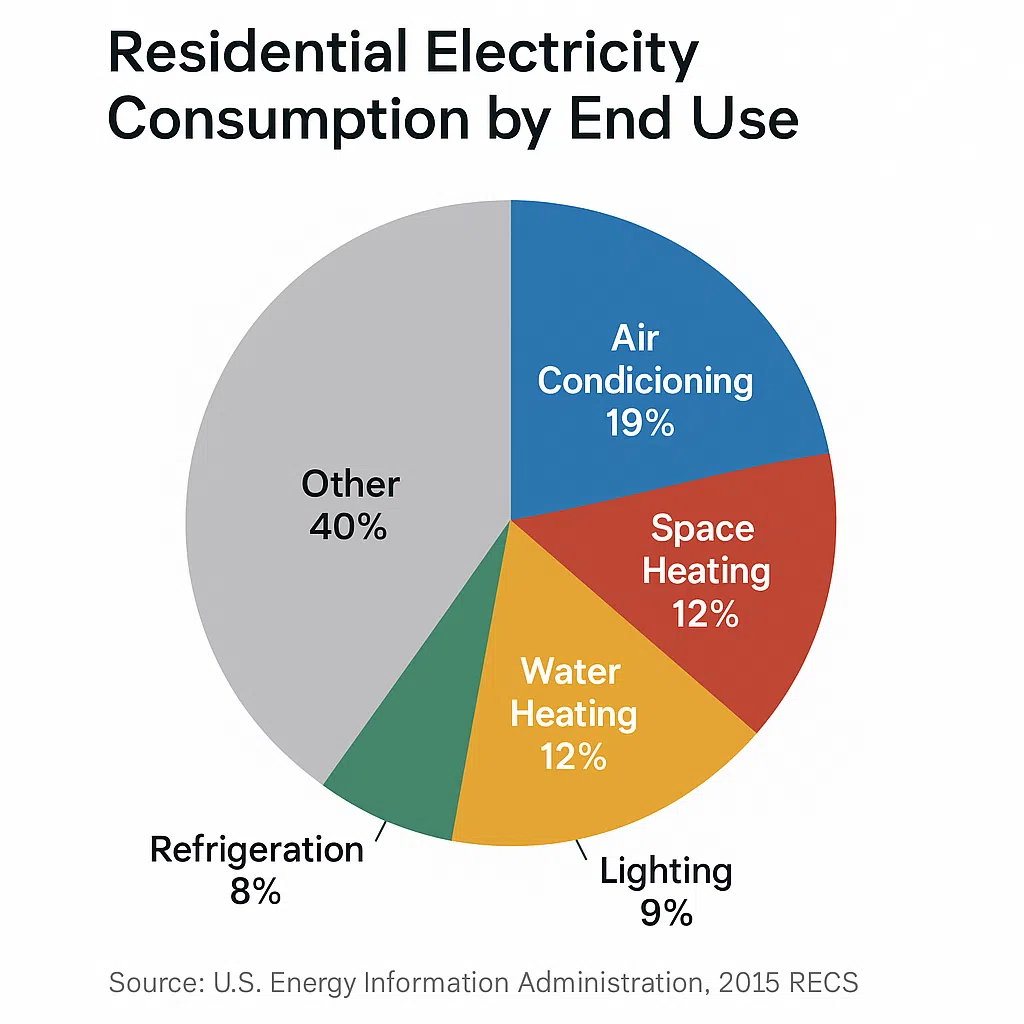
Home heating, ventilation, and air conditioning (HVAC) systems represent one of the most significant energy consumers in American households, accounting for a combined 31% of residential electricity consumption—with air conditioning alone responsible for 19% and space heating contributing an additional 12% [1]. This substantial energy footprint translates to approximately $29 billion in annual costs for U.S. homeowners, making HVAC efficiency a critical factor in household budgets and environmental impact [2]. The residential HVAC market, valued at $15.4 billion in 2024, is projected to reach $31.4 billion by 2034, driven by technological advances, energy efficiency mandates, and growing consumer demand for smart home integration [3]. Understanding modern HVAC systems, their efficiency standards, and emerging technologies has become essential for homeowners seeking to optimize comfort while minimizing energy costs and environmental impact.
Why HVAC Systems Matter in 2025
The significance of residential HVAC systems extends far beyond basic comfort, representing a convergence of economic, environmental, and technological factors that define modern home ownership. With the average U.S. household consuming approximately 10,500 kilowatt-hours (kWh) of electricity annually, HVAC systems emerge as the dominant energy consumer, directly impacting both household budgets and national energy security [1]. This energy intensity varies dramatically across regions, with single-family detached homes in the South consuming significantly more electricity than apartments in the Northeast, primarily due to increased reliance on electric heating and extended air conditioning usage [1].
Climate change imperatives have elevated HVAC efficiency from a cost consideration to an environmental necessity. The residential HVAC sector contributes over 100 million metric tons of carbon dioxide emissions annually, making system efficiency improvements a critical component of national decarbonization strategies [2]. Federal and state governments have responded with increasingly stringent efficiency standards, including the implementation of EER2 ratings in January 2023, which establish more rigorous testing protocols for air conditioning systems [2].
The integration of smart home technologies has fundamentally transformed HVAC system capabilities and consumer expectations. Modern systems incorporate programmable thermostats, home automation platforms, and Internet of Things (IoT) connectivity, enabling unprecedented control over energy consumption and indoor comfort [4]. This technological evolution coincides with substantial federal incentives, including tax credits up to $3,200 for energy-efficient home improvements, creating powerful economic drivers for system upgrades [5].
However, the HVAC landscape presents significant challenges alongside these opportunities. The replacement and retrofit market, while representing the largest segment of residential HVAC activity, faces constraints including aging housing stock, complex installation requirements, and the need for electrical system upgrades to accommodate modern high-efficiency equipment [3]. Additionally, the transition to environmentally friendly refrigerants, while necessary for ozone layer protection, introduces technical complexities and potential cost increases for consumers [2].
Understanding HVAC Energy Impact
The energy consumption patterns of residential HVAC systems reveal a complex landscape of regional variations, system types, and efficiency standards that directly influence both household economics and national energy policy. Current data from the U.S. Energy Information Administration demonstrates that 88% of American homes utilize air conditioning systems, with 66% equipped with central air systems, representing a dramatic increase from 27% central air adoption in 1980 [1, 2]. This widespread adoption has positioned HVAC systems as the primary driver of residential electricity demand, particularly during peak summer months when grid stability becomes a critical concern.
Regional energy consumption patterns reflect both climatic conditions and housing characteristics, creating significant disparities in HVAC energy intensity across the United States. The following analysis examines these variations and their implications for system selection and efficiency investments.
| Region | Average Annual kWh | HVAC Share (%) | Primary Challenges | Efficiency Priority |
|---|---|---|---|---|
| Northeast | 8,500 | 28% | Heating efficiency, older housing stock | Heat pump adoption |
| Midwest | 10,200 | 32% | Extreme temperature variations | Dual-fuel systems |
| South | 13,800 | 38% | Cooling loads, humidity control | High-SEER AC systems |
| West | 9,400 | 29% | Dry heat, energy costs | Evaporative cooling integration |
Figure 1: Residential electricity consumption by end use. Source: U.S. Energy Information Administration, 2015 RECS
The economic implications of these consumption patterns extend beyond simple utility bills, influencing property values, insurance costs, and long-term financial planning. A typical household spending $1,200 annually on electricity allocates approximately $372 to HVAC operations, with significant seasonal variations that can strain household budgets during extreme weather events [1]. This cost burden disproportionately affects lower-income households, who often occupy older, less efficient housing stock and lack capital for efficiency upgrades.
Case Study Analysis: A comprehensive examination of a typical 2,000 square foot single-family home in Atlanta, Georgia, illustrates the complex interplay between system efficiency, usage patterns, and costs. The home, equipped with a 15-year-old central air system rated at 10 SEER, consumed 18,500 kWh annually, with HVAC accounting for 7,400 kWh (40% of total consumption). Monthly electricity bills ranged from $85 in mild weather to $285 during peak summer months, creating significant budget volatility. However, this analysis reveals important limitations: actual consumption varies dramatically based on occupant behavior, home insulation quality, and maintenance practices, factors that can override equipment efficiency ratings in determining real-world performance.
Cost Analysis by System Type
The financial landscape of residential HVAC systems encompasses initial equipment costs, installation expenses, operating costs, and long-term maintenance requirements, creating a complex decision matrix for homeowners. Modern heat pump systems, while commanding premium initial prices ranging from $4,000 to $8,000 for equipment and installation, demonstrate superior operating efficiency with coefficients of performance (COP) reaching 4.90 in advanced models [3]. This efficiency translates to operating costs approximately 30-50% lower than traditional electric resistance heating, though actual savings depend heavily on regional electricity rates and climate conditions.
Traditional split-system air conditioners, representing the largest market segment with expected growth rates of 7.4% annually through 2034, offer lower initial costs but higher long-term operating expenses [3]. The implementation of EER2 efficiency standards has increased equipment costs by an estimated 8-12%, but this investment typically recovers through energy savings within 3-5 years in moderate to high-usage applications [2]. However, these calculations assume consistent maintenance, optimal system sizing, and stable energy prices—assumptions that may not hold in real-world applications.
Figure 2: Annual operating costs by HVAC system type for 2,000 sq ft home in moderate climate
The maintenance cost component often receives insufficient attention in system selection decisions, yet represents a significant long-term expense. High-efficiency systems typically require more frequent professional service, with annual maintenance costs ranging from $150-300 for basic systems to $300-500 for advanced heat pump and smart-enabled systems [6]. Filter replacement costs, while seemingly minor at $20-60 annually, can significantly impact system performance when neglected, potentially increasing energy consumption by 15-25% and reducing equipment lifespan.
Financing considerations add another layer of complexity to HVAC investment decisions. Federal tax credits covering up to 30% of equipment and installation costs for qualifying high-efficiency systems can substantially reduce effective purchase prices, but these incentives often require significant upfront capital that may not be available to all homeowners [5]. Additionally, utility rebate programs, while valuable, frequently have limited funding and complex qualification requirements that can delay or complicate system upgrades.
Modern HVAC Technology Landscape
The residential HVAC industry has undergone a fundamental transformation over the past decade, driven by regulatory mandates, technological innovation, and evolving consumer expectations for energy efficiency and smart home integration. The implementation of more stringent efficiency standards, beginning with the EER2 rating system in January 2023, represents the most significant regulatory change in HVAC testing protocols in over two decades [2]. These new standards require manufacturers to test equipment under more realistic operating conditions, resulting in efficiency ratings that better reflect real-world performance but also revealing that many previously high-rated systems perform less efficiently than advertised.
Advanced heat pump technology exemplifies the industry’s technological evolution, with leading manufacturers now producing residential systems achieving coefficients of performance (COP) exceeding 4.90 under optimal conditions [3]. Carrier’s recent introduction of 4-14 kW heat pump systems utilizing propane refrigerant demonstrates the industry’s commitment to both efficiency and environmental responsibility, achieving leaving water temperatures up to 75°C while maintaining high efficiency ratings [3]. However, these performance figures represent laboratory conditions, and field performance typically ranges 15-25% lower due to installation variables, maintenance practices, and real-world operating conditions.
| Rating System | Application | Testing Conditions | Minimum Standards | Implementation Date |
|---|---|---|---|---|
| SEER2 | Central AC Seasonal Efficiency | Variable load conditions | 14.3 (South), 13.4 (North) | January 2023 |
| EER2 | Peak Cooling Efficiency | 95°F outdoor, full load | 11.7 (≤45k BTU) | January 2023 |
| HSPF2 | Heat Pump Heating Efficiency | Regional temperature profiles | 7.5 (South), 6.7 (North) | January 2023 |
| COP | Heat Pump Performance | 47°F outdoor, steady state | 3.2 minimum | Ongoing |
| ENERGY STAR | Premium Efficiency Certification | Enhanced testing protocols | 15% above federal minimums | Updated annually |
The refrigerant evolution represents another critical technological frontier, with significant implications for system performance, environmental impact, and long-term costs. The phase-out of chlorofluorocarbons (CFCs) due to ozone depletion concerns has led to widespread adoption of hydrofluorocarbons (HFCs), but growing climate change concerns are now driving transition to A2L refrigerants with lower global warming potential [2]. This transition, while environmentally necessary, introduces technical challenges including modified safety protocols, specialized training requirements for technicians, and potential compatibility issues with existing system components.
Figure 3: HVAC efficiency improvements timeline showing steady progress in both air conditioning and heat pump technologies. Source: DOE, AHRI, ENERGY STAR
Proper system sizing remains a critical yet often overlooked aspect of HVAC performance, with industry standards recommending approximately 20 BTU per square foot of living space as a baseline calculation [2]. However, this simplified approach fails to account for numerous variables including ceiling height, insulation quality, window orientation, local climate conditions, and occupancy patterns. Manual J load calculations, while more accurate, require specialized expertise and are often bypassed in favor of expedient rule-of-thumb sizing, leading to oversized systems that cycle inefficiently and provide poor humidity control.
The consequences of improper sizing extend beyond energy efficiency to encompass comfort, equipment longevity, and indoor air quality. Oversized systems, while capable of quickly reaching temperature setpoints, fail to operate long enough to effectively remove humidity, creating uncomfortable conditions and potential mold growth risks. Conversely, undersized systems operate continuously during peak conditions, leading to premature wear and inability to maintain comfortable temperatures during extreme weather events.
Smart Integration and IoT
The integration of Internet of Things (IoT) technology and smart home platforms has revolutionized HVAC system control and monitoring capabilities, enabling unprecedented optimization of energy consumption and comfort management. Modern programmable thermostats, now installed in over 60% of U.S. homes, offer features including learning algorithms, occupancy sensing, weather integration, and remote control via smartphone applications [4]. These devices can reduce HVAC energy consumption by 10-15% through optimized scheduling and automatic adjustments based on occupancy patterns and weather forecasts.
Advanced smart HVAC systems incorporate multiple sensors throughout the home, monitoring temperature, humidity, air quality, and occupancy to create detailed environmental profiles and automated responses. Zoned systems, utilizing smart dampers and multiple temperature sensors, can optimize comfort and efficiency by conditioning only occupied areas, potentially reducing energy consumption by 20-30% in larger homes with variable occupancy patterns [4]. However, these systems require significant upfront investment, typically adding $2,000-5,000 to installation costs, and depend on reliable internet connectivity and ongoing software support.
The integration of HVAC systems with broader home automation platforms enables sophisticated energy management strategies, including coordination with solar panel systems, battery storage, and time-of-use electricity pricing. Smart systems can pre-cool homes during off-peak electricity hours, reducing operating costs by 15-25% in areas with significant time-of-use rate differentials [4]. Additionally, integration with weather forecasting services allows systems to anticipate heating and cooling needs, optimizing comfort while minimizing energy consumption.
Despite these technological advances, smart HVAC systems present several challenges and limitations. Cybersecurity concerns have emerged as internet-connected devices create potential entry points for malicious actors, requiring ongoing security updates and potentially compromising system reliability. Additionally, the complexity of smart systems can overwhelm homeowners, leading to suboptimal configuration and reduced efficiency benefits. Technical support requirements and the potential for obsolescence as technology evolves represent ongoing concerns for homeowners considering smart HVAC investments.
Industry Growth and Innovation
The residential HVAC market demonstrates robust growth trajectories driven by technological innovation, regulatory requirements, and evolving consumer preferences for energy efficiency and environmental responsibility. Market analysis indicates the U.S. residential HVAC sector will experience a compound annual growth rate (CAGR) of 7.5% from 2025 to 2034, with total market value expanding from $15.4 billion in 2024 to an projected $31.4 billion by 2034 [3]. This growth significantly outpaces general construction industry expansion, reflecting the sector’s transition from basic comfort provision to comprehensive energy management and environmental control systems.
The heat pump segment represents the most dynamic growth area within the residential HVAC market, generating $7.4 billion in revenue during 2024 and positioned for accelerated expansion as federal and state policies increasingly favor electrification strategies [3]. Split air conditioning systems, while maintaining market dominance, are projected to grow at a more modest 7.4% CAGR through 2034, reflecting market maturation and increasing competition from heat pump alternatives [3]. The residential segment maintains an commanding 87% market share, underscoring the sector’s focus on single-family and small multi-family applications rather than commercial or industrial installations.
| Product Category | 2024 Revenue (Billions) | 2034 Projection (Billions) | CAGR (%) | Market Share 2024 |
|---|---|---|---|---|
| Heat Pumps | $7.4 | $16.8 | 8.5% | 48% |
| Split AC Systems | $5.2 | $10.4 | 7.4% | 34% |
| Furnace Systems | $2.1 | $3.2 | 4.3% | 14% |
| Other Systems | $0.7 | $1.0 | 3.6% | 4% |
The replacement and retrofit market constitutes the predominant driver of HVAC industry activity, accounting for approximately 55% of total market share as homeowners upgrade aging systems to meet efficiency standards and reduce operating costs [3]. This trend reflects the substantial installed base of systems approaching end-of-life, with the average HVAC system lifespan ranging from 15-20 years depending on maintenance practices and operating conditions. Federal and state incentive programs, including tax credits covering up to 30% of equipment and installation costs, have accelerated replacement cycles and encouraged adoption of high-efficiency systems that might otherwise be considered cost-prohibitive.
Figure 4: U.S. residential HVAC market growth forecast showing technology milestones and market evolution. Source: GM Insights Market Analysis
Innovation in HVAC technology extends beyond efficiency improvements to encompass advanced air quality management, with systems increasingly incorporating UV-C light sterilization, HEPA filtration, and bipolar ionization technologies [3]. These features, initially driven by COVID-19 concerns, have evolved into standard offerings that address broader indoor air quality issues including allergens, volatile organic compounds (VOCs), and particulate matter. However, the effectiveness of these technologies varies significantly based on implementation quality, maintenance practices, and specific air quality challenges, with some systems providing minimal benefit despite substantial cost premiums.
The integration of renewable energy systems, particularly solar photovoltaic installations, with HVAC systems represents an emerging market opportunity with significant growth potential. Heat pump systems combined with solar PV installations can achieve net-zero energy consumption for heating and cooling in favorable climates, while excess solar generation can offset HVAC consumption during peak demand periods [3]. Net metering policies in many states enable homeowners to sell excess electricity back to the grid, creating additional economic incentives for integrated renewable-HVAC systems. Nevertheless, these systems require substantial upfront investment, typically ranging from $25,000-40,000 for comprehensive installations, and depend on favorable solar exposure and supportive utility policies.
Environmental Impact and Decarbonization
The environmental implications of residential HVAC systems extend far beyond direct energy consumption, encompassing refrigerant emissions, manufacturing impacts, and end-of-life disposal considerations that collectively represent a significant component of residential carbon footprints. Current HVAC systems contribute over 100 million metric tons of carbon dioxide emissions annually through electricity consumption alone, with additional impacts from refrigerant leakage and manufacturing processes [2]. The transition to heat pump technology, while offering substantial efficiency improvements, requires careful consideration of electricity grid carbon intensity, as benefits depend heavily on the carbon content of local electricity generation.
Refrigerant management represents a critical environmental challenge, with hydrofluorocarbon (HFC) refrigerants possessing global warming potentials hundreds to thousands of times greater than carbon dioxide. The Kigali Amendment to the Montreal Protocol mandates an 85% reduction in HFC consumption by 2036, driving industry adoption of A2L refrigerants with significantly lower global warming potential [2]. This transition, while environmentally beneficial, introduces technical complexities including modified safety protocols, specialized training requirements, and potential performance trade-offs that may affect system efficiency and reliability.
Figure 5: Annual CO2 emissions comparison by HVAC system type for typical 2,000 sq ft home, demonstrating significant environmental benefits of efficient heat pump systems
The decarbonization potential of residential HVAC systems depends critically on regional electricity grid composition and the pace of renewable energy deployment. In regions with high renewable electricity penetration, such as California and the Pacific Northwest, heat pump systems can achieve carbon reductions of 60-80% compared to fossil fuel heating systems [7]. Conversely, in regions heavily dependent on coal-fired electricity generation, the carbon benefits of heat pump adoption may be minimal or even negative, particularly for heating applications in cold climates where heat pump efficiency decreases significantly.
Life-cycle environmental assessments reveal additional complexity in HVAC system environmental impacts, with manufacturing, transportation, and installation phases contributing 15-25% of total lifetime environmental impact [8]. High-efficiency systems, while offering superior operating performance, often require more complex manufacturing processes and specialized materials that increase embodied carbon. Additionally, the rapid pace of technological change can lead to premature system replacement, negating some environmental benefits through shortened equipment lifecycles.
The integration of HVAC systems with building envelope improvements presents the most effective approach to minimizing environmental impact while maintaining comfort. Comprehensive energy retrofits combining high-performance insulation, air sealing, and efficient HVAC systems can reduce total energy consumption by 40-60%, providing greater environmental benefits than HVAC upgrades alone [9]. However, these integrated approaches require substantial upfront investment and coordinated planning that exceeds the capabilities of many homeowners, highlighting the need for comprehensive policy support and financing mechanisms to achieve widespread adoption.
Choosing and Maintaining HVAC Systems
Selecting an optimal HVAC system requires systematic evaluation of multiple factors including climate conditions, home characteristics, energy costs, and long-term financial objectives. The ENERGY STAR certification provides a reliable baseline for efficiency evaluation, with certified systems performing at least 15% better than federal minimum standards [2]. However, efficiency ratings alone do not guarantee optimal performance, as proper sizing, installation quality, and ongoing maintenance significantly influence real-world system performance and longevity.
Professional load calculations using Manual J methodology represent the gold standard for system sizing, accounting for factors including building orientation, insulation levels, window characteristics, and local climate data. Systems sized using simplified square footage calculations frequently result in oversized installations that cycle inefficiently and provide poor humidity control. Homeowners should insist on detailed load calculations and verify that contractors possess appropriate certification and experience with high-efficiency systems.
Maintenance requirements vary significantly among system types, with heat pumps requiring more frequent professional service than traditional split systems due to their year-round operation and complex controls. Essential maintenance tasks include quarterly filter replacement, annual professional inspection and cleaning, and prompt attention to performance anomalies. Neglected maintenance can reduce system efficiency by 25-40% and significantly shorten equipment lifespan, negating efficiency investments through increased operating costs and premature replacement needs.
Financial planning for HVAC systems should encompass total cost of ownership including purchase price, installation costs, operating expenses, maintenance requirements, and expected lifespan. Federal tax credits and utility rebates can substantially reduce effective system costs, but these incentives often have limited availability and specific qualification requirements. Homeowners should evaluate financing options carefully, as low-interest loans or utility financing programs may provide more favorable terms than manufacturer financing offers.
HVAC Industry Trends 2025-2030
The residential HVAC industry faces transformative changes over the next five years, driven by evolving efficiency standards, technological innovation, and climate policy initiatives. The implementation of updated refrigerant regulations will require widespread adoption of A2L refrigerants by 2030, necessitating technician retraining and potentially affecting system costs and performance characteristics [2]. Additionally, proposed federal efficiency standards may further increase minimum SEER requirements, potentially adding 10-15% to equipment costs while delivering corresponding energy savings.
Smart home integration will become increasingly sophisticated, with artificial intelligence and machine learning algorithms enabling predictive maintenance, automated optimization, and integration with broader home energy management systems. However, cybersecurity concerns and the potential for technology obsolescence represent ongoing challenges that may limit adoption among risk-averse consumers. The industry must balance innovation with reliability and security to maintain consumer confidence in connected HVAC systems.
Market consolidation among HVAC manufacturers may reduce competition and innovation while potentially increasing costs for consumers. Conversely, the entry of technology companies into the HVAC market could accelerate innovation but may also introduce reliability concerns as non-traditional manufacturers learn the complexities of HVAC system design and manufacturing. Regulatory oversight will be critical to ensuring that innovation does not compromise safety or performance standards.
Climate change impacts, including more frequent extreme weather events and shifting temperature patterns, will challenge HVAC system design assumptions and potentially require more robust systems capable of handling expanded operating ranges. This evolution may increase system costs while highlighting the importance of proper sizing and installation practices to ensure adequate performance under changing conditions.
Key Takeaways
- Energy Impact: HVAC systems consume 31% of residential electricity (19% cooling, 12% heating), costing U.S. homeowners $29 billion annually, with significant regional variations affecting system selection and efficiency priorities.
- Market Growth: The residential HVAC market will grow from $15.4 billion (2024) to $31.4 billion (2034) at 7.5% CAGR, driven by heat pump adoption (8.5% growth) and replacement of aging systems, though benefits depend on proper installation and maintenance.
- Technology Evolution: New EER2 standards and heat pump COP ratings up to 4.90 improve efficiency, but real-world performance typically runs 15-25% lower than laboratory ratings due to installation and maintenance variables.
- Environmental Considerations: HVAC systems contribute 100+ million tons of CO2 emissions annually, with heat pump adoption offering 60-80% carbon reduction potential in renewable-heavy grids, but minimal benefits in coal-dependent regions, highlighting the importance of regional electricity sources in system selection.
Frequently Asked Questions
What is the most energy-efficient HVAC system for residential use?
Heat pump systems currently offer the highest efficiency for most residential applications, with advanced models achieving coefficients of performance (COP) up to 4.90. However, efficiency depends heavily on climate conditions, with heat pumps performing best in moderate climates and potentially requiring backup heating in extreme cold conditions.
How often should HVAC systems be replaced?
Most residential HVAC systems last 15-20 years with proper maintenance, though efficiency improvements and changing technology may justify earlier replacement. Systems over 10 years old with frequent repair needs or SEER ratings below 13 are typically good candidates for replacement, especially when utility rebates and tax credits are available.
What size HVAC system do I need for my home?
Proper sizing requires professional Manual J load calculations considering factors beyond square footage, including insulation levels, window characteristics, and local climate. The common rule of 20 BTU per square foot is inadequate for accurate sizing and can lead to oversized systems with poor efficiency and comfort performance.
Are smart thermostats worth the investment?
Smart thermostats can reduce HVAC energy consumption by 10-15% through optimized scheduling and automatic adjustments, typically paying for themselves within 2-3 years. However, benefits depend on consistent use of programming features and may be minimal for households with irregular schedules or existing efficient manual thermostat management.
How do federal tax credits work for HVAC systems?
Federal tax credits cover up to 30% of equipment and installation costs for qualifying high-efficiency systems, with maximum credits varying by system type. Credits apply to tax liability rather than providing direct rebates, and systems must meet specific efficiency thresholds and ENERGY STAR certification requirements.
What maintenance is required for high-efficiency HVAC systems?
High-efficiency systems require quarterly filter replacement, annual professional inspection and cleaning, and prompt attention to performance issues. Heat pumps need more frequent service due to year-round operation, with maintenance costs typically ranging from $300-500 annually for advanced systems compared to $150-300 for basic systems.
References
Pacific Northwest National Laboratory. “Integrated Building Energy Retrofits: Performance and Cost Analysis.” Buildings Program, 2024..
U.S. Energy Information Administration. “Electricity use in homes.” December 18, 2023.
U.S. Department of Energy. “Air Conditioning.” Energy Saver Program.
GM Insights. “U.S. Residential HVAC Market Size, Forecast 2025-2034.” February 2025.
Gartner Research. “Emerging Tech: The Future of the Smart Home.” October 2024.
Internal Revenue Service. “Energy Efficient Home Improvement Credit.” May 29, 2025.
ASHRAE. “Residential Buildings Resources – Standards and Guidelines.” 2024.
Lawrence Berkeley National Laboratory. “Heat Pump Performance in Cold Climates.” Energy Technologies Area, 2024.
National Renewable Energy Laboratory. “Life Cycle Assessment of Residential HVAC Systems.” Building Technologies Office, 2023.
Pacific Northwest National Laboratory. “Integrated Building Energy Retrofits: Performance and Cost Analysis.” Buildings Program, 2024.