


Cubic feet per minute (CFM) represents the lifeblood of every heating, ventilation, and air conditioning (HVAC) system, yet this critical measurement remains poorly understood by many building owners and facility managers. According to the U.S. Energy Information Administration, HVAC systems account for 40% of commercial building electricity consumption[1], with cooling alone representing 14% and ventilation adding another 18%. Understanding and optimizing CFM is not merely a technical exercise—it directly impacts energy costs, occupant comfort, and indoor air quality in ways that can save thousands of dollars annually while ensuring regulatory compliance.
This comprehensive analysis examines CFM’s role in HVAC performance through authoritative government data, industry case studies, and engineering standards. From EPA ventilation requirements to real-world optimization results achieving 25-50% return on investment, we explore both the opportunities and limitations of CFM-based system improvements. The evidence reveals that while proper CFM management offers substantial benefits, success depends heavily on existing equipment age, building characteristics, and implementation approach.
Why CFM Optimization Matters in 2025
The significance of CFM optimization has intensified dramatically in recent years due to converging factors that make airflow management both more critical and more complex than ever before. The COVID-19 pandemic fundamentally altered building ventilation requirements, with the Centers for Disease Control and Prevention now recommending that indoor air should be completely replaced at least five times every hour and cleaned with minimum efficiency reporting value (MERV) filters[2]. This represents a substantial increase from traditional standards and directly impacts CFM calculations for millions of commercial and residential buildings.
Energy costs continue to escalate, making HVAC efficiency optimization a financial imperative rather than merely an environmental consideration. The U.S. Energy Information Administration reports that 5.9 million commercial buildings consumed 6.8 quadrillion British thermal units of energy and spent $141 billion on energy in 2018[3]. With HVAC systems representing the largest single energy consumer in most buildings, even modest CFM optimization improvements can yield substantial cost savings. Manufacturing facilities demonstrate this impact at industrial scale, where facility HVAC systems account for 8% of total electricity use, equivalent to 76 billion kilowatt-hours annually[4].

Regulatory compliance adds another layer of complexity to CFM management. ASHRAE Standard 62.1, the national consensus standard for outside air ventilation, requires mechanical systems to provide at least 15 cubic feet per minute of outside air per occupant[5]. This requirement translates to substantial airflow volumes in occupied spaces—a typical classroom with 30 people requires a minimum of 450 CFM of outside air, representing just the baseline ventilation before considering additional cooling or heating loads. State and local building codes often incorporate these standards while adding region-specific requirements, creating a complex regulatory landscape that building operators must navigate.
The economic drivers for CFM optimization extend beyond simple energy savings to encompass productivity, health, and liability considerations. Poor indoor air quality linked to inadequate ventilation can reduce cognitive performance by up to 15% according to Harvard School of Public Health research, while also increasing sick building syndrome complaints and potential legal exposure. Conversely, over-ventilated spaces waste energy without providing proportional benefits, highlighting the critical importance of precise CFM calculation and control in achieving optimal building performance.
Understanding CFM Fundamentals and Calculation Methods
Cubic feet per minute (CFM) measures the volume of air that moves through an HVAC system within a 60-second period, serving as the fundamental metric for ventilation adequacy and system performance. This measurement directly correlates with a building’s ability to maintain acceptable indoor air quality, temperature control, and energy efficiency. Unlike static measurements such as temperature or humidity, CFM represents dynamic airflow that must be continuously maintained to ensure proper building operation.

The basic CFM calculation formula provides the foundation for most ventilation design: CFM = (Room Volume in cubic feet) × (Air Changes per Hour) ÷ 60. Room volume is determined by multiplying length × width × height, while air changes per hour (ACH) varies based on building type and occupancy. Commercial and industrial buildings typically require a minimum of 4 ACH, while warehouses may need anywhere from 6 to 30 ACH depending on specific applications and local codes[6].
For existing systems, airflow measurement uses a different approach: CFM = Feet Per Minute (FPM) × Duct Cross Sectional Area. FPM is calculated using the formula FPM = 4005 × √ΔP, where ΔP represents the pressure differential across the measurement point. This method proves essential for commissioning and troubleshooting existing HVAC systems, allowing technicians to verify that designed airflow rates are actually being achieved in practice.
| Building Type | Minimum ACH | CFM per Person | Special Requirements |
|---|---|---|---|
| Office Buildings | 4-6 | 15-20 | Demand control ventilation for >40 people/1000ft² |
| Classrooms | 4-6 | 15 | CO₂ monitoring recommended |
| Warehouses | 6-30 | Variable | Based on stored materials and processes |
| Kitchens | 5 | 100 intermittent | Exhaust fan requirements |
| Healthcare | 6-15 | 25-30 | Positive/negative pressure requirements |
The relationship between CFM and building performance manifests in three critical areas: energy consumption, occupant comfort, and regulatory compliance. Insufficient CFM leads to poor indoor air quality, potential health issues, and regulatory violations, while excessive CFM wastes energy and increases operational costs. The Environmental Protection Agency emphasizes that buildings already providing code-compliant indoor air quality can often provide even more clean air without requiring major renovation[7], highlighting the optimization potential within existing systems.
Modern HVAC systems employ various technologies to measure and control CFM, including direct digital controls (DDC), demand-controlled ventilation (DCV), and variable air volume (VAV) systems. These technologies enable real-time monitoring and adjustment of airflow based on occupancy, outdoor conditions, and indoor air quality parameters. However, the effectiveness of these systems depends heavily on proper installation, calibration, and maintenance—factors that significantly influence long-term performance and energy efficiency.
Energy Efficiency and CFM Optimization Strategies
The relationship between CFM management and energy efficiency represents one of the most significant opportunities for building operators to reduce operational costs while improving system performance. HVAC systems consume substantial energy across all building types, with air conditioning accounting for 19% of electricity consumption in U.S. homes (254 billion kilowatt-hours annually) and HVAC systems representing approximately 40% of total energy use in commercial buildings[8]. These figures translate to billions of dollars in annual energy costs, making CFM optimization a critical economic consideration.
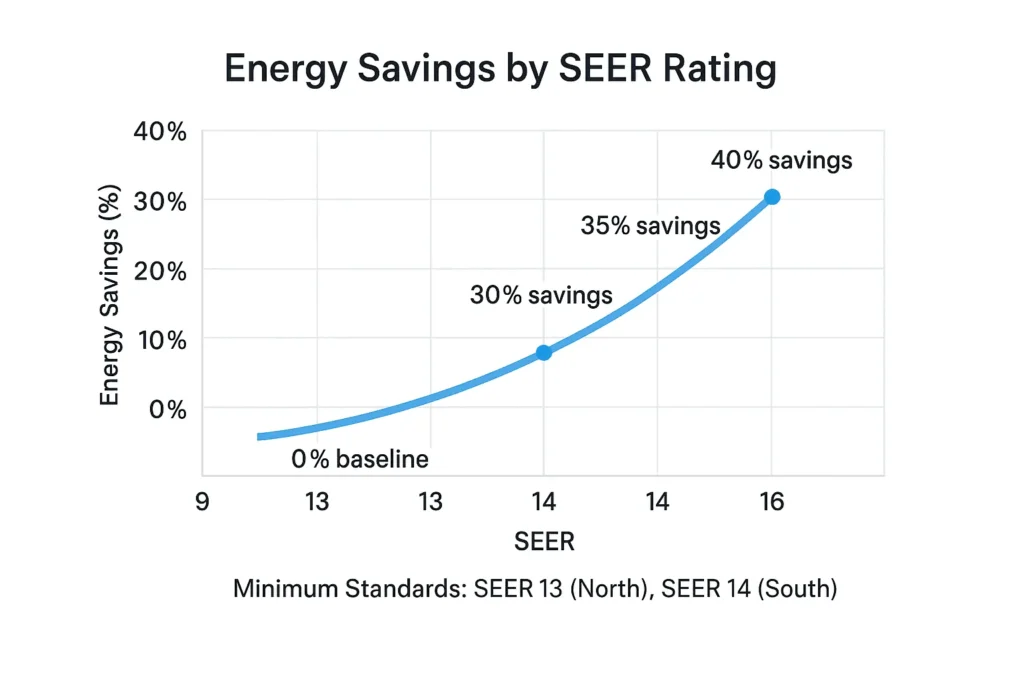
The Department of Energy’s efficiency standards demonstrate the potential for energy savings through proper system design and operation. Since January 2006, all residential air conditioners sold in the United States must have a Seasonal Energy Efficiency Ratio (SEER) of at least 13, with ENERGY STAR central air conditioners requiring SEER ratings of at least 14[9]. Upgrading from SEER 9 to SEER 14 systems can reduce energy consumption by more than 35%, with monthly savings potentially reaching $35 for every $100 in direct cooling costs.
CFM optimization strategies extend beyond equipment efficiency to encompass system design, control strategies, and operational practices. Variable air volume (VAV) systems represent one of the most effective approaches for commercial buildings, allowing airflow to be adjusted based on actual demand rather than maintaining constant volumes. These systems can reduce fan energy consumption by 30-50% compared to constant volume systems while maintaining adequate ventilation and comfort levels.
Demand-controlled ventilation (DCV) offers another significant opportunity for energy savings, particularly in spaces with variable occupancy. DCV systems use CO₂ sensors or occupancy detectors to modulate outside air intake based on actual occupancy levels rather than design maximums. The International Mechanical Code requires DCV for large high-occupancy areas (spaces greater than 500 square feet with more than 40 people per 1000 square feet)[10], recognizing both the energy savings potential and the importance of maintaining adequate air quality.
However, CFM optimization efforts must balance energy efficiency with indoor air quality requirements and occupant comfort. Oversized cooling systems can be noisy, provide inadequate thermal comfort, and lead to mold and poor indoor air quality issues. The Department of Energy emphasizes that proper system sizing determines not only heating and cooling ability but also energy bills, highlighting the importance of accurate load calculations and CFM requirements in system design[11].
Case studies from commercial building retrofits demonstrate the real-world potential for CFM optimization. A typical office building retrofit incorporating VAV systems, upgraded controls, and optimized ventilation strategies can achieve 20-50% energy savings with payback periods of 3-7 years. These improvements often qualify for utility rebates and tax incentives, further improving the economic attractiveness of CFM optimization investments.
The limitations of CFM optimization must also be acknowledged. Older buildings with outdated ductwork may require substantial infrastructure investments to achieve optimal airflow distribution. Additionally, some energy-saving strategies may conflict with enhanced ventilation requirements implemented in response to indoor air quality concerns. Building operators must carefully evaluate these trade-offs to develop optimization strategies that meet all performance objectives while remaining economically viable.
Regulatory Standards and Compliance Requirements
Federal and state regulations establish minimum CFM requirements that form the foundation for HVAC system design and operation, creating a complex regulatory landscape that building owners must navigate to ensure compliance while optimizing performance. The EPA’s Indoor Air Quality Design Tools reference ASHRAE Standard 62.1-2010 as the national consensus standard, which specifies outdoor air quantities that must be provided by natural or mechanical ventilation systems to various building areas[12]. These requirements vary significantly based on occupancy type, with some spaces requiring substantially higher ventilation rates than others.
ASHRAE Standard 62.1 continues to evolve, with the 2022 version providing updated procedures and methods for minimum ventilation requirements, indoor air quality, and operation guidelines for engineers and design professionals. The standard’s ventilation rate procedure specifies minimum outdoor air requirements based on both occupancy density and floor area, recognizing that different spaces have different ventilation needs. For example, office spaces typically require 5 CFM per person plus 0.06 CFM per square foot, while conference rooms need 5 CFM per person plus 0.06 CFM per square foot, but with higher occupancy densities that significantly increase total airflow requirements.
The Centers for Disease Control and Prevention has recently strengthened indoor air guidance, announcing that indoor air should be completely replaced at least five times every hour and cleaned with minimum efficiency reporting value (MERV) filters[13]. This recommendation represents a significant increase from traditional standards and reflects growing awareness of airborne disease transmission and indoor air quality importance. The CDC’s guidance particularly impacts healthcare facilities, educational institutions, and high-occupancy commercial buildings, where enhanced ventilation requirements may necessitate substantial CFM increases.
State and local building codes often incorporate ASHRAE standards while adding region-specific requirements that can significantly impact CFM calculations. The International Mechanical Code requires that every occupied space be ventilated by natural means in accordance with Section 402 or by mechanical means in accordance with Section 403[14]. For residential applications, the code specifies that mechanical ventilation is required where the air infiltration rate of a dwelling unit is 5 air changes per hour or less when tested with a blower door at a pressure differential of 50 pascals.
Commercial building requirements extend beyond basic ventilation to encompass specialized applications and energy efficiency considerations. The International Mechanical Code requires demand control ventilation for large high-occupancy areas, specifically spaces greater than 500 square feet with more than 40 people per 1000 square feet. This requirement recognizes both the energy savings potential of DCV systems and the importance of maintaining adequate air quality in variable-occupancy spaces.
Kitchen ventilation represents a specialized area with specific CFM requirements that often exceed general building ventilation standards. The EPA’s building codes guidance specifies that mechanical kitchen ventilation must provide an exhaust fan capable of delivering at least 100 CFM intermittent or airflow equivalent to 5 air changes per hour based on kitchen volume[15]. These requirements reflect the unique air quality challenges associated with cooking activities and the need for effective contaminant removal.
Compliance verification and ongoing monitoring present additional challenges for building operators. Many jurisdictions require commissioning of HVAC systems to verify that installed equipment meets design specifications and regulatory requirements. This process typically includes airflow measurement and verification that actual CFM rates match design calculations. However, ongoing monitoring and maintenance are equally important, as system performance can degrade over time due to filter loading, duct leakage, and equipment wear.
The regulatory landscape continues evolving, with increasing emphasis on energy efficiency and indoor air quality creating both compliance challenges and opportunities for building owners. Washington’s Building Performance Standards focus on energy efficiency and emissions reduction, requiring precise energy management that modern DDC systems can provide through CFM optimization[16]. These evolving regulations create incentives for building owners to achieve regulatory adherence while reducing operational costs through intelligent system design and operation.
Practical Implementation Strategies for CFM Optimization
Successful CFM optimization requires a systematic approach that begins with comprehensive assessment of existing systems and progresses through design, implementation, and ongoing monitoring phases. Building operators must first establish baseline performance through detailed airflow measurements and energy consumption analysis before implementing optimization strategies. This foundational step ensures that improvement efforts target the most significant opportunities while avoiding unintended consequences that could compromise indoor air quality or occupant comfort.

The initial assessment phase should include comprehensive airflow testing using calibrated instruments to measure actual CFM rates at supply and return registers, verification of duct integrity through pressure testing, and evaluation of control system performance. Many buildings discover significant discrepancies between design airflow rates and actual performance, with common issues including duct leakage, filter loading, and control system malfunctions. These baseline measurements provide the foundation for calculating potential energy savings and prioritizing improvement investments.
System design optimization focuses on matching airflow delivery to actual building needs rather than conservative design assumptions that may result in over-ventilation. Variable air volume systems offer significant opportunities for commercial buildings, allowing airflow to be modulated based on occupancy, outdoor conditions, and indoor air quality parameters. However, VAV implementation requires careful attention to minimum airflow rates to ensure adequate ventilation and proper system operation under all conditions.
Control system upgrades represent one of the most cost-effective CFM optimization strategies, particularly for buildings with older pneumatic or basic electric controls. Modern direct digital control systems enable sophisticated ventilation strategies including demand-controlled ventilation, economizer operation, and optimal start/stop scheduling. These systems can typically achieve 15-30% energy savings while improving indoor air quality and occupant comfort through more precise environmental control.
Equipment selection and sizing must balance energy efficiency with performance requirements and installation constraints. High-efficiency fans and motors can reduce energy consumption by 20-40% compared to standard efficiency equipment, while variable frequency drives enable precise airflow control and additional energy savings. However, these technologies require proper application and commissioning to achieve their full potential, highlighting the importance of qualified design and installation professionals.
Implementation sequencing should prioritize low-cost, high-impact improvements before proceeding to more complex system modifications. Simple measures such as filter replacement, duct sealing, and control system calibration can often achieve 10-20% energy savings with minimal investment. These quick wins provide immediate benefits while generating cash flow to support more substantial improvement projects.
Commissioning and verification ensure that optimization improvements achieve their intended performance objectives. This process should include airflow measurement and verification, control system testing and calibration, and documentation of system operation procedures. Many optimization projects fail to achieve their full potential due to inadequate commissioning, emphasizing the importance of thorough testing and verification protocols.
Ongoing monitoring and maintenance are essential for sustaining CFM optimization benefits over time. Building automation systems should include trending and alarming capabilities to identify performance degradation before it significantly impacts energy consumption or indoor air quality. Regular maintenance activities including filter replacement, coil cleaning, and belt adjustment help maintain optimal system performance while preventing costly equipment failures.
Future Outlook and Emerging Technologies
The future of CFM optimization in HVAC systems will be shaped by advancing technologies, evolving regulatory requirements, and growing emphasis on building performance and occupant health. Artificial intelligence and machine learning algorithms are beginning to enable predictive optimization strategies that can anticipate building loads and adjust airflow proactively rather than reactively. These systems promise to achieve even greater energy savings while maintaining superior indoor air quality through continuous learning and adaptation to building-specific patterns.
Internet of Things (IoT) sensors and wireless monitoring technologies are dramatically reducing the cost and complexity of comprehensive airflow monitoring. Advanced sensor networks can provide real-time data on air quality, occupancy, and system performance throughout a building, enabling more precise control strategies and early identification of performance issues. These technologies will likely become standard in new construction while offering cost-effective retrofit opportunities for existing buildings.
Building performance standards and energy codes continue to evolve toward more stringent efficiency requirements and enhanced indoor air quality standards. The trend toward net-zero energy buildings and carbon neutrality goals will drive demand for increasingly sophisticated CFM optimization strategies that minimize energy consumption while meeting enhanced ventilation requirements. Building operators must prepare for these evolving standards by implementing flexible systems capable of adapting to changing requirements.
However, several challenges may limit the pace of CFM optimization adoption. The complexity of modern building systems requires increasingly specialized knowledge and training, potentially creating workforce development challenges. Additionally, the integration of multiple building systems and technologies may introduce new failure modes and maintenance requirements that building operators must be prepared to address.
Climate change impacts on building performance will also influence CFM optimization strategies. Increasing temperatures and extreme weather events may require enhanced cooling capacity and modified ventilation strategies, potentially conflicting with energy efficiency objectives. Building designers and operators must develop adaptive strategies that can maintain performance under changing environmental conditions while achieving sustainability goals.
Key Takeaways
CFM optimization in HVAC systems offers substantial opportunities for energy savings, cost reduction, and improved indoor air quality when implemented through systematic, evidence-based approaches. Commercial buildings can typically achieve 20-50% energy savings through comprehensive CFM optimization strategies, with payback periods of 3-7 years for most improvement investments. However, success depends heavily on proper assessment, design, implementation, and ongoing monitoring to ensure that optimization efforts achieve their intended objectives without compromising indoor air quality or occupant comfort.
Regulatory compliance requirements continue to evolve, with enhanced ventilation standards and energy efficiency mandates creating both challenges and opportunities for building operators. ASHRAE Standard 62.1 provides the foundation for ventilation design, requiring minimum 15 CFM per occupant for most commercial spaces, while emerging standards may require even higher ventilation rates to address indoor air quality concerns.
Technology advances including variable air volume systems, demand-controlled ventilation, and advanced building automation systems enable sophisticated optimization strategies that were not feasible with older technologies. These systems can achieve significant energy savings while maintaining superior indoor air quality through precise control and real-time adaptation to changing conditions.
The economic case for CFM optimization is compelling, with HVAC systems representing 40% of commercial building energy consumption and offering multiple pathways for improvement. However, building operators must carefully evaluate trade-offs between energy efficiency and indoor air quality requirements to develop optimization strategies that meet all performance objectives while remaining economically viable.
References
- U.S. Energy Information Administration. Commercial Buildings Energy Consumption Survey (CBECS)
- Centers for Disease Control and Prevention. Ventilation in Buildings
- U.S. Energy Information Administration. Commercial Buildings Energy Consumption Survey Reports
- U.S. Energy Information Administration. Manufacturing Energy Consumption Survey
- ASHRAE. Standards 62.1 & 62.2 – Ventilation and Acceptable Indoor Air Quality
- International Code Council. International Mechanical Code 2021 – Chapter 4 Ventilation
- U.S. Environmental Protection Agency. Heating, Ventilation and Air-Conditioning Systems
- U.S. Energy Information Administration. Residential Energy Consumption Survey
- U.S. Department of Energy. Guide to Home Heating and Cooling
- International Mechanical Code 2021. Chapter 4 – Ventilation Requirements
- U.S. Department of Energy. Residential Buildings Integration
- U.S. Environmental Protection Agency. Building Codes and Indoor Air Quality
- Centers for Disease Control and Prevention. Indoor Air Quality Guidelines
- International Code Council. International Mechanical Code Ventilation Requirements
- U.S. Environmental Protection Agency. Kitchen Ventilation Requirements
- U.S. Department of Energy. HVAC System Performance for Energy Codes