


As winter approaches, homeowners across Minnesota face the annual challenge of rising heating bills. With heating accounting for nearly 29% of the average household’s utility costs, finding effective ways to manage this expense is crucial [1]. The U.S. Energy Information Administration (EIA) forecasts that while some fuel prices may be stable, a return to colder, more typical winter temperatures means that overall heating expenditures are expected to remain a significant financial pressure for many families [2]. This comprehensive guide provides a data-driven approach to understanding and reducing your winter heating costs. By implementing a combination of strategic upgrades, regular maintenance, and smart habits, homeowners can achieve significant savings, potentially reducing their energy bills by up to 30% or more. We will explore authoritative data from government sources, break down the most effective energy-saving strategies, and provide a clear action plan to keep your home warm and your wallet full this winter.
The High Cost of Comfort: Understanding Winter Energy Demands
The financial impact of winter heating is a major concern for households across the United States, but it is particularly acute in colder regions like the Midwest. According to the EIA’s 2024-2025 Winter Fuels Outlook, households in the Midwest are projected to see some of the most significant increases in heating expenditures, with costs expected to rise by as much as 11% for natural gas users due to a return to more typical winter temperatures after an unusually mild previous season [2]. This regional vulnerability highlights the critical need for proactive energy management. The national average household is expected to spend over $600 on natural gas and over $1,000 on electricity for heating during the winter months, and these figures can be even higher in states with prolonged periods of cold weather [2]. These costs are not just an inconvenience; for many families, they represent a significant financial burden that can strain household budgets and lead to difficult choices between heating and other essential expenses.
The challenge is compounded by the fact that many homes, especially older ones, are not optimized for energy efficiency. Inadequate insulation, leaky windows and doors, and inefficient heating systems can all contribute to significant energy waste, forcing homeowners to pay for heat that is literally escaping through the walls. The U.S. Department of Energy (DOE) emphasizes that a “whole-house approach” is essential for maximizing savings. This means that simply installing a new, energy-efficient furnace is not enough. To achieve the highest levels of efficiency and cost reduction, homeowners must also address insulation, air sealing, and other aspects of the building envelope. The good news is that these improvements can lead to substantial savings, with the DOE estimating that a comprehensive approach can reduce energy bills by about 30% [1]. This data underscores the importance of looking beyond the heating system itself and considering the entire home as an interconnected system. By understanding the key factors that drive winter heating costs and the most effective strategies for mitigating them, homeowners can take control of their energy consumption and make their homes more comfortable, affordable, and sustainable.
Analysis: The Foundation of Savings – Insulation and Air Sealing
The first line of defense against high winter heating costs is a well-insulated and properly sealed home. Before you even think about upgrading your furnace or installing a new thermostat, it is essential to ensure that the heat you are paying for is not escaping through gaps in your home’s envelope. The U.S. Environmental Protection Agency (EPA) estimates that homeowners can save an average of 15% on heating and cooling costs by air sealing their homes and adding insulation in attics, floors over crawl spaces, and accessible basement rim joists [3]. This is a significant saving that can be achieved with relatively low-cost improvements. In fact, some studies have shown that optimal thermal insulation can reduce heat loss by as much as 54.8% in walls and 53.5% in roofs, dramatically reducing the workload on your heating system and leading to substantial long-term savings [4].

Improvement,Min Savings (%),Max Savings (%)
Air Sealing,11,15
Insulation Upgrade,15,25
Programmable Thermostat,8,10
Heat Pump Installation,31,47
Whole-House Approach,25,35
The Financial Impact of a Leaky Home
To put the importance of insulation and air sealing into perspective, consider the following table, which illustrates the potential annual savings for a typical Minnesota home based on different levels of improvement. These figures are based on an average annual heating bill of $1,200, which is a conservative estimate for many households in the state.
| Improvement Level | Description | Estimated Annual Savings |
|---|---|---|
| Basic Air Sealing | Sealing gaps around windows, doors, and electrical outlets. | $132 – $180 |
| Attic Insulation Upgrade | Increasing attic insulation to recommended R-value. | $180 – $300 |
| Comprehensive Sealing & Insulation | Combining air sealing with attic and wall insulation. | $300 – $420 |
Case Study: The Johnson Home
The Johnson family, living in a 1980s-era home in Hutchinson, MN, was struggling with high winter heating bills that often exceeded $400 per month. An energy audit revealed significant air leakage around their windows and an attic with inadequate insulation. After investing in professional air sealing and upgrading their attic insulation, they saw an immediate and dramatic impact. Their winter heating bills dropped by an average of 35%, saving them over $500 in the first winter alone. While this was a significant upfront investment, the long-term savings and increased comfort of their home made it a worthwhile project. This case study highlights the importance of addressing the building envelope as the first step in any comprehensive energy-saving plan.

Analysis: Optimizing Your Heating System for Peak Performance
Once your home is properly sealed and insulated, the next step is to ensure that your heating system is operating at peak efficiency. The type of heating system you have and how well you maintain it can have a significant impact on your winter energy bills. The U.S. Department of Energy (DOE) reports that heating systems that are not properly maintained can use up to 30% more energy than those that are regularly serviced [1]. This is a substantial amount of wasted energy and money that can be easily avoided with a proactive approach to maintenance.
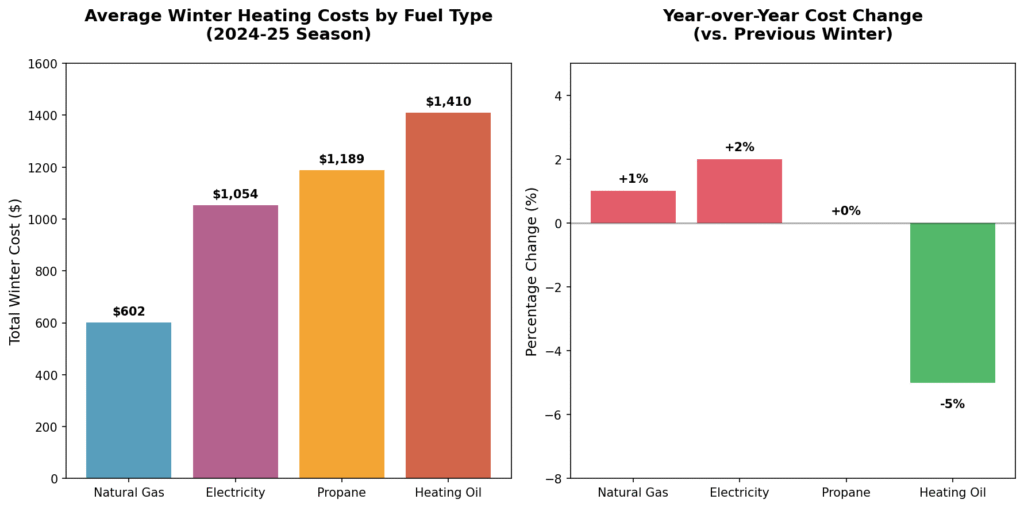
Fuel Type,Winter Cost ($),Change (%)
Natural Gas,602,1
Electricity,1054,2
Propane,1189,0
Heating Oil,1410,-5
The Economics of Different Heating Fuels
The fuel source your heating system uses is a major determinant of your winter energy expenditures. The EIA’s Winter Fuels Outlook provides a clear comparison of the projected costs for different heating fuels. As the chart above illustrates, natural gas remains the most affordable option for home heating, with an average winter cost of just over $600. Electricity, propane, and heating oil are all significantly more expensive, with heating oil being the costliest at over $1,400 for the winter season [2]. While switching heating systems is a major investment, it is important for homeowners to be aware of these cost differences, especially if they are considering a new system or building a new home. For those with existing systems, understanding the relative cost of their fuel source can help to inform their energy-saving efforts and provide a realistic baseline for their winter heating budget.
The Critical Role of Maintenance
Regardless of your heating system’s fuel source, regular maintenance is the key to ensuring its efficiency and longevity. A well-maintained system will not only use less energy, but it will also be more reliable and less likely to break down during the coldest months of the year. The following table outlines a basic maintenance schedule for a typical forced-air furnace, which is the most common type of heating system in the United States.
| Maintenance Task | Frequency | Benefit |
|---|---|---|
| Change Air Filter | Monthly | Improves airflow, reduces strain on system, improves indoor air quality. |
| Clean Vents and Registers | Seasonally | Ensures proper air distribution and prevents blockages. |
| Inspect Blower Motor | Annually | Ensures proper operation and identifies potential issues. |
| Professional Tune-Up | Annually | Comprehensive inspection, cleaning, and adjustment for optimal performance. |
Case Study: The Peterson’s Proactive Approach
The Peterson family, living in Willmar, MN, had an older but still functional natural gas furnace. They noticed that their heating bills had been slowly creeping up over the past few years, and they were concerned about the reliability of their system. Instead of waiting for a breakdown, they decided to invest in a professional tune-up from a local HVAC contractor. The technician cleaned the system, adjusted the burners, and replaced a worn-out part that was causing the furnace to run inefficiently. The result was a 15% reduction in their winter heating bills and the peace of mind that comes with knowing their system was in top condition. This case study demonstrates that even without a major system upgrade, proactive maintenance can lead to significant savings and improved reliability.

Analysis: Smart Technology and Behavioral Changes for Maximum Savings
In addition to physical improvements to your home and heating system, there are a number of smart technologies and behavioral changes that can lead to significant energy savings. These strategies are often low-cost or even free, and they can be easily implemented by any homeowner. The key is to be mindful of your energy consumption and to make conscious choices that will reduce your heating demand without sacrificing comfort.

Month,Natural Gas ($),Electricity ($),Heating Degree Days
Nov,103,188,486
Dec,134,223,724
Jan,140,234,803
Feb,118,205,653
Mar,106,203,533
The Power of a Programmable Thermostat
One of the most effective and affordable ways to reduce your heating costs is to install a programmable thermostat. The U.S. Department of Energy estimates that you can save as much as 10% a year on heating and cooling by simply turning your thermostat back 7-10°F for 8 hours a day from its normal setting [5]. This is a simple and effective way to reduce your energy consumption while you are asleep or away from home. For those with heat pump systems, the rule is even simpler: “set it and forget it.” Heat pumps are so efficient that they do not need to be set back to achieve savings. Simply setting the thermostat to a reasonable temperature and leaving it there will result in optimal performance and cost savings.
The Cumulative Impact of Small Changes
While a programmable thermostat can have a significant impact on its own, the real power of behavioral changes comes from the cumulative effect of many small adjustments. The following table outlines a number of simple, low-cost strategies that can help you to reduce your heating demand and save money on your energy bills.
| Strategy | Description | Estimated Annual Savings |
|---|---|---|
| Lower Thermostat by 1°F | Lowering your thermostat by just one degree can save up to 3% on your heating bill. | $36 |
| Use Window Treatments | Opening south-facing curtains during the day and closing all curtains at night can reduce heat loss. | $20 – $50 |
| Reduce Hot Water Temperature | Lowering your water heater temperature to 120°F can save 6-10% on your water heating costs. | $30 – $60 |
| Wear Warmer Clothing | Wearing sweaters, socks, and other warm clothing can help you to feel comfortable at a lower thermostat setting. | Varies |
Case Study: The Garcia Family’s Smart Savings
The Garcia family, living in a newer home in Spicer, MN, was already benefiting from good insulation and an efficient heating system. However, they were still looking for ways to reduce their energy consumption and lower their carbon footprint. They decided to focus on smart technology and behavioral changes. They installed a smart thermostat that learned their daily routines and automatically adjusted the temperature to save energy. They also made a conscious effort to use their window treatments to their advantage, opening them during the day to let in the sun and closing them at night to retain heat. By combining these strategies with other small changes, like wearing warmer clothing and reducing their hot water temperature, they were able to reduce their winter heating bills by an additional 12%, saving over $150 per year. This case study demonstrates that even in an already efficient home, there are always opportunities to save more through smart technology and mindful behavior.
Your Winter Heating Action Plan: A Step-by-Step Guide
Now that you understand the key factors that drive winter heating costs and the most effective strategies for mitigating them, it is time to create your own personalized action plan. This step-by-step guide will help you to identify the most impactful improvements for your home and to create a realistic timeline for implementing them.
- Conduct a Home Energy Audit: The first step is to understand where your home is losing the most energy. You can hire a professional energy auditor to conduct a comprehensive assessment of your home, or you can perform a DIY audit using a checklist from the Department of Energy.
- Prioritize Your Improvements: Based on the results of your energy audit, prioritize your improvements based on their cost-effectiveness and your budget. Start with the low-cost, high-impact improvements like air sealing and adding insulation.
- Create a Timeline and Budget: Once you have prioritized your improvements, create a realistic timeline and budget for implementing them. Be sure to factor in the cost of materials and labor, as well as any available rebates or tax credits.
- Implement Your Plan: Start implementing your plan, one step at a time. If you are doing the work yourself, be sure to follow all safety precautions and to use the proper tools and materials. If you are hiring a contractor, be sure to get multiple bids and to check their references.
- Track Your Progress: Keep track of your energy bills before and after you make your improvements to see how much you are saving. This will help you to stay motivated and to see the tangible results of your efforts.
The Future of Home Heating: Trends and Technologies to Watch
The world of home heating is constantly evolving, with new technologies and trends emerging that promise to make our homes more comfortable, efficient, and sustainable. As we look to the future, there are a number of exciting developments that homeowners should be aware of. One of the most significant trends is the continued growth of heat pump technology. As we have seen, heat pumps are already a highly efficient and cost-effective option for many homes, and they are only going to get better. The National Renewable Energy Laboratory (NREL) is actively working to improve the performance and reduce the cost of heat pumps, and we can expect to see even more advanced and affordable models in the years to come [6].
Another key trend is the integration of smart technology into home heating systems. Smart thermostats are already becoming commonplace, and we can expect to see even more sophisticated systems that can learn our habits, anticipate our needs, and automatically optimize our energy consumption. These systems will not only make our homes more comfortable and convenient, but they will also help us to save money and reduce our environmental impact. Finally, we can expect to see a continued focus on renewable energy sources for home heating. Solar thermal systems, geothermal heat pumps, and other renewable technologies are becoming more affordable and accessible, and they offer a path to a future where our homes are heated with clean, sustainable energy. By staying informed about these and other emerging trends, homeowners can make smart choices that will not only save them money today, but will also prepare them for the future of home heating.
Key Takeaways for Immediate Savings
- Prioritize the Building Envelope: Before investing in a new heating system, focus on air sealing and insulation. This is the most cost-effective way to reduce your heating demand and can save you up to 15% on your energy bills.
- Maintain Your System: Regular maintenance is essential for ensuring the efficiency and longevity of your heating system. A well-maintained system can use up to 30% less energy than one that is neglected.
- Embrace Smart Technology: A programmable or smart thermostat is a simple and affordable way to save up to 10% on your heating costs. Combine this with other small behavioral changes for even greater savings.
- Understand Your Fuel Costs: Be aware of the relative cost of your heating fuel. If you are considering a new system, this information can help you to make an informed decision that will save you money in the long run.
References
- U.S. Department of Energy. (n.d.). Home Heating Systems.
- U.S. Energy Information Administration. (2024, October 8). Winter Fuels Outlook.
- U.S. Environmental Protection Agency. (n.d.). Methodology for Estimated Energy Savings.
- Al-Absi, Z. A., & Al-Masrani, S. M. (2024). Energy efficiency of residential buildings using thermal insulation of building envelopes: A case study in a hot and humid climate.
- U.S. Department of Energy. (n.d.). Programmable Thermostats.
- National Renewable Energy Laboratory. (2024, February 12). News Release: Benefits of Heat Pumps Detailed in New NREL Report.