

Regular air conditioning maintenance is not just a recommendation; it’s a critical investment in your home’s comfort, energy efficiency, and long-term financial health. According to the U.S. Department of Energy, a well-maintained air conditioner can be up to 15% more efficient than a neglected one [1]. This translates to significant savings on your monthly energy bills, especially during the peak of summer. Furthermore, the Environmental Protection Agency (EPA) highlights that preventive maintenance improves indoor air quality by removing contaminant sources and ensuring the proper operation of your HVAC system [2]. In this comprehensive guide, we will explore the essential maintenance tasks that every homeowner should perform, the benefits of professional service, and how to create a proactive maintenance plan that keeps your home cool and your AC running smoothly for years to come.
The Critical Context of Modern Home Cooling
In today’s world, air conditioning is no longer a luxury but a fundamental component of a comfortable and healthy home, especially in regions with significant temperature fluctuations. The U.S. Energy Information Administration (EIA) reported that nearly 90% of U.S. households used air conditioning in 2020, a testament to its widespread adoption and importance [3]. However, this reliance on cooling technology comes with a significant energy footprint. The residential sector accounts for a substantial portion of national energy consumption, with HVAC systems being a primary driver. This makes energy efficiency not just a personal financial concern but also a broader environmental issue.
The performance of an air conditioning system is not static; it degrades over time without regular maintenance. This degradation is often gradual and may go unnoticed until a major breakdown occurs, typically during a heatwave when the system is under maximum stress. The consequences of neglecting maintenance extend beyond inconvenience and discomfort. They include higher energy bills, reduced equipment lifespan, poor indoor air quality, and unexpected, costly repairs. A study on residential HVAC installation practices revealed that a significant percentage of systems in homes have performance issues, many of which can be mitigated with proper maintenance [4]. Therefore, understanding the context of AC maintenance—why it matters, who it affects, and the constraints involved—is the first step toward a more efficient and reliable home cooling experience.
Analysis: A Deep Dive into Proactive AC Maintenance
The Foundation of Efficiency: Filters and Coils
The most fundamental and impactful aspect of air conditioning maintenance revolves around two key components: the filters and the coils. These elements are at the frontline of your system’s operation, directly influencing airflow, efficiency, and indoor air quality. According to ENERGY STAR, airflow problems can reduce your system’s efficiency by up to 15 percent, a significant and entirely preventable loss [5]. Neglecting these basic components can lead to a cascade of problems, from reduced cooling capacity to premature system failure.
The Critical Role of Air Filters
Your air conditioner’s filter is the first line of defense against dust, pollen, and other airborne particles. Its primary job is to protect the sensitive internal components of your HVAC system, particularly the evaporator coil, from accumulating dirt and debris. A clogged filter restricts airflow, forcing the system to work harder to circulate air. This not only increases energy consumption but also puts unnecessary strain on the blower motor and other components. The Department of Energy recommends inspecting, cleaning, or changing air filters once a month during the cooling season to ensure optimal performance [1].

Understanding Filter Types and Ratings
Not all filters are created equal. They vary in material, construction, and efficiency, which is measured by the Minimum Efficiency Reporting Value (MERV) rating. A higher MERV rating indicates a greater ability to capture smaller particles. However, it’s crucial to select a filter that is compatible with your specific HVAC system, as high-efficiency filters can sometimes restrict airflow more than the system is designed to handle. Consulting your system’s manual or a qualified HVAC technician is the best way to determine the appropriate filter type and MERV rating for your home.
| Filter Type | MERV Rating | Typical Replacement Frequency | Key Characteristics |
|---|---|---|---|
| Fiberglass | 1-4 | 30 days | Basic, low-cost, protects system from large particles. |
| Pleated | 5-8 | 60-90 days | Better filtration, captures smaller particles like pollen and mold spores. |
| Electrostatic | 8-10 | Washable, reusable | Uses static electricity to attract and capture particles. |
| High-Efficiency (HEPA) | 17-20 | 6-12 months | Requires professional installation, captures up to 99.97% of airborne particles. |
The Importance of Clean Coils
The evaporator and condenser coils are where the magic of heat exchange happens. The evaporator coil, located inside your home, absorbs heat from the indoor air, while the condenser coil, located in the outdoor unit, releases that heat outside. Over time, both coils can accumulate a layer of dirt and grime, which acts as an insulator and significantly reduces their ability to transfer heat. This forces the compressor to run longer and work harder, leading to increased energy consumption and a higher risk of burnout. The EPA emphasizes that cleaning coils and drain pans is a key preventive maintenance task that improves both IAQ and energy efficiency [2].

label,value
Regular Filter Changes,8
Coil Cleaning,12
Professional Tune-up,15
Condensate Drain Cleaning,5
Thermostat Calibration,6
Airflow Optimization,15
Case Study: The Impact of Neglected Maintenance
A homeowner in a hot climate noticed their energy bills were steadily increasing each summer, and their home never seemed to get cool enough. They had not had their AC system serviced in over five years. A professional inspection revealed a severely clogged air filter and a thick layer of dirt on the evaporator coil. After a thorough cleaning and filter replacement, the system’s cooling performance improved dramatically, and the homeowner saw a 25% reduction in their next energy bill. This case highlights the direct financial and comfort benefits of basic, regular maintenance.

- Check/Replace Filters (monthly)
- Clean Evaporator Coils
- Clear Condensate Drain
- Inspect Outdoor Unit
- Check Thermostat Settings
- Lubricate Moving Parts
- Test Electrical Connections
- Schedule Professional Service
Beyond the Basics: Condensate Management and Mechanical Integrity
While filters and coils are the foundation of AC maintenance, several other components require regular attention to ensure the system operates safely, efficiently, and reliably. These include the condensate drain system, electrical connections, and moving parts. Neglecting these areas can lead to water damage, electrical hazards, and premature mechanical failure. A holistic approach to maintenance that addresses these components is essential for long-term system health.
The Importance of a Clear Condensate Drain
Your air conditioner not only cools the air but also removes moisture from it. This moisture, known as condensate, is collected in a drain pan and channeled away through a drain line. If the drain line becomes clogged with algae, mold, or debris, the water can back up and overflow, causing significant water damage to your home. A clogged drain can also lead to increased indoor humidity levels, creating a more hospitable environment for mold and mildew growth. ENERGY STAR recommends checking and inspecting the condensate drain as part of a typical maintenance check-up to prevent these issues [5].
Ensuring Mechanical and Electrical Integrity
Your air conditioning system is a complex piece of machinery with numerous moving parts and electrical components. Over time, electrical connections can loosen, and moving parts can lose their lubrication. These issues can lead to increased friction, higher energy consumption, and a greater risk of component failure. A professional maintenance visit should include tightening all electrical connections, measuring voltage and current on motors, and lubricating all moving parts. These simple steps can significantly improve the safety and efficiency of your system and extend its lifespan.
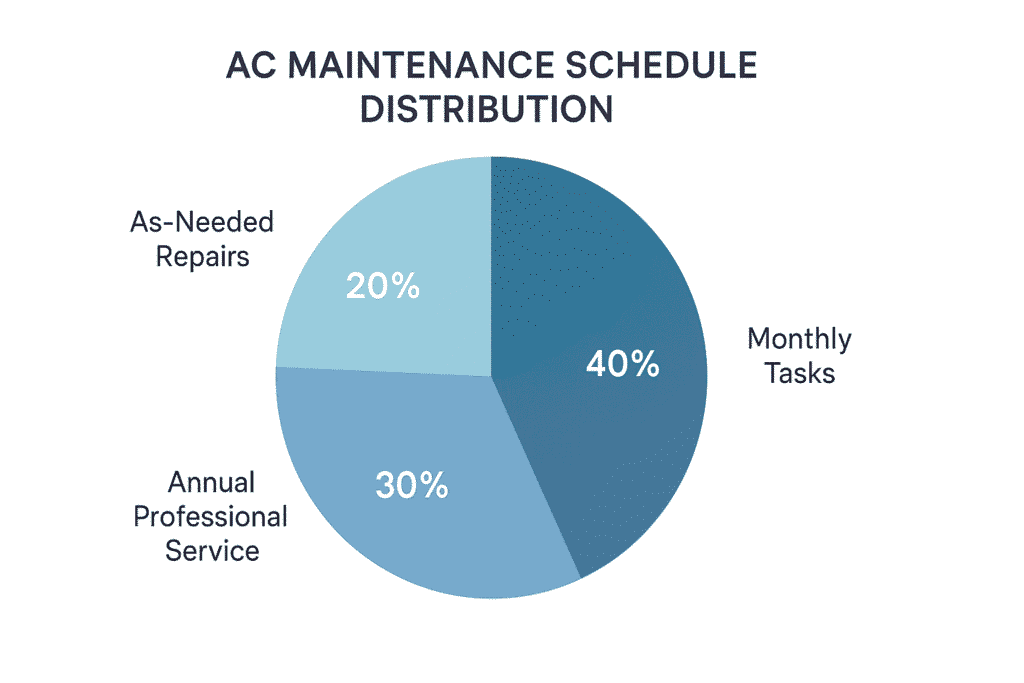
label,value
Monthly Tasks,40
Seasonal Tasks,30
Annual Professional Service,20
As-Needed Repairs,10
The Value of a Professional Tune-Up
While many basic maintenance tasks can be performed by homeowners, a comprehensive annual tune-up by a qualified HVAC technician is essential. A professional has the tools, training, and expertise to perform a thorough inspection, diagnose potential problems, and make necessary adjustments. This includes checking refrigerant levels, testing for leaks, sealing ductwork, and verifying the accuracy of the thermostat. An annual tune-up not only ensures your system is running at peak efficiency but also provides an opportunity to catch and address minor issues before they become major, costly repairs.

- Energy Savings: 5-15%
- Extended Lifespan: +5 years
- Improved Air Quality
- Reduced Repair Costs: -50%
- Better Performance
- Enhanced Comfort
Your Proactive AC Maintenance Action Plan
Taking a proactive approach to air conditioning maintenance is the most effective way to ensure your system runs efficiently and reliably. This action plan provides a clear, step-by-step guide to creating a comprehensive maintenance schedule that combines DIY tasks with professional service. By following this plan, you can maximize your system’s performance, minimize your energy bills, and extend the life of your equipment.
Monthly Maintenance Checklist (DIY)
- Inspect and Clean/Replace Air Filter: This is the single most important maintenance task. Check your filter monthly and replace it if it’s dirty, or at least every 90 days.
- Clear Debris from Outdoor Unit: Remove any leaves, grass clippings, or other debris that has accumulated around the outdoor condenser unit.
- Check for Unobstructed Airflow: Ensure that there is at least two feet of clearance around the outdoor unit on all sides.
Seasonal Maintenance Checklist (DIY)
- Clean the Evaporator Coil: At the beginning and end of the cooling season, use a soft brush and a no-rinse coil cleaner to remove any dirt or dust from the indoor evaporator coil.
- Clear the Condensate Drain: Pour a mixture of one part bleach and sixteen parts water down the condensate drain to prevent the growth of algae and mold.
- Inspect Window Seals: For room air conditioners, check the seals around the unit to ensure they are tight and preventing cool air from escaping.
Annual Professional Maintenance
Schedule a professional tune-up with a qualified HVAC technician at least once a year, ideally in the spring before the cooling season begins. A professional service should include:
- A thorough cleaning of the evaporator and condenser coils.
- A check of refrigerant levels and a test for leaks.
- An inspection of all electrical components and a tightening of all connections.
- Lubrication of all moving parts.
- A comprehensive system performance test.
Future Outlook: The Evolution of Smart and Sustainable Cooling
The future of air conditioning is being shaped by two powerful forces: the drive for greater energy efficiency and the integration of smart technology. As concerns about climate change and energy consumption grow, regulatory bodies and manufacturers are pushing for higher efficiency standards and more sustainable cooling solutions. At the same time, the rise of the Internet of Things (IoT) is enabling a new generation of smart air conditioners that can be controlled and monitored remotely, offering unprecedented levels of convenience and control.
We can expect to see a continued emphasis on inverter-driven, variable-speed technology, which allows air conditioners to adjust their output to match the cooling demand, resulting in significant energy savings. We will also see a greater integration of smart thermostats and sensors that can learn your preferences and optimize your cooling schedule for maximum efficiency. The development of new, more environmentally friendly refrigerants will also play a key role in reducing the environmental impact of air conditioning. As these technologies become more widespread, the importance of regular maintenance will only increase, as these more complex systems will require specialized knowledge and care to keep them running at peak performance.
Advanced Maintenance Considerations for Optimal Performance
While the basic maintenance tasks we’ve discussed form the foundation of a healthy air conditioning system, there are several advanced considerations that can further enhance your system’s performance and longevity. These include understanding the role of ductwork in system efficiency, the importance of proper insulation, and the benefits of upgrading to smart thermostats and controls. Addressing these areas can provide additional energy savings and improved comfort, making your investment in maintenance even more worthwhile.
The Hidden Impact of Ductwork
Your air conditioning system is only as good as the ductwork that distributes the cooled air throughout your home. Leaky, poorly insulated, or improperly sized ducts can significantly reduce your system’s efficiency and effectiveness. According to the Department of Energy, duct losses can account for more than 30% of energy consumption for space conditioning, particularly if the ducts are located in unconditioned spaces such as attics or crawlspaces [1]. A professional duct inspection and sealing can be a valuable addition to your maintenance routine, especially if your home is older or if you’ve noticed uneven cooling or higher-than-expected energy bills.
The Role of Insulation in System Efficiency
Proper insulation is crucial for maintaining the efficiency of your air conditioning system. Poor insulation allows conditioned air to escape and unconditioned air to enter, forcing your AC to work harder to maintain the desired temperature. This is particularly important in areas like attics, basements, and crawl spaces, where temperature differences can be significant. Upgrading your home’s insulation can reduce the load on your air conditioning system, leading to lower energy bills and improved comfort. The EPA’s ENERGY STAR program provides guidelines for recommended insulation levels based on your geographic location and climate zone.
Smart Technology and Advanced Controls
The integration of smart technology into HVAC systems represents a significant advancement in home comfort and energy efficiency. Smart thermostats can learn your schedule and preferences, automatically adjusting the temperature to optimize comfort and energy savings. Many models can be controlled remotely via smartphone apps, allowing you to adjust your home’s temperature even when you’re away. Some advanced systems can even integrate with other smart home devices, such as occupancy sensors and weather monitoring systems, to provide even more precise control and optimization.
Seasonal Considerations and Climate-Specific Maintenance
The maintenance needs of your air conditioning system can vary significantly depending on your local climate and the time of year. Understanding these variations and adapting your maintenance routine accordingly can help ensure optimal performance throughout the cooling season and proper preparation for the off-season. This is particularly important in regions with extreme weather conditions or high levels of airborne contaminants.
Pre-Season Preparation
Before the start of each cooling season, it’s important to perform a comprehensive inspection and preparation of your air conditioning system. This includes checking and replacing the air filter, cleaning the outdoor condenser unit, testing the thermostat, and ensuring that all vents and registers are open and unobstructed. If you have a heat pump system that provides both heating and cooling, you should also check the reversing valve and ensure that the system is properly set to cooling mode. This pre-season preparation can help identify and address any issues before they become problems during the peak of summer.
Mid-Season Monitoring and Adjustments
During the peak cooling season, it’s important to monitor your system’s performance and make adjustments as needed. This includes checking the air filter more frequently, especially if you have pets or live in a dusty environment. You should also monitor your energy bills for any unexpected increases, which could indicate a problem with your system. If you notice that your home is not cooling as effectively as usual, or if you hear unusual noises from your air conditioning system, it’s important to address these issues promptly to prevent more serious problems.
End-of-Season Maintenance and Winterization
At the end of the cooling season, it’s important to properly prepare your air conditioning system for the off-season. This includes cleaning or replacing the air filter, cleaning the outdoor condenser unit, and covering or removing window air conditioning units. For central air conditioning systems, you should also consider having the system professionally inspected and serviced to address any issues that may have developed during the cooling season. Proper end-of-season maintenance can help ensure that your system is ready for the next cooling season and can help prevent problems during the off-season.
Troubleshooting Common Issues and When to Call a Professional
Even with regular maintenance, air conditioning systems can occasionally experience problems. Understanding how to identify and troubleshoot common issues can help you determine whether a problem can be resolved with simple DIY steps or whether it requires professional attention. This knowledge can save you time, money, and frustration, and can help prevent minor issues from becoming major problems.
Common DIY Troubleshooting Steps
Many air conditioning problems can be resolved with simple troubleshooting steps that don’t require professional expertise. If your system is not cooling effectively, the first step is to check the air filter and replace it if it’s dirty. You should also check that all vents and registers are open and unobstructed, and that the thermostat is set correctly. If your system is not turning on at all, check the circuit breaker and ensure that the system is receiving power. For outdoor units, check that the condenser coil is clean and that there is adequate clearance around the unit.
When to Call a Professional
While many basic maintenance tasks and simple troubleshooting steps can be performed by homeowners, there are certain situations that require professional expertise. These include any issues involving refrigerant, electrical problems, or mechanical failures. If your system is making unusual noises, producing strange odors, or not cooling effectively despite basic troubleshooting, it’s time to call a qualified HVAC technician. Additionally, any maintenance tasks that involve opening the refrigerant system or working with electrical components should always be left to professionals.
The Importance of Professional Diagnosis
A qualified HVAC technician has the training, experience, and specialized tools needed to accurately diagnose and repair air conditioning problems. They can identify issues that may not be apparent to homeowners and can ensure that repairs are performed safely and correctly. Professional diagnosis is particularly important for complex problems or when multiple issues may be present. Attempting to repair complex problems without proper expertise can lead to further damage and potentially dangerous situations.
Key Takeaways
- Regular AC maintenance can improve energy efficiency by up to 15%, according to the U.S. Department of Energy [1].
- Dirty filters are a primary cause of reduced airflow and system inefficiency; they should be checked monthly and replaced every 1-3 months [1].
- Preventive maintenance, including cleaning coils and drain pans, improves indoor air quality and reduces energy use, as noted by the EPA [2].
- An annual professional tune-up is crucial for checking refrigerant levels, electrical connections, and overall system performance, which can prevent costly repairs and extend equipment life [5].