


Nearly 90% of air conditioner service calls from customers are due to refrigerant leaks, a startling statistic that underscores the critical importance of understanding, preventing, and managing this pervasive issue in HVAC systems [1]. The environmental and economic implications are staggering: refrigerant leakage in Maine alone generates an estimated 61,500 to 171,500 tons of CO2 equivalent emissions annually, with approximately 91% originating from commercial sector equipment [2]. For property owners and facility managers, the financial impact is equally significant, with refrigerant leak detection and repair costs typically ranging from $200 to $1,500, though complex commercial systems can require investments up to $2,000 [3]. As regulatory frameworks tighten under EPA Section 608 requirements and new global warming potential restrictions take effect, the stakes for proper refrigerant management have never been higher. This comprehensive analysis examines the technical, environmental, and economic dimensions of refrigerant leaks, providing evidence-based strategies for detection, prevention, and compliance in an evolving regulatory landscape.
Why Refrigerant Leaks Matter More Than Ever in 2025
The landscape of refrigerant management has undergone dramatic transformation in recent years, driven by converging environmental, regulatory, and economic pressures that make leak prevention and detection more critical than ever before. The Environmental Protection Agency’s strengthened Section 608 regulations now mandate specific trigger rates for leak repair, with industrial process refrigeration systems required to address leaks exceeding 30% annually, commercial refrigeration systems at 20%, and comfort cooling applications at just 10% [4]. These regulatory thresholds represent a significant tightening of oversight, reflecting growing recognition that refrigerant emissions contribute substantially to climate change through their high global warming potential values.

The environmental drivers behind this regulatory evolution are compelling. Hydrofluorocarbon refrigerants like HFC-134a, the most common refrigerant in mobile air conditioning systems since the 1990s, possess a global warming potential 1,430 times greater than carbon dioxide [5]. Even more concerning, HFC-134a accounts for an estimated 24% of total global HFC consumption and represents the most abundant HFC in the atmosphere [5]. The phase-down of high-GWP refrigerants under the American Innovation and Manufacturing Act has created additional compliance complexity, with substances exceeding 150 GWP facing prohibition in motor vehicle air conditioning applications by 2028 [5].
Economic stakeholders across the HVAC ecosystem face mounting pressures from these regulatory changes. Building owners and facility managers must navigate increasingly complex compliance requirements while managing the direct costs of leak detection, repair, and potential system retrofits. HVAC contractors and service technicians require enhanced training and equipment to meet new detection and reporting standards. Equipment manufacturers are investing heavily in low-GWP refrigerant alternatives and leak-resistant system designs. The convergence of these factors has created an environment where proactive refrigerant management is not merely a best practice but an operational necessity for regulatory compliance and cost control.
Understanding Refrigerant Leak Rates: A Data-Driven Analysis
The quantification of refrigerant leak rates represents one of the most challenging aspects of HVAC system management, complicated by the inherent difficulty and expense of conducting comprehensive leakage studies. As noted by the Efficiency Maine Trust, there have been only three primary studies published since 2006 from which the Intergovernmental Panel on Climate Change has been able to update their stationary HVAC and refrigeration leak rate estimates [2]. This scarcity of primary research stems from the complex methodology required for accurate measurement, which involves evacuating systems, weighing refrigerant content, and recharging systems—processes that often release refrigerant into the atmosphere and risk introducing problems that may not have existed before testing.
| Equipment Type | Refrigerant | Low Estimate (%) | High Estimate (%) | Sector |
|---|---|---|---|---|
| Refrigerators/Freezers | R-134a | 0.10 | 0.20 | Residential |
| Heat Pumps | R-410a | 1.00 | 3.00 | Residential |
| Window ACs | R-410a | 0.10 | 0.20 | Residential |
| Central ACs | R-410a | 1.00 | 3.00 | Residential |
| Packaged HVAC | R-410a | 2.00 | 6.00 | Commercial |
| Commercial Compressors | R-410a | 7.00 | 15.00 | Commercial |
| Commercial Condensers | R-410a | 7.00 | 15.00 | Commercial |
Despite these methodological challenges, the available data reveals significant variations in leak rates across different equipment types and applications. The EPA’s regulatory framework recognizes these differences through its tiered trigger rate system, which establishes different thresholds for corrective action based on equipment complexity and application. Industrial process refrigeration systems, which include complex customized appliances directly linked to chemical, pharmaceutical, petrochemical, and manufacturing processes, are permitted the highest leak rate threshold at 30% annually [4]. This category also encompasses industrial ice machines, electricity generation equipment, and ice rinks, reflecting the technical complexity and operational constraints of these specialized applications.

Real-world leak rate data from the Efficiency Maine Trust assessment provides crucial insights into actual system performance across different equipment categories. Residential systems demonstrate relatively low leak rates, with refrigerators and freezers using R-134a experiencing annual leakage of just 0.10% to 0.20% [2]. However, residential heat pumps and central air conditioning systems using R-410a show significantly higher rates, ranging from 1.00% to 3.00% annually [2]. This disparity reflects the different operating pressures, system complexity, and installation variables between sealed refrigeration appliances and field-assembled HVAC systems.
The commercial sector presents even more dramatic variations in leak rates. Packaged HVAC equipment, including chillers, unitary direct expansion systems, and other packaged equipment primarily used for space conditioning, experiences annual leak rates between 2.00% and 6.00% [2]. Commercial compressors and condensers, reflecting primarily commercial refrigeration equipment in grocery applications and other split systems, demonstrate the highest leak rates at 7.00% to 15.00% annually [2]. These elevated rates indicate frequent system failures and highlight the operational challenges inherent in complex commercial refrigeration systems with multiple connection points and extensive piping networks.
Detection Methods and Technologies: From Traditional to Advanced
The evolution of refrigerant leak detection technology reflects the increasing sophistication required to identify smaller leaks with greater accuracy while minimizing system disruption and environmental impact. Traditional detection methods, while still valuable in certain applications, have been supplemented by advanced electronic and chemical detection systems that offer enhanced sensitivity and precision. Understanding the capabilities, limitations, and appropriate applications of different detection methods is essential for developing effective leak management strategies.
| Detection Method | Sensitivity | Cost | Best Application | Limitations |
|---|---|---|---|---|
| Visual Inspection | Low | Very Low | Major leaks, initial screening | Cannot detect small leaks |
| Bubble Solution | Medium | Low | Leak confirmation, accessible areas | Requires system access |
| Electronic Detectors | High | Medium | Small leak detection, screening | Requires calibration |
| UV Fluorescent Dye | High | Medium | Multiple leaks, intermittent leaks | Requires system injection |
| Ultrasonic Detection | Medium | High | Inaccessible areas, screening | Affected by ambient noise |
Electronic leak detectors have revolutionized refrigerant leak detection by providing highly sensitive detection capabilities that can identify leaks far smaller than those detectable through traditional methods. These devices utilize various sensing technologies, including heated diode, heated pentode, corona discharge, and infrared absorption, each optimized for different refrigerant types and detection scenarios. Modern electronic detectors can identify refrigerant concentrations as low as a few parts per million, enabling detection of leaks that would otherwise go unnoticed until they became major system failures.
Fluorescent dye detection has emerged as a powerful complement to electronic detection methods, particularly for identifying intermittent or very small leaks that may be difficult to locate through other means. This method involves injecting specialized fluorescent dyes into the refrigerant system, allowing the dye to circulate with the refrigerant and escape at leak sites. Ultraviolet light inspection then reveals the dye deposits as bright fluorescent spots, providing precise leak location identification.
Environmental and Economic Impact: The True Cost of Refrigerant Leaks
The environmental and economic consequences of refrigerant leaks extend far beyond the immediate costs of refrigerant replacement and system repairs, encompassing complex interactions between climate impact, regulatory compliance, energy efficiency, and long-term system reliability. Understanding these multifaceted impacts is essential for developing comprehensive leak management strategies that address both immediate operational needs and broader environmental responsibilities.
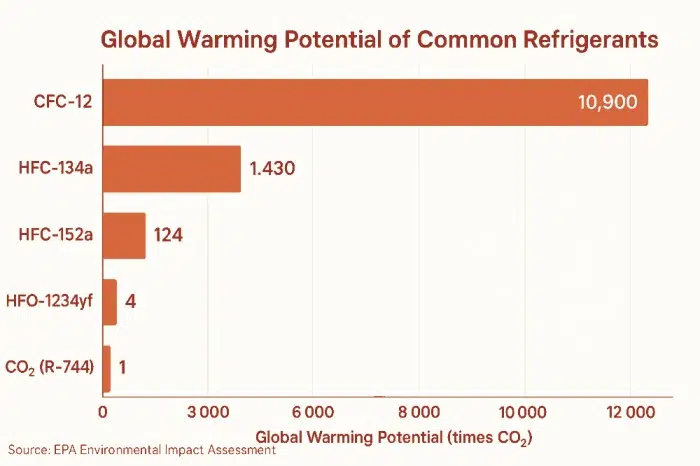
The environmental impact of refrigerant leaks is primarily determined by the global warming potential of the specific refrigerants involved and the quantities released to the atmosphere. The EPA’s comprehensive assessment of refrigerant environmental impacts reveals dramatic differences in climate impact between different refrigerant types [5]. CFC-12, the ozone-depleting refrigerant phased out in the 1990s, possesses a global warming potential of 10,900 times that of carbon dioxide, making even small leaks environmentally significant. While CFC-12 is no longer used in new equipment, legacy systems and improper disposal practices continue to contribute to atmospheric concentrations.
| Refrigerant | Global Warming Potential | Ozone Depleting | Status |
|---|---|---|---|
| CFC-12 | 10,900 | Yes | Phased out |
| HFC-134a | 1,430 | No | Being phased down |
| HFC-152a | 124 | No | Alternative option |
| HFO-1234yf | 4 | No | Low-GWP alternative |
| CO2 (R-744) | 1 | No | Natural refrigerant |
The economic impact of refrigerant leaks encompasses both direct costs associated with leak detection, repair, and refrigerant replacement, and indirect costs related to energy efficiency losses, regulatory compliance, and system reliability. Direct repair costs vary significantly based on leak location, system accessibility, and repair complexity. Industry data indicates that minor leak repairs typically range from $200 to $650, while more complex repairs can cost between $200 and $1,500 [3]. Maximum repair costs can reach $2,000 for complex commercial systems requiring extensive component replacement or system modifications.
Case study analysis of supermarket refrigeration systems illustrates the complex economic dynamics of refrigerant leak management. A typical supermarket refrigeration system contains 1,000 to 3,000 pounds of refrigerant and may experience annual leak rates of 10% to 25% without proper maintenance. At current refrigerant prices of $5 to $15 per pound, annual refrigerant replacement costs alone can range from $5,000 to $45,000. When combined with energy efficiency losses, potential compressor damage, and regulatory compliance costs, the total annual cost of unmanaged leaks can exceed $100,000 for large supermarket operations.
Prevention and Maintenance Strategies: Building Leak-Resistant Systems
The most effective approach to refrigerant leak management emphasizes prevention through proper system design, installation quality, and proactive maintenance rather than reactive repair strategies. Research consistently demonstrates that systems designed and installed with leak prevention as a primary consideration experience significantly lower leak rates throughout their operational life, providing both environmental and economic benefits that far exceed the incremental costs of enhanced installation practices.
| Maintenance Activity | Frequency | System Type | Key Benefits |
|---|---|---|---|
| Visual Inspection | Monthly | All systems | Early problem identification |
| Electronic Leak Detection | Quarterly | Commercial systems | Small leak identification |
| Performance Monitoring | Continuous | Critical systems | Trend analysis |
| Component Replacement | As scheduled | All systems | Prevent failures |
| System Cleaning | Semi-annually | All systems | Corrosion prevention |
Installation quality represents the single most critical factor in long-term leak prevention, with poor installation practices accounting for a substantial portion of premature system failures. The EPA’s guidance emphasizes that ensuring air conditioning systems are installed by certified professionals is key to preventing leaks from the outset [1]. Proper installation encompasses multiple technical disciplines, including refrigerant line sizing, joint preparation, brazing techniques, evacuation procedures, and system charging protocols. Each of these elements contributes to overall system integrity and leak resistance.
Action Plan: Implementing Effective Leak Management
Developing and implementing an effective refrigerant leak management strategy requires a systematic approach that addresses detection, prevention, repair, and compliance requirements. The following step-by-step framework provides a comprehensive roadmap for organizations seeking to minimize refrigerant losses while ensuring regulatory compliance and optimizing system performance.
Step 1: System Assessment and Baseline Establishment
Begin with a comprehensive assessment of all refrigerant-containing equipment to establish current leak rates and identify high-risk systems. Document system types, refrigerant charges, operating conditions, and maintenance history. Conduct initial leak detection surveys using appropriate detection methods for each system type. Calculate baseline leak rates using EPA methodologies and compare against regulatory trigger rates.
Step 2: Regulatory Compliance Evaluation
Review all applicable regulatory requirements, including EPA Section 608 leak repair requirements, state and local regulations, and industry-specific standards. Determine which systems are subject to leak repair requirements based on refrigerant charge quantities and system types. Establish record-keeping systems to track leak rates, repair activities, and compliance status.
Step 3: Detection and Monitoring Program Implementation
Implement systematic leak detection programs appropriate for each system type and application. Establish detection frequencies based on regulatory requirements, system criticality, and historical leak rates. Train personnel in proper detection techniques and equipment operation. Consider automated monitoring systems for critical applications or high-leak-rate systems.
Step 4: Preventive Maintenance Enhancement
Develop comprehensive preventive maintenance programs that emphasize leak prevention through proactive component replacement and system optimization. Establish maintenance schedules based on equipment type, operating conditions, and manufacturer recommendations. Implement vibration control measures, corrosion prevention strategies, and proper installation practices for new equipment.
Step 5: Professional Service Integration
Establish relationships with qualified HVAC contractors and service providers who understand regulatory requirements and proper leak detection and repair techniques. Ensure service providers have appropriate certifications, equipment, and experience for your specific system types. Develop service agreements that include leak detection, performance monitoring, and emergency response capabilities.
Future Outlook: Navigating the Evolving Landscape
The refrigerant industry is experiencing unprecedented transformation driven by environmental regulations, technological advancement, and climate commitments that will fundamentally reshape leak management strategies over the next decade. Understanding these emerging trends is essential for developing forward-looking leak management programs that remain effective and compliant in an evolving regulatory environment.
The transition to low-global warming potential refrigerants represents the most significant near-term change affecting leak management strategies. The EPA’s restrictions on high-GWP refrigerants will eliminate HFC-134a from new nonroad vehicle applications by 2028, while similar restrictions are expected for stationary applications [5]. This transition will require adaptation of leak detection methods, safety procedures, and maintenance practices to accommodate new refrigerant properties and handling requirements.
Advanced leak detection technologies are emerging that promise enhanced sensitivity, selectivity, and automation capabilities. Sensor networks capable of continuous monitoring and automated alerting are becoming economically viable for large commercial and industrial applications. Artificial intelligence and machine learning algorithms are being developed to predict leak development based on system performance patterns and environmental conditions.
Key Takeaways
- Refrigerant leaks represent a critical environmental and economic challenge, with 90% of air conditioner service calls attributed to leak-related issues and annual emissions in Maine alone ranging from 61,500 to 171,500 tons CO2 equivalent.
- Commercial systems account for 91% of refrigerant leakage despite representing a smaller equipment population, with leak rates ranging from 2% to 15% annually compared to 0.1% to 3% for residential systems.
- EPA regulatory trigger rates vary by application, requiring corrective action when annual leak rates exceed 30% for industrial process refrigeration, 20% for commercial refrigeration, and 10% for comfort cooling systems.
- Comprehensive leak management programs provide positive returns on investment through reduced refrigerant costs, energy savings, and prevention of major system failures, with typical payback periods of 12 to 24 months for commercial applications.
References
- Northern Services Today. “Preventing and Dealing with Air Conditioner Refrigerant Leaks.” https://northernservicestoday.com/blog/air-conditioner-refrigerant-leaks/
- Efficiency Maine Trust. “Refrigerant Leakage Assessment: Staff Report of the Efficiency Maine Trust.” March 14, 2022. https://www.efficiencymaine.com/docs/EMT_Refrigerants_Report_FINAL_2022-3-14.pdf
- Season Control HVAC. “How Much Does AC Refrigerant Leak Repair Cost?” February 24, 2025. https://seasoncontrolhvac.com/blog/ac-refrigerant-leak-repair-cost/
- U.S. Environmental Protection Agency. “Stationary Refrigeration Leak Repair Requirements.” December 13, 2024. https://www.epa.gov/section608/stationary-refrigeration-leak-repair-requirements
- U.S. Environmental Protection Agency. “Acceptable Refrigerants and their Impacts.” https://www.epa.gov/mvac/acceptable-refrigerants-and-their-impacts