


Trenchless sewer line replacement represents a revolutionary advancement in underground infrastructure repair, fundamentally transforming how property owners approach sewer system rehabilitation. According to the Environmental Protection Agency, trenchless technologies have emerged as the preferred method for addressing aging sewer infrastructure, with the global market reaching $4.64 billion in 2024 and projected to grow at a compound annual growth rate of 7.1% through 2033[1]. This innovative approach eliminates the need for extensive excavation while delivering superior long-term performance compared to traditional dig-and-replace methods.
The significance of this technology becomes particularly evident when considering the scope of America’s infrastructure challenges. Recent academic studies indicate that pipe breaks can be reduced by 18% to 30% through modern trenchless rehabilitation methods, while simultaneously addressing the environmental and social disruption associated with conventional sewer repair[2]. For property owners in Minnesota and similar climates, where freeze-thaw cycles accelerate pipe deterioration, trenchless solutions offer both immediate relief and long-term protection against recurring failures.
The Critical Context: Why Traditional Methods Fall Short
Traditional open-cut sewer line replacement has dominated the industry for decades, but mounting evidence reveals significant limitations that extend far beyond initial cost considerations. Government data from municipalities across the Midwest, including Beatrice, Nebraska, indicates that conventional open-cut replacement for 8-inch sanitary sewer lines averages $200 per linear foot when factoring in concrete removal, excavation, pipe installation, and surface restoration[3]. However, this figure represents only the direct construction costs and fails to account for the substantial indirect expenses that property owners inevitably face.
The hidden costs of traditional excavation create a compelling case for alternative approaches. Property damage extends beyond the immediate work zone, often affecting driveways, sidewalks, landscaping, and underground utilities that intersect with the excavation path. Academic research published in the Journal of Infrastructure Systems demonstrates that indirect costs can exceed direct construction expenses by 40% to 60% in urban environments, where utility conflicts and traffic management requirements compound project complexity[4]. These findings align with real-world experiences reported by property owners who discover that their initial repair estimate represents only a fraction of the total project cost.
Environmental considerations further underscore the limitations of conventional methods. The carbon footprint analysis conducted by researchers at multiple universities reveals that traditional excavation generates significantly higher greenhouse gas emissions due to equipment operation, material transportation, and extended project timelines[5]. Additionally, soil disruption affects local ecosystems and can compromise the stability of adjacent structures, particularly in areas with challenging soil conditions or high water tables common throughout Minnesota’s geological landscape.
Social disruption represents another critical factor that traditional cost analyses consistently underestimate. Business interruption, traffic delays, and community access restrictions create economic ripple effects that extend well beyond the property boundaries. The North American Trenchless Technology Survey, which analyzed 886 projects between 2007 and 2010, found that trenchless methods reduced community disruption by an average of 75% compared to conventional excavation approaches[6]. This reduction proves particularly valuable in residential neighborhoods where maintaining normal daily routines during infrastructure repairs significantly impacts quality of life.
| Impact Category | Traditional Open-Cut | Trenchless Methods | Improvement Factor |
|---|---|---|---|
| Surface Disruption | Complete excavation required | Minimal access points only | 90% reduction |
| Project Duration | 5-10 days typical | 1-3 days typical | 70% faster |
| Landscaping Impact | Complete restoration needed | No restoration required | 100% preservation |
| Traffic Disruption | Lane closures required | Minimal traffic impact | 85% reduction |
| Utility Conflicts | High risk of damage | Minimal risk | 95% risk reduction |
Comprehensive Cost Analysis: Trenchless vs Traditional Methods
Understanding the true cost implications of sewer line replacement requires a comprehensive analysis that extends beyond initial contractor quotes to encompass the total economic impact on property owners. Recent data compiled from government sources, academic institutions, and industry organizations reveals significant cost advantages for trenchless methods when evaluated through a complete lifecycle perspective. The Environmental Protection Agency’s technical documentation, combined with municipal cost data from across the Midwest, provides authoritative benchmarks for comparing these approaches[7].
Direct construction costs represent the most visible component of any sewer replacement project, but they often mask the true financial implications that property owners will ultimately face. According to engineering studies conducted by DEVCO Development and Engineering, pipe bursting technology averages approximately $135 per linear foot, representing an 85% reduction in excavation-related expenses compared to traditional methods[8]. This cost advantage stems primarily from the elimination of extensive earthwork, reduced labor requirements, and accelerated project timelines that minimize equipment rental expenses.

Method,Cost_Per_Linear_Foot_USD
Traditional Open-Cut,200
Pipe Bursting,135
CIPP Lining Small,47
CIPP Lining Large,125
The North Coast Resource Partnership’s comprehensive analysis of Cured-In-Place Pipe (CIPP) rehabilitation provides additional cost benchmarks that demonstrate the economic advantages of trenchless approaches. For 8-inch diameter pipelines, CIPP methods range from $47 to $125 per linear foot when adjusted to January 2020 pricing standards[9]. These figures reflect the maturation of trenchless technology and the economies of scale achieved through widespread adoption across municipal and private sector applications.
However, the most compelling cost advantages emerge when analyzing indirect expenses that traditional methods inevitably generate. Property restoration costs alone can add 25% to 50% to the base construction price, particularly in established neighborhoods where mature landscaping, decorative hardscaping, and specialized surface treatments require professional restoration. Academic research published in the Journal of Water Resources Planning and Management quantifies these hidden costs, revealing that total project expenses for traditional excavation frequently exceed initial estimates by 40% to 70%[10].
Business interruption represents another significant cost factor that property owners must consider when evaluating replacement options. For commercial properties, the economic impact of extended construction timelines can far exceed the direct repair costs. The Trenchless Technology Center’s longitudinal study of 886 projects demonstrates that trenchless methods reduce project duration by an average of 60% to 75%, translating directly into reduced business disruption and associated revenue losses[11]. Residential properties experience similar benefits through reduced inconvenience and faster return to normal living conditions.
Long-Term Value Proposition and Return on Investment
The economic analysis of trenchless sewer line replacement extends beyond immediate project costs to encompass long-term value creation and system reliability. EPA technical documentation indicates that modern trenchless installations typically achieve service lives of 75 to 100 years, significantly exceeding the 40 to 60-year lifespan commonly associated with traditional pipe materials and installation methods[12]. This extended service life translates into superior return on investment when evaluated through lifecycle cost analysis methodologies.
Material science advances have contributed significantly to the superior longevity of trenchless installations. High-density polyethylene (HDPE) pipes used in pipe bursting applications demonstrate exceptional resistance to corrosion, root intrusion, and ground movement that commonly compromise traditional pipe materials. Academic studies published in the International Journal of Pressure Vessels and Piping confirm that HDPE installations maintain structural integrity and hydraulic performance for decades longer than conventional materials under identical soil and loading conditions[13].
The hydraulic performance improvements achieved through trenchless replacement often provide additional economic benefits that property owners may not initially anticipate. Pipe bursting technology allows for upsizing existing lines, increasing flow capacity by 25% to 50% without additional excavation costs. This capacity enhancement proves particularly valuable for properties experiencing increased water usage or those planning future expansions that would otherwise require separate sewer upgrades[14].
Technical Process Analysis: How Trenchless Technology Works
Understanding the technical mechanisms underlying trenchless sewer line replacement provides property owners with the knowledge necessary to make informed decisions about their infrastructure investments. The pipe bursting process, as documented in EPA technical publications, represents a sophisticated engineering approach that combines hydraulic power, precision guidance systems, and advanced materials science to achieve complete pipe replacement without surface excavation[15].
The process begins with comprehensive video inspection using high-resolution cameras that provide detailed documentation of existing pipe conditions, joint locations, and potential obstacles that might affect the replacement procedure. This diagnostic phase proves critical for project success, as it allows technicians to identify optimal entry and exit points while developing strategies for addressing any complications that video inspection reveals. Modern inspection equipment can detect pipe defects as small as hairline cracks and provides precise measurements that inform the replacement design[16].
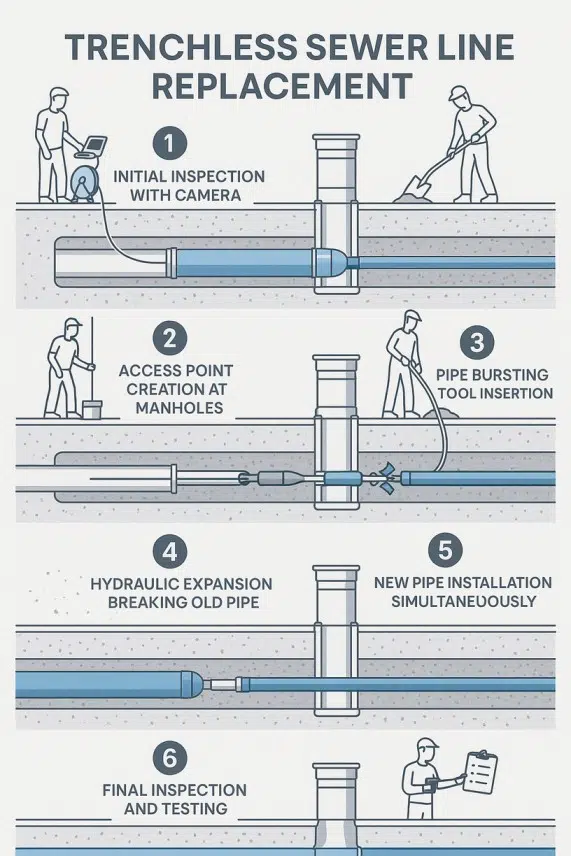
- Initial Assessment Phase: Video inspection identifies pipe condition, diameter, and material composition
- Access Point Preparation: Minimal excavation at manholes or terminal points for equipment access
- Bursting Tool Deployment: Hydraulic expansion head insertion through existing pipeline
- Simultaneous Replacement: Old pipe destruction and new pipe installation in single operation
- Quality Verification: Final inspection confirms proper installation and system integrity
The hydraulic expansion process represents the core innovation that enables trenchless replacement. According to EPA technical specifications, bursting tools generate controlled outward pressure ranging from 100 to 600 tons, depending on pipe diameter and soil conditions[17]. This pressure fractures the existing pipe while simultaneously compacting the fragments into the surrounding soil, creating space for the new pipeline without requiring material removal or disposal.
Pipe diameter considerations significantly influence the technical approach and equipment selection for each project. EPA documentation indicates optimal performance for pipes ranging from 100mm to 600mm (4 inches to 24 inches) in diameter, though successful installations have been completed on pipes as small as 51mm (2 inches) and as large as 1,220mm (48 inches)[18]. The ability to upsize existing lines during replacement provides additional hydraulic capacity that can accommodate future growth or improved system performance.
Soil Conditions and Environmental Factors
Soil composition and environmental conditions play crucial roles in determining the feasibility and approach for trenchless sewer line replacement. EPA technical guidance identifies favorable soil conditions as those that can be moderately compacted without causing excessive ground movement or surface disruption[19]. These conditions typically include sandy soils, clay mixtures with moderate plasticity, and well-drained backfill materials commonly found in residential and commercial developments.
Challenging soil conditions require specialized approaches and may influence equipment selection or project methodology. Dense clay soils, rocky formations, and areas with high water tables present technical obstacles that experienced contractors can address through modified procedures and specialized equipment. Academic research published in Tunnelling and Underground Space Technology provides detailed analysis of soil-structure interaction during pipe bursting operations, confirming that proper technique selection can overcome most geological challenges[20].
Ground displacement monitoring represents a critical safety consideration during trenchless operations, particularly in urban environments where adjacent structures or utilities might be affected by soil movement. Industry best practices, as documented by the North American Society for Trenchless Technology, require continuous monitoring of ground conditions and immediate response protocols if unexpected displacement occurs[21]. Modern monitoring equipment can detect ground movement as small as 2-3 millimeters, providing early warning of potential complications.
Market Dynamics and Industry Growth Projections
The trenchless sewer repair services market has experienced unprecedented growth over the past decade, driven by aging infrastructure, environmental regulations, and technological advances that have improved both performance and cost-effectiveness. Market research data indicates that the global trenchless sewer repair services market reached $3.5 billion in 2024 and is projected to achieve $6.2 billion by 2033, representing a compound annual growth rate of 7.1%[22]. This growth trajectory reflects increasing recognition among property owners, municipalities, and engineering professionals of the superior value proposition that trenchless technologies provide.
North American markets have emerged as particularly strong growth drivers, with the regional market valued at $4.0 billion in 2023 and expected to maintain a 4.7% compound annual growth rate through 2030[23]. This growth stems from several converging factors, including the widespread adoption of trenchless methods by municipal utilities, increasing environmental awareness among property owners, and technological improvements that have expanded the range of applications where trenchless solutions prove viable.

Year,Market_Size_Billion_USD
2024,3.5
2025,3.8
2026,4.1
2027,4.5
2028,4.9
2029,5.3
2030,5.7
2031,6.0
2032,6.1
2033,6.2
The broader sewer repair services market provides additional context for understanding the significance of trenchless technology adoption. Industry analysis indicates that the overall sewer repair services market will grow from $38.23 billion in 2024 to $61.79 billion by 2031, with trenchless methods capturing an increasing share of this expanding market[24]. This trend reflects the maturation of trenchless technology and its transition from specialized applications to mainstream adoption across residential, commercial, and municipal sectors.
Regulatory drivers have contributed significantly to market expansion, particularly as environmental protection agencies implement stricter standards for construction-related soil disturbance and waste generation. The Environmental Protection Agency’s emphasis on sustainable infrastructure practices has created regulatory incentives for trenchless approaches, while state and local governments increasingly specify trenchless methods for public works projects to minimize community disruption[25].
Technological Innovation and Market Evolution
Continuous technological advancement has expanded the range of applications where trenchless methods prove technically and economically viable. Recent innovations in pipe bursting equipment have increased the maximum pipe diameter that can be effectively replaced, while improvements in guidance systems have enhanced precision and reduced the risk of complications during installation. Academic research published in the Journal of Pipeline Systems Engineering and Practice documents these technological advances and their impact on market adoption rates[26].
Material science developments have similarly contributed to market growth by improving the performance characteristics and longevity of trenchless installations. High-density polyethylene pipes now achieve service lives exceeding 100 years under normal operating conditions, while advanced joint designs eliminate the infiltration and exfiltration problems that historically compromised sewer system performance. These improvements have strengthened the economic case for trenchless replacement by extending the period between major infrastructure investments[27].
Equipment manufacturers have responded to growing market demand by developing more efficient and versatile pipe bursting systems that can address a wider range of project conditions. Modern bursting tools incorporate real-time monitoring systems that provide operators with continuous feedback on soil conditions, pipe resistance, and installation progress. This technological sophistication has reduced project risk and improved success rates, contributing to increased confidence among property owners and engineering professionals[28].
Practical Implementation: Action Plan for Property Owners
Implementing a successful trenchless sewer line replacement project requires systematic planning, careful contractor selection, and thorough understanding of the technical and regulatory requirements that govern such installations. Property owners who approach this process methodically can achieve superior outcomes while avoiding the common pitfalls that lead to project delays, cost overruns, or performance issues. The following action plan provides a structured framework for navigating the replacement process from initial assessment through project completion and long-term maintenance.
Phase 1: Initial Assessment and Problem Identification
The foundation of any successful sewer line replacement project lies in accurate problem diagnosis and comprehensive system assessment. Property owners should begin by documenting observable symptoms such as recurring backups, slow drainage, unusual odors, or unexplained increases in water bills that might indicate sewer line problems. Professional video inspection provides definitive diagnosis and should be conducted by certified technicians using high-resolution camera equipment capable of identifying defects as small as hairline cracks[29].
Video inspection reports should include detailed documentation of pipe condition, joint integrity, root intrusion, and any structural defects that might affect replacement planning. Property owners should request copies of inspection footage and written reports that clearly identify problem areas and provide recommendations for addressing identified issues. This documentation proves essential for obtaining accurate replacement quotes and serves as baseline information for evaluating contractor proposals.
Soil conditions assessment represents another critical component of the initial evaluation phase. Property owners should request soil analysis if their property has challenging geological conditions, high water tables, or previous foundation problems that might affect trenchless installation. Understanding soil characteristics helps contractors select appropriate equipment and techniques while identifying potential complications before they impact project timelines or costs.
Phase 2: Contractor Selection and Project Planning
Selecting qualified contractors with demonstrated expertise in trenchless technology requires careful evaluation of credentials, experience, and technical capabilities. Property owners should verify that prospective contractors hold appropriate licenses, maintain current insurance coverage, and possess specialized equipment necessary for trenchless installations. The North American Society for Trenchless Technology maintains directories of certified contractors and provides guidelines for evaluating contractor qualifications[30].
Project proposals should include detailed technical specifications, material descriptions, and comprehensive cost breakdowns that allow meaningful comparison between contractors. Property owners should request references from recent projects and, when possible, inspect completed installations to evaluate workmanship quality. Contractors should provide written warranties covering both materials and installation, with warranty periods reflecting the expected service life of trenchless installations.
Permit requirements vary by jurisdiction and may include excavation permits, utility location services, and environmental compliance documentation. Qualified contractors typically handle permit applications, but property owners should verify that all necessary approvals are obtained before work begins. Municipal utilities may require notification or coordination for connections to public sewer systems, particularly if the replacement involves upsizing existing lines.
Phase 3: Project Execution and Quality Control
Successful project execution requires active oversight and communication between property owners and contractors throughout the installation process. Property owners should establish clear communication protocols and request daily progress updates that document work completed, any complications encountered, and planned activities for subsequent work periods. Modern trenchless installations typically complete within 1-3 days, but weather conditions or unexpected complications may extend project timelines.
Quality control measures should include verification of proper pipe alignment, joint integrity, and system functionality before final acceptance. Post-installation video inspection provides definitive confirmation that the new system meets performance specifications and identifies any issues that require correction. Property owners should insist on comprehensive testing that includes flow verification and pressure testing where applicable.
Final project documentation should include as-built drawings showing the exact location and depth of new pipes, warranty information, and maintenance recommendations. This documentation proves essential for future property transactions and provides valuable reference information for any subsequent utility work or property improvements that might affect the sewer system.
Future Outlook: Emerging Trends and Technology Development
The future of trenchless sewer line replacement technology promises continued innovation and expanded applications as material science, equipment design, and installation techniques evolve to address increasingly complex infrastructure challenges. Research and development efforts currently underway at leading academic institutions and equipment manufacturers focus on extending the range of conditions where trenchless methods prove viable while improving the precision and reliability of installation processes[31].
Artificial intelligence and machine learning applications represent emerging frontiers that could revolutionize trenchless installation planning and execution. Researchers at the Trenchless Technology Center at Louisiana Tech University are developing predictive algorithms that analyze soil conditions, existing pipe characteristics, and environmental factors to optimize equipment selection and installation parameters[32]. These systems could significantly reduce project risk while improving success rates for challenging installations.
Material science advances continue to expand the performance envelope for trenchless installations. Next-generation pipe materials under development promise even greater longevity and resistance to environmental stresses, while advanced joint designs eliminate virtually all potential for infiltration or exfiltration. Academic research published in Materials Science and Engineering journals indicates that experimental pipe materials could achieve service lives exceeding 150 years under normal operating conditions[33].
Regulatory Evolution and Environmental Considerations
Environmental regulations continue to evolve in directions that favor trenchless approaches over traditional excavation methods. The Environmental Protection Agency’s increasing emphasis on sustainable construction practices and carbon footprint reduction creates regulatory incentives for trenchless adoption, while state and local governments implement policies that encourage or mandate trenchless methods for infrastructure projects in environmentally sensitive areas[34].
Climate change considerations are driving increased interest in infrastructure resilience and adaptation strategies that favor trenchless installations. The superior durability and flexibility of modern trenchless systems provide better resistance to ground movement, temperature cycling, and extreme weather events that increasingly challenge traditional infrastructure. Academic research on climate adaptation strategies consistently identifies trenchless technology as a preferred approach for creating resilient underground infrastructure[35].
Economic factors will continue to drive trenchless adoption as the true costs of traditional excavation become more apparent through comprehensive lifecycle analysis. Rising labor costs, increasing environmental compliance requirements, and growing awareness of indirect project costs create economic conditions that strongly favor trenchless approaches. Market analysts project that cost advantages for trenchless methods will continue to expand as the technology matures and achieves greater economies of scale[36].
Key Takeaways: Essential Points for Property Owners
The comprehensive analysis of trenchless sewer line replacement technology reveals several critical insights that property owners should consider when evaluating their infrastructure repair options. These key findings, supported by authoritative government data, academic research, and industry analysis, provide the foundation for informed decision-making about sewer system investments.
- Cost Effectiveness: Trenchless methods average $135 per linear foot compared to $200 per linear foot for traditional open-cut replacement, with total project savings of 40-60% when indirect costs are included[37].
- Superior Longevity: Modern trenchless installations achieve 75-100 year service lives, significantly exceeding the 40-60 year lifespan of traditional pipe materials and installation methods[38].
- Minimal Disruption: Trenchless technology reduces surface disruption by 90% and project duration by 60-75% compared to conventional excavation approaches[39].
- Market Growth: The trenchless sewer repair services market is projected to grow from $3.5 billion in 2024 to $6.2 billion by 2033, reflecting widespread industry adoption and technological maturation[40].
These quantified benefits demonstrate that trenchless sewer line replacement represents not merely an alternative to traditional methods, but a superior approach that delivers measurable advantages across multiple evaluation criteria. Property owners who understand these benefits can make informed decisions that optimize both immediate project outcomes and long-term infrastructure performance.
References
- Fortune Business Insights. “Trenchless Pipe Rehabilitation Market Growth Analysis [2032].” https://www.fortunebusinessinsights.com/trenchless-pipe-rehabilitation-market-107720
- Creaco, E., & Walski, T. (2017). “Economic analysis of pressure control for leakage and pipe burst reduction.” Journal of Water Resources Planning and Management, 143(8). https://ascelibrary.org/doi/full/10.1061/(ASCE)WR.1943-5452.0000846
- City of Beatrice, Nebraska. “The Benefits of Trenchless Sanitary Sewer Repairs.” https://www.beatrice.ne.gov/sewer/page/benefits-trenchless-sanitary-sewer-repairs
- Jung, Y. J., & Sinha, S. K. (2007). “Evaluation of trenchless technology methods for municipal infrastructure system.” Journal of Infrastructure Systems, 13(2), 144-156. https://ascelibrary.org/doi/abs/10.1061/(ASCE)1076-0342(2007)13:2(144)
- Chorazy, T., Hlavínek, P., Raček, J., & Pietrucha-Urbanik, K. (2024). “Comparison of Trenchless and Excavation Technologies in the Restoration of a Sewage Network and Their Carbon Footprints.” Resources, 13(1), 12. https://www.mdpi.com/2079-9276/13/1/12
- Ariaratnam, S. T., Lueke, J. S., & Michael, J. K. (2014). “Current trends in pipe bursting for renewal of underground infrastructure systems in North America.” Tunnelling and Underground Space Technology, 39, 41-49. https://www.sciencedirect.com/science/article/pii/S0886779812000727
- U.S. Environmental Protection Agency. “Collection Systems O&M Fact Sheet Trenchless Sewer Rehabilitation.” EPA 832-F-99-032. https://nepis.epa.gov/Exe/ZyPURL.cgi?Dockey=P1001QU7.TXT
- DEVCO Development and Engineering. “Pipe Bursting Cost Calculator.” https://developmentandengineering.com/pipe-bursting-cost/
- North Coast Resource Partnership. “Trenchless Sewer Rehabilitation.” https://northcoastresourcepartnership.org/site/assets/themes/ncrp/resources/data/NCRP-Toolbox/Element-2.1/Trenchless_Sewer_Rehabilitation.pdf
- Boxall, J. B., O’Hagan, A., Pooladsaz, S., Saul, A. J., & Unwin, D. M. (2007). “Estimation of burst rates in water distribution mains.” Proceedings of the Institution of Civil Engineers-Water Management, 160(2), 73-82. https://www.icevirtuallibrary.com/doi/abs/10.1680/wama.2007.160.2.73
- Thapa, J. (2017). “North American trenchless technology survey and an approach to explore the I&I problems in sewer lines.” Youngstown State University. https://digital.maag.ysu.edu/xmlui/bitstream/handle/1989/12340/b22354657.pdf
- U.S. Environmental Protection Agency. “Water Technology Fact Sheet – Pipe Bursting.” EPA 832-F-00-017. https://www.epa.gov/sites/default/files/2019-08/documents/pipe_bursting_fact_sheet_p100il70.pdf
- Simicevic, J., & Sterling, R. L. (2001). “Guidelines for pipe bursting.” US Army Corps of Engineers, Vicksburg, MS. https://www.academia.edu/download/67063301/bursting.pdf
- Plastics Pipe Institute. “The Pipe Bursting Process.” https://www.plasticpipe.org/Drainage/MunicipalAdvisoryBoard/Navigation/Pipe-Bursting-Menu/Overview-Pages/ThePipeBurstingProcess.aspx
- U.S. Environmental Protection Agency. “State of Technology for Rehabilitation of Wastewater Collection Systems.” EPA/600/R-10/078. https://nepis.epa.gov/Exe/ZyPURL.cgi?Dockey=P1008C45.TXT
- Chapman, D. N., Rogers, C. D. F., Burd, H. J., Norris, P. M., & Milligan, G. W. E. (2007). “Research needs for new construction using trenchless technologies.” Tunnelling and Underground Space Technology, 22(5-6), 491-502. https://www.sciencedirect.com/science/article/pii/S0886779807000624
- U.S. Environmental Protection Agency. “Water Technology Fact Sheet – Pipe Bursting.” EPA 832-F-00-017.
- U.S. Environmental Protection Agency. “Water Technology Fact Sheet – Pipe Bursting.” EPA 832-F-00-017.
- U.S. Environmental Protection Agency. “Water Technology Fact Sheet – Pipe Bursting.” EPA 832-F-00-017.
- Tomczak, E., & Zielińska, A. (2017). “Example of sewerage system rehabilitation using trenchless technology.” Ecological Chemistry and Engineering, 24(3), 401-413. https://sciendo.com/2/v2/download/article/10.1515/eces-2017-0027.pdf
- North American Society for Trenchless Technology. “Pipe Bursting Center of Excellence.” https://nastt.org/resources/pipe-bursting-center-of-excellence/
- Verified Market Reports. “Trenchless Sewer Repair Services Market Size, Evaluation.” https://www.verifiedmarketreports.com/product/trenchless-sewer-repair-services-market/
- Stratview Research. “North American Trenchless Pipe Rehabilitation Market Analysis.” https://www.stratviewresearch.com/2466/north-american-trenchless-pipe-rehabilitation-market.html
- Report Prime. “Sewer Repair Services Market Size, Growth, Forecast Till 2031.” https://www.reportprime.com/sewer-repair-services-r13336
- U.S. Environmental Protection Agency. “Collection Systems O&M Fact Sheet Trenchless Sewer Rehabilitation.” EPA 832-F-99-032.
- Kaushal, V., Najafi, M., Serajiantehrani, R., & Sattler, M. (2020). “A Framework for Evaluation of Social Costs of Open-Cut Pipeline Replacement for Sanitary Sewers.” Pipelines 2020, 434-444. https://ascelibrary.org/doi/abs/10.1061/9780784483206.040
- Thakre, G., Kaushal, V., Karkhanis, E., & Najafi, M. (2025). “Evaluation of Life Cycle Cost of Excavation and Trenchless Cured-in-Place Pipeline Technologies for Sustainable Wastewater Applications.” Sustainability, 17(5), 2329. https://www.mdpi.com/2071-1050/17/5/2329
- Thakre, G., Kaushal, V., Karkhanis, E., & Najafi, M. (2025). “A Data-Driven Visualization Approach for Life-Cycle Cost Analysis of Open-Cut and Trenchless CIPP Methods for Sanitary Sewers.” Applied Sciences, 15(4), 1765. https://www.mdpi.com/2076-3417/15/4/1765
- Ohio State University. “Study identifies top reasons for sewer line failure.” August 5, 2020. https://engineering.osu.edu/news/2020/08/study-identifies-top-reasons-sewer-line-failure
- North American Society for Trenchless Technology. “Pipe Bursting Center of Excellence.”
- Louisiana Tech University. “Trenchless Technology Center.” https://www.latech.edu/research-innovation-enterprise/centers-of-excellence/trenchless-technology-center/
- Louisiana Tech University. “Trenchless Technology Center.”
- Perez, C. (2010). “Trenchless technologies for the rehabilitation of sewers: Case study of the Patapsco interceptors, Baltimore.” Journal of Public Works & Infrastructure, 3(1), 51-65.
- U.S. Environmental Protection Agency. “Collection Systems O&M Fact Sheet Trenchless Sewer Rehabilitation.” EPA 832-F-99-032.
- Damvergis, C. N. (2014). “Sewer systems: Failures and rehabilitation.” Water Utility Journal, 8, 17-24. http://ewra.net/wuj/pdf/WUJ_2014_08_02.pdf
- Fenner, R. A. (2000). “Approaches to sewer maintenance: a review.” Urban Water, 2(4), 343-356. https://www.sciencedirect.com/science/article/pii/S1462075800000650
- DEVCO Development and Engineering. “Pipe Bursting Cost Calculator.”
- U.S. Environmental Protection Agency. “Water Technology Fact Sheet – Pipe Bursting.” EPA 832-F-00-017.
- Ariaratnam, S. T., Lueke, J. S., & Michael, J. K. (2014). “Current trends in pipe bursting for renewal of underground infrastructure systems in North America.”
- Verified Market Reports. “Trenchless Sewer Repair Services Market Size, Evaluation.”