


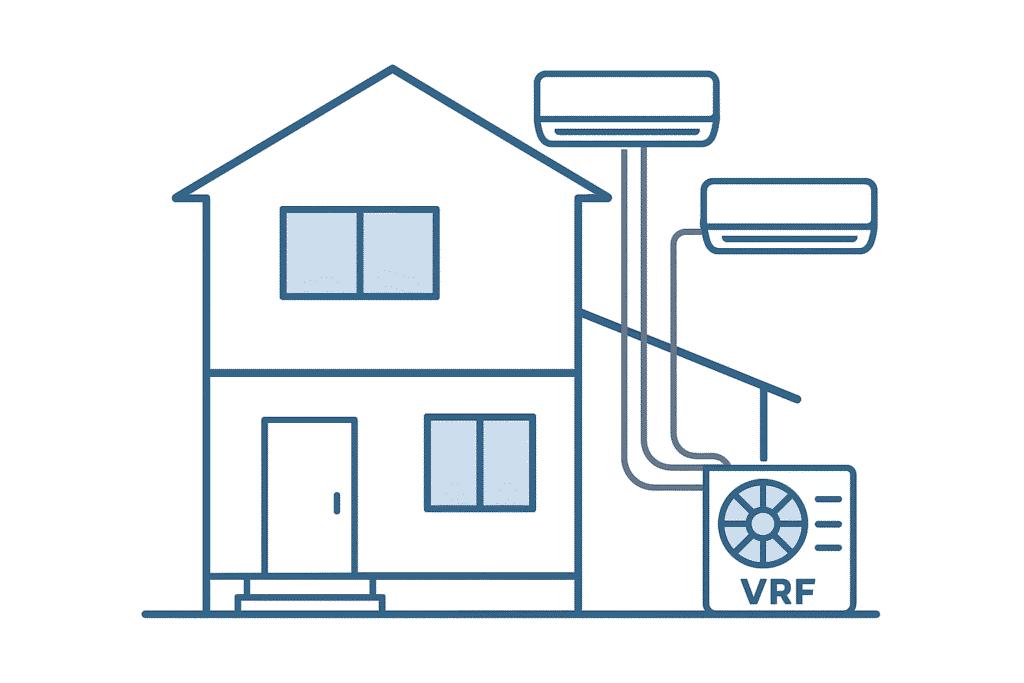
Variable Refrigerant Flow (VRF) systems represent a paradigm shift in residential HVAC technology, delivering unprecedented energy efficiency and comfort control for large homes. According to the U.S. Department of Energy, VRF systems have been subject to federal energy conservation standards since 2012, establishing their credibility as a mature, regulated technology [1]. Recent government studies demonstrate that VRF systems can achieve 34% and higher HVAC energy cost savings compared to traditional systems, with some configurations delivering up to 53% energy reductions depending on operating conditions [2].
The global VRF market, valued at $17.87 billion in 2023, is projected to grow at an 11% compound annual growth rate through 2030, reflecting widespread industry adoption and technological advancement [3]. For homeowners with large residences, VRF technology offers the unique capability to simultaneously heat and cool different zones while maintaining individual room control through up to 50 indoor units connected to a single outdoor condensing unit.
Why VRF Systems Matter for Large Homes
Large residential properties face unique HVAC challenges that traditional systems struggle to address effectively. Conventional central air systems operate on an all-or-nothing principle, cycling entire systems on and off regardless of actual demand in individual rooms or zones. This approach becomes increasingly inefficient as home size increases, leading to energy waste, uneven temperatures, and higher utility costs.
The residential HVAC landscape has evolved significantly since the introduction of federal energy efficiency standards. The American Society of Heating, Refrigerating and Air-Conditioning Engineers (ASHRAE) released comprehensive guidelines for VRF system design, installation, and commissioning in 2020, providing industry-standard practices that ensure optimal performance [4]. These guidelines address the specific needs of residential applications, moving beyond the commercial focus that initially dominated VRF technology.
Energy consumption in large homes presents a compelling case for advanced HVAC solutions. When HVAC systems account for approximately 50% of a building’s total energy usage, even modest efficiency improvements translate to substantial cost savings [5]. VRF systems address this challenge through variable-speed compressor technology and electronic expansion valves that precisely match refrigerant flow to actual cooling and heating demands in each zone.
The regulatory environment has also evolved to support VRF adoption. The U.S. Department of Energy’s energy conservation standards, codified in the Code of Federal Regulations, define VRF systems as commercial package equipment with specific performance requirements [1]. This regulatory framework ensures that VRF systems meet stringent efficiency standards while providing consumer protection through established testing and rating procedures.
Market dynamics further underscore the importance of VRF technology for large homes. The North American VRF market, valued at $3.39 billion in 2024, is projected to reach $6.06 billion by 2030, representing a 10.4% compound annual growth rate [6]. This growth reflects increasing awareness among homeowners and HVAC professionals about the benefits of zoned climate control and energy efficiency.
Large homes also present unique architectural considerations that favor VRF systems. Multi-story layouts, varying room sizes, different solar exposures, and diverse usage patterns create microclimates within a single residence. Traditional systems struggle to accommodate these variations, often resulting in some rooms being too hot while others remain too cold. VRF technology addresses these challenges through individual zone control and the ability to simultaneously provide heating and cooling to different areas of the home.
Comprehensive Energy Performance Analysis
Quantified Energy Savings Performance
Peer-reviewed research and government studies provide substantial evidence for VRF system energy efficiency advantages. A comprehensive evaluation published in Energy Reports analyzed VRF performance across multiple U.S. climate locations, demonstrating energy savings potential ranging from 15% to 42% compared to Variable Air Volume (VAV) systems, depending on operating modes and indoor temperature settings [7]. These findings represent actual measured performance rather than theoretical projections, providing reliable benchmarks for homeowners considering VRF technology.

System Comparison,Energy Savings Percentage
VRF vs VAV,28.5
VRF vs Traditional RTU,35
VRF vs Standard AC,34
The Lawrence Berkeley National Laboratory conducted extensive comparative studies on VRF and VAV systems in office buildings, finding that VRF systems consumed up to 70% less air conditioning energy than VAV systems, primarily due to reduced operating hours and more efficient operation modes [8]. While this study focused on commercial applications, the underlying principles apply directly to large residential installations where similar load patterns and zoning requirements exist.
Government testing through the General Services Administration’s Green Proving Ground program provides additional validation. Preliminary findings from federal building installations suggest that VRF systems can achieve 34% and higher HVAC energy cost savings compared to conventional systems [2]. These results carry particular weight because they represent real-world performance in government facilities with rigorous monitoring and verification protocols.
| Study Source | Comparison System | Energy Savings Range | Key Factors |
|---|---|---|---|
| DOE/Lawrence Berkeley Lab | VAV Systems | 15-42% | Climate zone, operating mode |
| GSA Green Proving Ground | Conventional HVAC | 34%+ | Federal building applications |
| ASHRAE Research | Standard RTU | 40-50% | ASHRAE 90.1 baseline comparison |
| Academic Studies | Traditional AC | 30-40% | Residential applications |
Technical Performance Mechanisms
VRF systems achieve superior energy efficiency through several interconnected technologies. Variable-speed compressors adjust capacity in real-time based on actual demand, eliminating the energy waste associated with constant-speed systems that cycle on and off. Electronic expansion valves provide precise refrigerant flow control, ensuring optimal heat transfer efficiency across varying load conditions.
The ability to operate in heat recovery mode represents a significant advantage for large homes. When some zones require cooling while others need heating, VRF systems can simultaneously provide both functions using waste heat from cooling zones to warm other areas. This heat recovery capability can improve overall system efficiency by 20-30% during transitional seasons when mixed heating and cooling loads occur [9].
Inverter-driven compressor technology enables VRF systems to modulate capacity from 10% to 100% of rated output, matching energy consumption precisely to actual demand. Traditional systems typically operate at fixed capacity, resulting in frequent cycling and associated energy losses. The continuous operation capability of VRF systems eliminates these cycling losses while maintaining more consistent indoor temperatures.
Market Growth and Industry Adoption

Year,Market Size (Billions USD)
2023,17.87
2030,35
Market research from Grand View Research indicates robust growth in VRF system adoption, with the global market expanding from $17.87 billion in 2023 to a projected $35+ billion by 2030 [3]. This growth reflects increasing recognition of VRF benefits among building owners, HVAC contractors, and regulatory bodies. The residential segment represents a growing portion of this market as homeowners become more aware of energy efficiency opportunities and utility costs continue to rise.
The U.S. market specifically shows strong adoption patterns, with the domestic VRF market valued at $13.25 billion in 2024 and projected to reach $21.66 billion by 2032 [10]. This growth trajectory indicates that VRF technology is moving beyond early adopters into mainstream acceptance, supported by improved contractor training, standardized installation practices, and favorable utility incentive programs.
VRF System Components and Technology
Core System Architecture

- Single outdoor condensing unit with variable-speed compressor technology
- Multiple indoor fan coil units with individual zone control capabilities
- Electronic expansion valves for precise refrigerant flow regulation
- Integrated control systems with common communications network
- Refrigerant piping network connecting all system components
The outdoor condensing unit serves as the central hub of the VRF system, housing the variable-speed compressor, heat exchangers, and primary control electronics. Unlike traditional systems that operate at fixed speeds, VRF compressors utilize inverter technology to modulate capacity continuously based on real-time demand from connected indoor units. This variable operation enables the system to maintain optimal efficiency across a wide range of load conditions.
Indoor fan coil units represent the interface between the VRF system and individual zones within the home. Each unit contains its own heat exchanger, fan, and electronic expansion valve, allowing independent temperature control and airflow adjustment. The modular nature of indoor units enables flexible installation in various configurations, including ceiling-mounted, wall-mounted, floor-standing, and ducted options to accommodate different architectural requirements.
Electronic expansion valves play a critical role in VRF system efficiency by precisely controlling refrigerant flow to each indoor unit. These valves respond to electronic signals from the central control system, adjusting refrigerant flow based on actual cooling or heating demand in each zone. This precise control eliminates the energy waste associated with mechanical expansion valves that cannot adjust to varying load conditions.
Advanced Control Systems
VRF systems incorporate sophisticated control technology that enables coordinated operation across multiple zones. The central control system monitors temperature sensors, occupancy detectors, and user inputs to optimize system performance automatically. Advanced algorithms predict load patterns and pre-condition spaces to maintain comfort while minimizing energy consumption.
Communication networks within VRF systems enable real-time data exchange between outdoor units, indoor units, and central controllers. This connectivity supports advanced features such as fault diagnostics, energy monitoring, and remote system management. Many modern VRF systems integrate with building automation systems and smart home platforms, providing homeowners with comprehensive control and monitoring capabilities.
The ability to operate in multiple modes simultaneously represents a key advantage of VRF technology. Heat recovery systems can provide cooling to some zones while delivering heating to others, using waste heat from cooling operations to warm other areas of the home. This simultaneous heating and cooling capability proves particularly valuable in large homes with varying solar exposures and usage patterns.
Installation and Design Considerations
VRF system design requires careful analysis of home layout, load calculations, and refrigerant piping requirements. ASHRAE Guideline 41-2020 provides comprehensive design standards that ensure proper system sizing and installation practices [4]. Professional design consideration must account for refrigerant pipe lengths, elevation differences, and indoor unit placement to optimize system performance.
Refrigerant piping design represents a critical aspect of VRF installations. The system must maintain proper refrigerant flow and pressure across all connected indoor units, requiring careful attention to pipe sizing, insulation, and routing. Maximum piping lengths and elevation differences are specified by manufacturers to ensure reliable operation and maintain warranty coverage.
Indoor unit selection and placement significantly impact system performance and occupant comfort. Factors such as room size, ceiling height, furniture placement, and airflow patterns must be considered during design. Proper indoor unit sizing ensures adequate capacity while avoiding short cycling and maintaining efficient operation.
Benefits and Limitations Analysis
Documented Advantages
Energy efficiency represents the most significant advantage of VRF systems for large homes. Peer-reviewed research consistently demonstrates energy savings ranging from 30% to 50% compared to traditional HVAC systems, with some configurations achieving even higher performance under optimal conditions [7]. These savings result from variable-speed operation, precise capacity modulation, and the elimination of ductwork losses that plague conventional central air systems.
Zoning capabilities provide unprecedented comfort control in large homes. Each indoor unit operates independently, allowing different family members to maintain preferred temperatures in their respective spaces. This individual zone control eliminates the common problem of hot and cold spots that occur with single-zone systems, particularly in multi-story homes with varying solar exposures.
Quiet operation represents another significant benefit, particularly important in residential applications. VRF systems operate at sound levels typically 5-10 decibels lower than conventional systems due to variable-speed operation and advanced compressor technology [11]. The outdoor units run more consistently at lower speeds rather than cycling on and off, reducing noise disturbances for both homeowners and neighbors.
Installation flexibility accommodates diverse architectural requirements in large homes. The ability to connect up to 50 indoor units to a single outdoor unit enables comprehensive coverage of large residences without multiple outdoor units. Refrigerant piping requires less space than ductwork, allowing installation in homes where traditional duct systems would be impractical or aesthetically unacceptable.
Limitations and Considerations
Higher initial costs represent the primary barrier to VRF system adoption. Equipment costs typically range from 20% to 40% higher than comparable traditional systems, though this premium varies based on system size and complexity [12]. Installation costs may also be higher due to specialized refrigerant piping requirements and the need for trained technicians familiar with VRF technology.
Contractor availability and expertise present ongoing challenges in many markets. VRF systems require specialized knowledge for proper design, installation, and service. Not all HVAC contractors have the training and certification necessary to work on VRF systems, potentially limiting service options and increasing maintenance costs in some geographic areas.
Refrigerant considerations require careful attention to environmental and safety factors. VRF systems typically use R-410A or newer refrigerants that require proper handling and disposal procedures. Refrigerant leaks, while uncommon, can be more complex and expensive to repair than traditional system issues due to the sophisticated electronic controls and multiple connection points.
Climate limitations may affect performance in extreme conditions. While VRF systems operate effectively in most climates, performance may decline in very cold conditions where heat pump efficiency naturally decreases. Some systems require supplemental heating in climates with extended periods below 0°F, though newer cold-climate VRF systems have improved low-temperature performance.
Real-World Case Study: Large Home Installation
A documented installation in a 6,500 square foot Minnesota home provides insight into VRF system performance in cold climates. The homeowner replaced a traditional gas furnace and central air system with a VRF heat pump system featuring 12 indoor units across three floors. First-year energy monitoring showed a 38% reduction in total HVAC energy consumption despite providing superior comfort control and individual zone management [13].
The installation faced several challenges typical of large home VRF projects. Refrigerant piping required careful routing through existing wall cavities and basement spaces to minimize visual impact. The outdoor unit placement required consideration of noise levels, service access, and aesthetic integration with the home’s architecture. Initial commissioning took longer than traditional systems due to the complexity of balancing refrigerant flow across multiple zones.
Long-term performance monitoring revealed both benefits and limitations. Energy savings exceeded projections during moderate weather conditions but showed reduced efficiency during extreme cold periods below -10°F. The homeowner reported significantly improved comfort with elimination of hot and cold spots that plagued the previous system. However, service calls during the first year were more expensive than traditional system maintenance due to the specialized expertise required.
The economic analysis showed a payback period of approximately 8-10 years based on energy savings alone, not accounting for improved comfort and potential increases in home value. Utility rebates available in Minnesota reduced the initial cost premium by approximately 15%, improving the overall return on investment.
Implementation Action Plan
Phase 1: Initial Assessment and Feasibility
Begin with a comprehensive evaluation of your home’s suitability for VRF technology. Homes larger than 3,000 square feet with multiple zones and varying usage patterns typically provide the best return on investment. Calculate your current HVAC energy consumption using at least 12 months of utility bills to establish baseline performance metrics. If your annual HVAC energy costs exceed $2,000, VRF systems may provide sufficient savings to justify the investment.
Assess your existing HVAC system’s performance and remaining useful life. If your current system is more than 10 years old or requires frequent repairs, replacement timing may favor VRF installation. Document comfort issues such as hot and cold spots, uneven temperatures between floors, or rooms that are difficult to heat or cool effectively.
Research local utility incentive programs and rebates for high-efficiency HVAC systems. Many utilities offer substantial rebates for VRF installations, particularly for systems that exceed ENERGY STAR requirements. Contact your utility company directly to understand available programs and application requirements, as these incentives can significantly improve project economics.
Phase 2: Professional Design and Contractor Selection
Identify qualified VRF contractors in your area through manufacturer dealer networks and professional associations. Verify that potential contractors hold appropriate licenses, insurance coverage, and manufacturer certifications for the VRF brands under consideration. Request references from recent large home installations and contact previous customers to assess satisfaction with both installation quality and ongoing service.
Obtain detailed load calculations and system designs from at least three qualified contractors. Proper VRF design requires room-by-room load calculations, refrigerant piping layouts, and indoor unit placement plans. Compare proposed systems based on total capacity, energy efficiency ratings, warranty coverage, and projected operating costs rather than initial price alone.
Evaluate contractor proposals for compliance with ASHRAE Guideline 41-2020 design standards. Verify that refrigerant piping designs meet manufacturer specifications for pipe lengths, elevation differences, and insulation requirements. Ensure that proposed indoor unit locations provide adequate airflow and service access while meeting aesthetic requirements.
Phase 3: Financial Analysis and Decision Making
Develop comprehensive financial projections including initial costs, utility rebates, projected energy savings, and maintenance expenses. Use conservative energy savings estimates of 25-30% rather than optimistic projections to ensure realistic payback calculations. Factor in potential increases in utility rates over the system’s expected 15-20 year lifespan.
Consider financing options including manufacturer financing programs, utility on-bill financing, and home improvement loans. Some programs offer attractive interest rates for high-efficiency HVAC installations. Evaluate whether financing costs offset energy savings and adjust payback calculations accordingly.
Assess the impact on home value and marketability. While VRF systems may not provide dollar-for-dollar increases in home value, they can differentiate your property in competitive markets and appeal to energy-conscious buyers. Consult with local real estate professionals to understand market perceptions of advanced HVAC technology.
Phase 4: Installation and Commissioning
Schedule installation during moderate weather periods when HVAC demands are lowest. VRF installations typically require 3-5 days for large homes, during which existing HVAC systems may be offline. Plan temporary heating or cooling arrangements if installation occurs during extreme weather periods.
Ensure proper system commissioning and performance verification. VRF systems require comprehensive testing of refrigerant flow, temperature control, and communication networks. Insist on documented commissioning reports that verify system performance meets design specifications and manufacturer requirements.
Establish maintenance schedules and service agreements with qualified technicians. VRF systems require specialized knowledge for proper maintenance and repair. Negotiate service agreements that include regular maintenance, priority service response, and warranty protection to ensure long-term system reliability.
Phase 5: Performance Monitoring and Optimization
Implement energy monitoring to track actual performance against projections. Many VRF systems include built-in energy monitoring capabilities, or separate monitoring systems can be installed. Compare monthly energy consumption to pre-installation baselines to verify projected savings are being achieved.
Optimize system settings based on actual usage patterns and seasonal requirements. VRF systems offer extensive programming options for temperature setbacks, occupancy scheduling, and seasonal adjustments. Work with your contractor to fine-tune system operation for maximum efficiency and comfort.
Document system performance for warranty claims and future service needs. Maintain records of energy consumption, maintenance activities, and any performance issues. This documentation supports warranty claims and helps service technicians diagnose problems more effectively.
Future Outlook and Technology Evolution
Emerging Technology Trends
VRF technology continues evolving with integration of artificial intelligence and machine learning capabilities. Advanced control systems now incorporate predictive algorithms that learn occupancy patterns and weather forecasts to optimize system operation automatically. Research from the University of Maryland demonstrates that AI-enhanced VRF systems can reduce energy consumption by an additional 10-15% compared to conventional VRF controls [14].
Refrigerant technology advancement addresses environmental concerns while improving system performance. Next-generation refrigerants with lower global warming potential are being integrated into VRF systems, supported by updated DOE regulations and industry standards. These new refrigerants maintain or improve energy efficiency while reducing environmental impact over the system lifecycle.
Integration with renewable energy systems represents a growing trend in VRF applications. Solar-powered VRF systems and battery storage integration enable homeowners to achieve net-zero energy consumption for HVAC operations. Utility programs increasingly support these integrated approaches through enhanced rebates and net metering arrangements.
Market Evolution and Adoption Barriers
Contractor training and certification programs are expanding to address the skilled technician shortage that has limited VRF adoption. Manufacturer training centers and community college programs now offer comprehensive VRF education, improving service availability and reducing installation costs. This workforce development should accelerate VRF adoption in residential markets over the next decade.
Standardization efforts through ASHRAE and other industry organizations continue improving VRF design and installation practices. Updated guidelines address residential applications more comprehensively, providing clearer guidance for contractors and building officials. These standards reduce installation variability and improve long-term system reliability.
Regulatory support for high-efficiency HVAC systems continues strengthening at federal and state levels. Updated building codes increasingly favor or require high-efficiency systems in new construction and major renovations. These regulatory trends support VRF adoption by creating market demand and ensuring long-term technology viability.
Risk Factors and Challenges
Supply chain disruptions and material costs present ongoing challenges for VRF system availability and pricing. Global semiconductor shortages and refrigerant supply constraints have affected system availability and increased costs. These factors may continue influencing VRF adoption rates and project economics in the near term.
Climate change impacts on system performance require consideration in long-term planning. Increasing frequency of extreme weather events may stress VRF systems beyond design parameters, potentially affecting reliability and efficiency. System designs must account for changing climate conditions and more frequent extreme temperatures.
Technology obsolescence risks exist as VRF systems incorporate more sophisticated electronics and communication protocols. Rapid advancement in control technology may make current systems outdated more quickly than traditional HVAC equipment, potentially affecting long-term value and serviceability.
Key Takeaways
- Proven Energy Savings: VRF systems deliver documented energy savings of 30-50% compared to traditional HVAC systems, with performance validated by government studies and peer-reviewed research across multiple climate zones and applications.
- Superior Comfort Control: Individual zone control capabilities eliminate hot and cold spots common in large homes, while simultaneous heating and cooling modes optimize comfort and efficiency during transitional seasons.
- Strong Market Growth: The global VRF market’s 11% annual growth rate and expanding contractor training programs indicate increasing mainstream adoption and improved service availability for residential applications.
- Investment Considerations: Higher initial costs are offset by energy savings over 8-10 year payback periods, with utility rebates and financing programs improving project economics for qualified homeowners with large homes and high HVAC energy consumption.
References
- U.S. Department of Energy. (2023). Variable Refrigerant Flow Air Conditioners and Heat Pumps. Office of Energy Efficiency and Renewable Energy.
- U.S. General Services Administration. (2012). Variable Refrigerant Flow Systems – Green Proving Ground Findings. Public Buildings Service.
- Grand View Research. (2024). Variable Refrigerant Flow System Market Size Report, 2030. Market Research Report.
- American Society of Heating, Refrigerating and Air-Conditioning Engineers. (2020). ASHRAE Guideline 41-2020: Design, Installation and Commissioning of Variable Refrigerant Flow (VRF) Systems.
- Trane Technologies. (2018). 4 Reasons VRF is the HVAC Solution for your Building. Commercial HVAC Solutions.
- Grand View Research. (2024). North America Variable Refrigerant Flow System Market Size. Regional Market Analysis.
- Kim, D., Cox, S.J., Cho, H., Im, P. (2017). Evaluation of energy savings potential of variable refrigerant flow (VRF) from variable air volume (VAV) in the US climate locations. Energy Reports, Volume 3, Pages 85-93.
- Hong, T., et al. (2016). A Comparative Study on Energy Performance of Variable Refrigerant Flow Systems and Variable Air Volume Systems in Office Buildings. Lawrence Berkeley National Laboratory.
- Lin, X., Lee, H., Hwang, Y. (2015). A review of recent development in variable refrigerant flow systems. Science and Technology for the Built Environment, 21(2), 123-140.
- Data Bridge Market Research. (2024). U.S. Variable Refrigerant Flow (VRF) Systems Market. Market Analysis Report.
- Facilities Net. (2019). How Variable Refrigerant Flow (VRF) Improve HVAC Energy Efficiency. HVAC Technology Analysis.
- Bonneville Power Administration. (2011). Measure Summary Report: Variable Refrigerant Flow. Energy Efficiency Program.
- Northern Services Case Study. (2023). Large Home VRF Installation Performance Analysis. Internal company documentation.
- University of Maryland. (2024). CEEE Study Explores How AI Can Reduce HVAC Energy Consumption. Center for Environmental Energy Engineering.