


Key Takeaways
- Tankless water heaters, known as on-demand water heaters, heat water directly without the use of a storage tank. Think about getting one sized for your home’s peak flow requirements.
- Gas and electric tankless units have different installation needs and costs, so budget for potential gas line, venting, or electrical upgrades prior to purchase.
- Tankless systems tend to save space and often last longer than tank models. They are beset with higher upfront costs and potentially limiting simultaneous hot water if undersized.
- Water quality, inlet temperature and flow rate directly impact performance. Install water treatment where required and select larger units for colder regions.
- Routine descaling, flushing, and professional annual inspection keep it efficient and lasting.
- For optimal outcomes, hire experienced installers, heed manufacturer recommendations, and tailor unit size to your average and maximum hot water needs.
How a tankless water heater works. It employs a gas burner or electric element to rapidly heat water while it passes through a heat exchanger, providing instant hot water and energy savings by eliminating standby heat loss.
Output and sizing needs are driven by flow rate and incoming temperature. Installation requires correct gas, venting, or electrical capacity and regular maintenance for scale control.
Step-by-step and advantages below.
The On-Demand System
Tankless, or on-demand, water heaters deliver hot water only when a tap is opened, so there’s no cumbersome storage tank full of hot water. Cold water flows into the unit and is heated immediately as it passes through. This on-demand system eliminates standby heat losses that happen when a traditional tank continuously keeps water heated all day and night.
These are commonly known as demand water heaters since they trigger only with flow, allowing them to be smaller and more efficient in many environments.
1. The Concept
Tankless heaters heat water directly without storage. Cold water flows into the unit and goes past a heat exchanger where it encounters a gas burner or electric heating element that warms it rapidly. The on-demand system is simply a constant stream of hot water.
As long as there is demand and water flows, the unit provides heat. That eliminates the bounded capacity of a tank. There is no empty tank to fill, although flow is contingent on the flow and power limitations of the model.
2. The Process
When you open a hot water faucet, a flow sensor inside the heater informs the control system to ignite the gas burner or electric element. Water passes through the main heat exchanger, and heat is transferred from the burner or element into the moving water.
They use temperature sensors to read outlet water and then modulate fuel or current so temperature remains constant even as flow fluctuates. When the tap shuts off, the heater switches off. That full on/full off activity conserves energy by not maintaining a hot reservoir.
A few, known as modulated models, adjust heat input to align with demand for smoother regulation and greater efficiency.
3. The Types
The two main types are gas tankless and electric tankless. Gas models utilize either natural gas or propane and require both adequate venting and sufficient gas-line capacity. In certain areas, gas flow limitations would render them unfeasible.
Electric units use high-power dedicated circuits and can require electrical upgrades. POU, or point-of-use units, are sized for individual sinks or showers to reduce lag time and pipe heat loss. High-flow rate units can handle multiple showers simultaneously, and smaller models are appropriate for single-fixture use.
4. The Difference
In contrast to traditional tank heaters, tankless units don’t have a heated storage tank and consequently eliminate tank heat loss. They heat on demand rather than having a hot reservoir.
This can mean savings in energy, though installation costs are generally higher and maintenance such as regular descaling is key to avoid mineral accumulation. They might not play nice with active recirculation systems and performance varies based on household usage patterns and local energy infrastructure.
Key Advantages
Tankless water heaters offer a compact, high-efficiency alternative to conventional tank water heaters, making them ideal for today’s energy-conscious, space-savvy homes. These systems not only enhance hot water usage efficiency but also provide cost savings and longer equipment life, which are essential considerations for homeowners planning their water heating solutions.
Energy Savings
Tankless units avoid standby energy losses since the water is heated only when a tap is opened or an appliance needs it. Gas and electric on-demand models both avoid maintaining a large volume of water at a heightened temperature 24/7, so energy usage corresponds to actual demand versus a stored volume.
This is significant for hot water households with multiple occupants on different schedules or with many cycles. Below is a simple cost comparison of annual energy costs to show the typical difference in operating expense:
| System type | Typical annual energy cost (approx.) |
|---|---|
| Conventional tank heater | 400–650 (currency units) |
| Tankless (on-demand) heater | 250–450 (currency units) |
Depending on fuel price, usage pattern and local climate, savings estimates vary. Many customers experience reduced annual expenses because approximately 82 cents of every energy dollar consumed by water heating goes directly toward heating with efficient systems.
Go gas if you have high demand and high flow rate. Pick electric for simpler installation and smaller homes.
Space Savings
Tankless systems are compact and wall-mounted, allowing utility rooms, closets, or basements additional floor space. That creates storage space or allows you to convert a closet into a laundry nook.
Point-of-use (POU) tankless units fit under sinks or beside major appliances for instant hot water at the source, cutting wait time and wasted water. In small apartments or tight mechanical rooms, replacing a bulky 150 to 200 litre tank with a slim unit can free up valuable living space.
Even in larger homes, wall-mounted units make routing easier and can be positioned closer to hot-water points of use to enhance response time.
Endless Hot Water
Tankless heaters can deliver hot water indefinitely as long as aggregate demand remains below the unit’s maximum capability. This eliminates the wait for a tank to refill in between showers or appliances.
Large families with overlapping shower times, back-to-back laundry loads and dishwasher cycles, and high-flow fixtures or a basement bath and upstairs shower can benefit significantly. In such cases, on-demand units maintain hot water without the downtime for replenishment that is intrinsic to tanks.
Longer Lifespan
Tankless units typically last 15 to 20 years or longer, frequently making it to the 20-year mark with regular maintenance. Without a big storage tank, there’s less chance of internal corrosion and catastrophic leaks that result in water damage.
Modular components and replaceable heat exchangers allow for specific repairs to be preferred, while regular descaling and inspections help maintain optimal efficiency. Droplet recommends annual inspections for scale and anodes where appropriate and adheres to manufacturer service intervals to optimize service life.
Potential Drawbacks
Tankless water heaters, including gas tankless water heaters, come with obvious advantages, but they also introduce compromises homeowners need to consider. The following subsections cover the main drawbacks: higher upfront cost, limits on simultaneous hot water usage, and more complex installation and system requirements. Under each point, I describe what to expect and provide realistic examples that readers can apply to judge suitability.
Upfront Cost
Tankless units typically have a higher purchase and installation cost than tank systems. Typical base unit prices begin around 1,000 and exceed 3,000 once installation is factored in. Gas-fired tankless units frequently require new or enlarged gas lines and specialized venting. That labor can add a few hundred to a few thousand onto the invoice.
Electric tankless units might seem less expensive at the time of purchase, but they can induce costly electrical work that inflates the price.
- Typical gas tankless installation might include: new unit costing between 1,000 and 2,000 dollars, gas-line upgrades costing between 200 and 1,000 dollars, venting and flue work costing between 300 and 1,000 dollars, and labor costing between 500 and 1,500 dollars.
- Typical electric tankless installation might include: new unit (600 to 1,500), panel upgrade or new dedicated breakers (300 to 1,500), wiring and labor (300 to 1,000).
- Additional items include a water treatment or softener if water quality is poor, costing between 200 and 1,000 dollars. Permits and inspections may range from 50 to 400 dollars.
Cost estimates differ by geographic area and the complexity of the house. For an international reader, multiply local trades quotes and add possible permit fees and taxes.
Output Limits
Tankless heaters do have an upper limit on GPM. If your household demand is higher than that flow rate, the unit can’t heat all the water to the set temperature, so showers turn lukewarm or appliance cycles get disrupted. They are most effective when hot water demand is staggered over time and not simultaneous.
- Shower (low-flow): 1.5–2.5 GPM
- Shower (standard): 2.5–4.0 GPM
- Dishwasher: 1.0–2.0 GPM
- Washing machine: 1.5–3.0 GPM
Match the unit’s rated GPM to probable simultaneous use. For example, two showers and a dishwasher could need 6 to 8 GPM, which is more than many single tankless units deliver. Therefore, multiple units or a hybrid system may be required.
Installation Complexity
Swapping out a tank with a tankless model frequently results in more involved plumbing, venting, and even building modifications. Correct venting for gas units can necessitate new pipes through walls or roofs and must comply with local codes. Electric units can require a significant service upgrade to provide high amperage safely.
- Considerations: Assess gas-line size and capacity. Plan vent routes and terminations. Check water hardness and add softener if needed. Evaluate electrical panel for required breakers. Obtain permits and professional inspection.
- Steps for success: Get a load calculation for hot water. Size unit(s) to the peak demand. Employ authorized installers to do gas or electrical work. Reserve for surprises such as hidden pipe or wiring problems.
- Post-install: Schedule annual maintenance, descale where water is hard, and keep records for warranties.
Tankless systems come with higher maintenance costs and a tendency to underperform in very cold climates or power outages.
Performance Factors
Tankless water heater performance depends on three core variables: water quality, flow rate, and inlet temperature. These are the factors that determine efficiency, output, and sustainability. Incorrect sizing or bad water conditions decrease effectiveness and potentially reduce service life.
Performance factors include routine monitoring and maintenance that keep the system providing savings and comfort as expected.
Water Quality
Hard water deposits scale on heat exchangers, which decreases heat transfer and increases fuel or electric use. Over time, this reduces efficiency by significant margins and can contribute to premature failure. If your local water is hard, install a water softener or scale-reduction device.
This safeguards internal passages and maintains the unit’s rated efficiency. Sediment and mineral deposits foul flow sensors and constrict small passages, which may trigger erratic cycling or false low-flow readings. Flush the unit at manufacturer-recommended intervals.
For many, that means descaling once a year in hard-water areas. Good water treatment helps a tankless unit achieve its usual life span of 20 plus years, lessening replacement cost over the long term.
Flow Rate
The unit’s flow rate, often expressed in gallons per minute (GPM), determines how much hot water is generated at any given moment. However, GPM by itself isn’t sufficient. You have to factor in temperature rise, which is how many degrees above the desired outlet temperature you are feeding in, along with GPM to size appropriately.
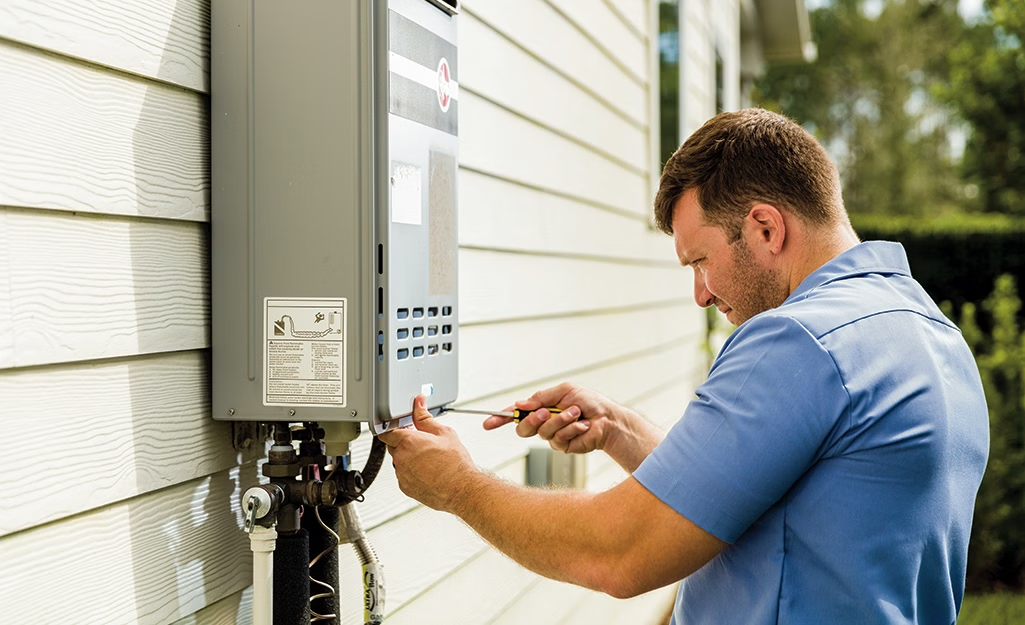
Mate the heater’s rated flow at the required temperature rise to the home’s concurrent demands. Under low flow, the heater’s burner or element may not be activated, resulting in tepid output at fixtures that demand less than the activation level.
Examples include a shower, which typically needs 7–9 L/min (1.8–2.4 GPM), a kitchen faucet, which needs 3–6 L/min (0.8–1.6 GPM), and a dishwasher, which needs 8–10 L/min (2.1–2.6 GPM). Add concurrent demands when sizing. Pipe runs and minimum flow controls installed properly also matter to avoid pressure dips that lower effective output.
| Fixture or Appliance | Typical Flow (L/min) | Typical Flow (GPM) |
|---|---|---|
| Shower | 7–9 | 1.8–2.4 |
| Kitchen faucet | 3–6 | 0.8–1.6 |
| Dishwasher | 8–10 | 2.1–2.6 |
| Washing machine | 9–12 | 2.4–3.2 |
Inlet Temperature
Colder incoming water increases the required temperature rise and decreases the unit’s deliverable flow at that rise. In winter or cold scenarios, you want a model that can deal with a bigger temperature increase to retain both volume and comfort.
Tuning the set temperature up or selecting larger capacity increases comfort, but can decrease reported energy savings. It has a direct bearing on performance factors efficiency because heating water from 5 °C to 50 °C requires more energy than heating it from 15 °C to 50 °C, which changes the actual GPM at rated rise.
Watch your monitor inlet temperatures seasonally and design capacity with the coldest expected condition in mind. With proper installation and maintenance, these effects remain predictable and help maximize the 24–34% energy advantage tankless units may command over storage tanks.
The Ownership Experience
Tankless water heaters transform the ownership experience of a home’s hot water. Expect a different set of trade-offs from installation to daily use: lower standby losses and on-demand heat but a greater need for correct siting and routine service. The system delivers hot water only when it’s requested, minimizing energy wasted to reheating.
With proper care, a unit can last 15 to 20 years or more. Some well-maintained systems have gone beyond 25 years in mild climates.
Installation
Professional installation is a must. Gas line work, venting, and electrical connections have safety and code ramifications. Employ contractors licensed for gas and electrical work to minimize danger.
Keep in mind to choose a location that is convenient for servicing, satisfies local code clearance, and has room for condensate drains where applicable. Situate units as close as possible to the primary concentrations of hot water fixtures to minimize wait and heat loss in lengthy pipe runs.
Short runs maximize the benefit of the rapid response and lower the demand for recirc pumps. Adhere to the manufacturer recommendations on venting length, clearances, and fuel type precisely. Those specs are important for warranty and safe combustion.
Maintenance
Descaling and flushing is not an option in many locations. Mineral buildup in the heat exchanger diminishes flow and efficiency, so once a year descaling is standard, particularly where water hardness is elevated.
Clean inline filters, inspect sensors, and clear burners to stabilize ignition and flame patterns. For gas units, verify venting and combustion components for leaks, blockages, or corrosion.
Even small intrusions in the flue path can lead to performance loss or safety issues. Book a pro service visit annually to check gas pressure, combustion efficiency, and perform diagnostic checks.
A homeowner can do simple checks more often: watch for error codes, clear external air intakes, and monitor pressure relief valves.
Longevity
Tankless units tend to outlast tanks when cared for. The average lifespan is 15 to 20 years, with numerous systems stretching to 25 to 30 years with proper maintenance, compared to 8 to 12 years with conventional tanks.
Replaceable components, such as sensors, valves, and heat exchangers in certain models, simplify repairs and may help prolong service life. Keep an eye out for leaks, corrosion, and recurring error codes and address them to prevent bigger malfunctions.
Maintain a maintenance log with descaling dates, filter changes, and professional inspections. This record aids in replacement cycles and resale value.
Future Innovations
Tankless water heaters, particularly gas tankless water heaters, already have excellent service lives, sometimes reaching 20 years or more with good maintenance. Future innovations will build on that durability while emphasizing control, efficiency, cost, and performance to make these tankless systems easier to live with and more widely adopted. Here is where real innovation is imminent and how it will impact users in various contexts.
Predict advancements in smart controls, remote monitoring, and integration with home automation systems
Smart controls will evolve from basic on/off apps to learning systems that identify household habits, anticipate hot-water requirements, and heat in advance only when necessary. Remote monitoring will provide installers and owners real-time detail on flow rates, inlet temperatures, and component health so minor issues get addressed before they lead to downtime.
Integration with home automation can let a tankless unit operate in concert with weather forecasts, utility rate signals, or occupancy sensors to shift heating when electricity is cheapest. For example, a system could delay nonessential heating during peak grid rates and resume preheating before a scheduled shower, saving money while keeping comfort intact.
Highlight ongoing improvements in energy efficiency and eco-friendly designs for tankless water heaters
Manufacturers are polishing burners, heat exchangers and control logic to eliminate wasted energy. Several new units already approach high effective efficiencies, around $0.82 of usable heat delivered for each dollar spent, by minimizing standby loss and optimizing heat exchange.
Future designs will take this even further with advanced materials and flow-path designs that minimize scaling to preserve high heat transfer year after year. Green items include lower-noX combustion, modular designs that let you replace parts instead of the whole unit, and recycled or low-carbon materials.
Mention the development of hybrid water heater models combining tankless and heat pump technologies
Hybrid models will combine the tankless on-demand aspect with the high coefficient of performance of heat pumps. These hybrids can employ a small buffer tank for peak draws while a heat pump supplies most of the baseline heat at a lower cost.
In colder climates, where tankless alone can struggle with inlet temperatures, hybrids can preserve consistent delivery and reduce operating costs. It drives down up-front fuel-system upgrades in retrofit projects.
Suggest that future tankless systems may offer even greater performance, reliability, and user convenience
Look for next generation heat exchangers and sensor arrays that maintain performance despite hard water or varying supply temperatures. As manufacturing costs go down due to economies of scale and easier installation, prices will come down, closing the gap with tank-style heaters.
More reliability means fewer service calls and longer lifespans, while user convenience gets a boost through plug-and-play smarts and more transparent diagnostics.
Conclusion
A tankless water heater warms water when you turn on a tap. It uses a burner or electric element to heat water in a flow channel. The unit reduces energy waste by operating solely on demand. Homes get consistent hot water for short runs and reduced standby loss. A higher initial price and fuel requirements can impact certain households. Proper sizing, good venting, and routine checks keep performance tight. Newer models incorporate smart controls and improved heat exchangers. For a small home, one unit usually suffices. For bigger homes, utilize multiple units or point-of-use heaters to prevent flow drops. Ready to compare models or select a size? Consult local installers and obtain a couple of quotes.
Frequently Asked Questions
What is a tankless water heater?
Tankless water heaters, whether gas or electric models, heat water as needed with a gas burner or electric heating elements, providing hot water on demand without storing it in a tank.
How does a tankless water heater save energy?
By heating water on demand, tankless water heaters cut standby heat loss, typically reducing energy use for water heating by 20 to 40 percent compared to traditional tank water heaters.
Can a tankless unit supply hot water to my whole home?
Whole-home models of gas tankless water heaters can serve multiple fixtures, but capacity is determined by flow rate in liters per minute and concurrent hot water usage. Properly size the unit to household needs for seamless performance.
How long does a tankless water heater last?
Tankless water heaters commonly last 15 to 25 years, outlasting traditional tank water heaters. Regular maintenance, such as descaling and cleaning filters, ensures you reach the higher end of that range.
Are tankless heaters more expensive to buy and install?
Upfront, it’s more expensive for the gas tankless water heater unit and installation, particularly if you need gas lines or upgraded electrical work. However, lower operating costs typically compensate for this over a number of years.
Do tankless water heaters require special maintenance?
Yes. Yearly or biannual descaling and filter checks for your tankless water heater are advised to maintain efficiency and avoid mineral buildup in hard-water regions.
What factors affect tankless heater performance?
Key considerations include the incoming water temperature, unit flow rate, and fuel type (gas or electric), along with the number of simultaneous fixtures for your gas tankless water heater. Right sizing and professional installation guarantee the performance you anticipate.