


HVAC duct sealing closes the gaps, seams, and connections in your ductwork so conditioned air reaches your rooms instead of leaking into attics, crawl spaces, and walls. The best sealant for most homes is UL 181B-M listed water-based mastic, backed by foil tape or aerosol sealing for hard-to-reach runs. In west-central Minnesota, where furnaces run hard from Willmar to Redwood Falls, sealed ducts cut heating bills and even out cold rooms.
Sealant choice matters, but the work behind it matters just as much. Surface prep, the right product for each joint, and a leakage test before and after separate a lasting seal from one that fails within a season or two. This guide walks through the main sealant types, the SMACNA and ASHRAE standards that govern them, and what to expect from a professional duct-sealing project.
Why Duct Sealing Matters More Than Ever
The importance of HVAC duct sealing has intensified significantly as building energy codes become more stringent and utility costs continue rising. The U.S. Department of Energy’s research demonstrates that residential HVAC systems can achieve 18-20% cooling energy savings through comprehensive duct sealing and system servicing. This performance improvement becomes increasingly valuable as extreme weather events drive higher heating and cooling demands, while grid reliability concerns emphasize the need for energy conservation.
Several key drivers are elevating duct sealing from an optional maintenance activity to an essential building performance strategy. Climate change is producing more frequent temperature extremes, placing greater stress on HVAC systems and highlighting the importance of efficient air distribution. Simultaneously, aging building infrastructure in many regions means that ductwork installed decades ago may have deteriorated seals that no longer meet current performance standards.
The regulatory landscape is also evolving rapidly. ASHRAE Standard 90.1 continues to reference SMACNA HVAC Air Duct Leakage Testing Manual procedures for commercial buildings, while residential energy codes increasingly mandate duct leakage testing and sealing. Utility rebate programs and weatherization assistance programs have expanded their focus on duct sealing as a high-impact, cost-effective measure for reducing energy consumption.
From a stakeholder perspective, building owners face mounting pressure to reduce operating costs and demonstrate environmental responsibility. Facility managers must balance energy efficiency goals with occupant comfort and indoor air quality requirements. HVAC contractors are adapting to new testing protocols and sealant technologies while managing customer expectations for performance guarantees and long-term durability.
The constraints facing the industry include skilled labor shortages for specialized duct sealing work, varying quality standards across different markets, and the challenge of accessing ductwork in existing buildings without major renovations. Additionally, the proliferation of sealant products with varying performance claims requires careful evaluation to ensure compliance with applicable standards and long-term effectiveness.
Energy Performance Impact and Quantified Benefits
The energy performance implications of duct sealing extend far beyond simple air leakage reduction. Comprehensive field studies conducted by the National Renewable Energy Laboratory demonstrate that combined manual and aerosol duct sealing can eliminate 70-90% of duct leaks. This dramatic improvement in system integrity translates to measurable reductions in energy consumption, peak demand, and equipment runtime.

The data reveals a stark contrast between well-maintained and neglected duct systems. Properly sealed ductwork typically experiences only 5% energy loss, while severely compromised systems can waste up to 40% of conditioned air. This performance differential has profound implications for both energy costs and equipment sizing requirements.
| Building Type | Typical Duct Leakage Rate | Post-Sealing Leakage Rate | Energy Savings Potential | Payback Period |
|---|---|---|---|---|
| Single-Family Residential | 15-25% | 3-8% | 15-25% | 2-4 years |
| Multi-Family Residential | 12-20% | 4-10% | 12-20% | 3-5 years |
| Small Commercial | 10-18% | 2-6% | 10-18% | 1-3 years |
| Large Commercial | 8-15% | 2-5% | 8-15% | 1-2 years |
The economic benefits of duct sealing vary significantly based on building characteristics, climate zone, and utility rates. However, the consistent pattern across all building types demonstrates positive returns on investment, with commercial buildings typically achieving faster payback periods due to higher energy usage and demand charges.
Beyond direct energy savings, properly sealed ductwork enables several secondary benefits that compound the economic value. HVAC equipment operates more efficiently when air distribution is optimized, potentially extending equipment life and reducing maintenance requirements. The improved system performance may also allow for downsizing replacement equipment, reducing capital costs for future upgrades.
Sealant Technologies and Performance Characteristics
The evolution of duct sealant technologies has produced a diverse array of products, each engineered for specific applications and performance requirements. Understanding the fundamental differences between sealant types is essential for selecting appropriate materials and achieving long-term sealing effectiveness.

Mastic sealants represent the gold standard for duct sealing applications, offering superior durability and long-term performance. These water-based compounds are specifically formulated to maintain flexibility across temperature cycles while providing excellent adhesion to metal, fiberglass, and flexible duct materials. UL 181B-M listed mastics undergo rigorous testing for flame spread, smoke development, and adhesion strength.
The performance advantages of mastic sealants stem from their chemical composition and application characteristics. Modern formulations typically feature viscosities ranging from 320,000 to 500,000 centipoise, providing excellent gap-filling capability while minimizing sagging during application. The non-flammable nature of water-based mastics enhances safety during installation, while their resistance to temperature cycling ensures long-term seal integrity.
| Sealant Property | Mastic Sealant | Foil Tape | Aerosol Sealant | Performance Standard |
|---|---|---|---|---|
| Temperature Range | -40°F to 200°F | -65°F to 180°F | -20°F to 160°F | ASTM D412 |
| Tensile Strength | 150-300 psi | 25-40 lbs/in | 100-200 psi | ASTM D412 |
| Elongation at Break | 200-400% | 15-25% | 150-300% | ASTM D412 |
| Service Life | 20+ years | 10-15 years | 15-20 years | Field studies |
| Application Pressure | Up to 15″ WG | Up to 10″ WG | Up to 6″ WG | SMACNA standards |
Foil-backed tapes offer convenience and speed of application, making them popular for accessible ductwork and maintenance applications. UL 181B-FX listed tapes feature pressure-sensitive adhesives specifically formulated for HVAC applications, with aluminum foil backing providing vapor barrier properties and mechanical strength. However, the performance limitations of tape sealants become apparent in high-stress applications or extreme temperature environments.
Aerosol duct sealing represents an innovative approach that addresses the challenge of sealing inaccessible ductwork from the inside. This technology involves introducing aerosolized sealant particles into the duct system under controlled pressure, allowing the particles to accumulate at leak sites and form permanent seals. While aerosol sealing can achieve impressive leak reduction rates, the technology requires specialized equipment and trained technicians.
Installation Standards and Quality Assurance
The effectiveness of duct sealing depends critically on proper installation procedures and adherence to industry standards. SMACNA’s HVAC Duct Construction Standards provide comprehensive guidance for sealant selection, surface preparation, and application techniques. These standards emphasize that sealant performance is only as good as the installation quality, regardless of the product’s inherent characteristics.

The four-step process illustrated above represents industry best practices developed through decades of field experience and laboratory testing. Each step serves a critical function in ensuring long-term seal performance and system reliability.
Surface preparation emerges as perhaps the most critical factor in sealant longevity. Ductwork surfaces must be clean, dry, and free from oil, dust, or loose debris that could compromise adhesion. SMACNA standards specify that surfaces should be wiped with a clean, lint-free cloth and allowed to dry completely before sealant application. In environments with significant contamination, solvent cleaning may be necessary to achieve adequate surface preparation.
The application technique varies significantly between sealant types, with each requiring specific tools and procedures. Mastic sealants are typically applied using brushes, trowels, or spray equipment, with thickness requirements ranging from 1/16 inch to 1/4 inch depending on the gap size and pressure class. The SMACNA standards emphasize that mastic should be worked into joints and seams to ensure complete coverage and eliminate air paths.
Quality testing represents the final validation of sealing effectiveness. ASHRAE Standard 152 provides standardized procedures for measuring duct leakage using calibrated fan pressurization equipment. These tests quantify leakage rates at specific pressure differentials, allowing for objective assessment of sealing performance and compliance with program requirements.
Comprehensive Benefits Analysis
The benefits of professional duct sealing extend across multiple performance dimensions, creating value for building owners, occupants, and the broader energy infrastructure. Understanding these interconnected benefits is essential for making informed decisions about duct sealing investments and prioritizing maintenance activities.
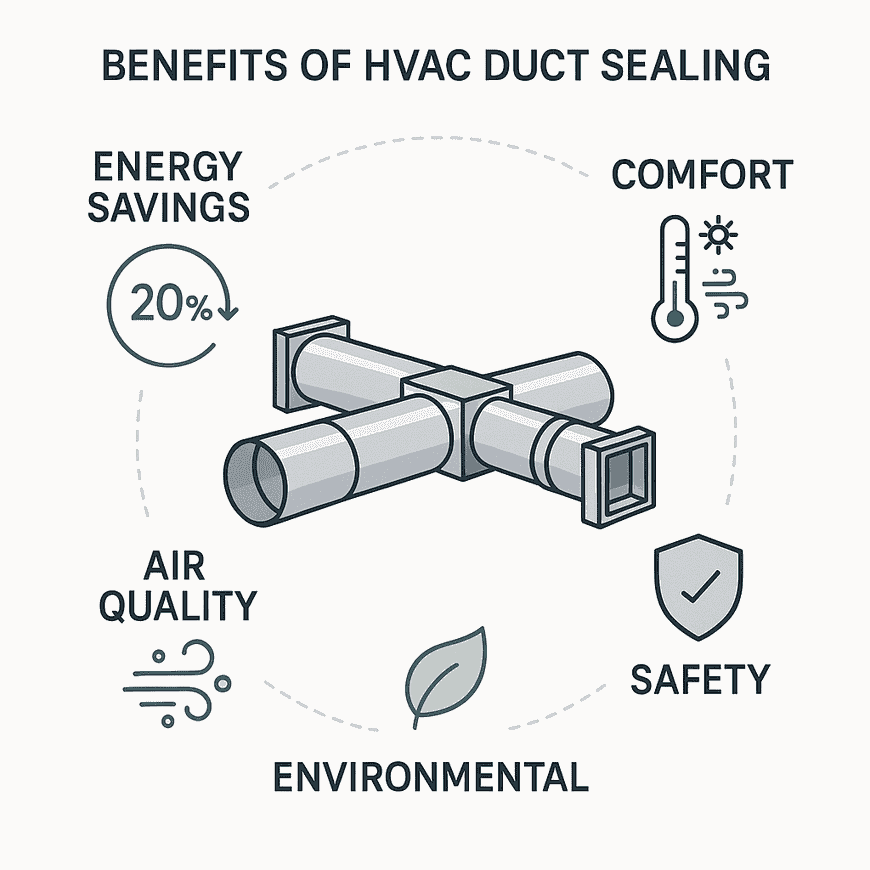
Energy efficiency improvements represent the most quantifiable and immediate benefit of duct sealing. The 20% efficiency improvement documented by ENERGY STAR translates to substantial cost savings over the system’s operational life. For a typical residential system consuming 3,000 kWh annually for cooling, a 20% reduction represents 600 kWh in savings, worth approximately $72-120 annually depending on local utility rates. Over a 15-year period, these savings can exceed $1,500, far exceeding the typical cost of professional duct sealing.
Indoor air quality benefits emerge from the elimination of uncontrolled air infiltration and the prevention of contaminant entrainment. Leaky return ducts can draw air from crawl spaces, attics, or mechanical rooms, introducing dust, moisture, and potentially harmful substances into the occupied space. EPA research indicates that proper duct sealing can significantly reduce the risk of backdrafting from combustion appliances, preventing carbon monoxide and other combustion gases from entering living spaces.
Comfort improvements result from more uniform air distribution and reduced temperature variations throughout the building. Sealed ductwork ensures that conditioned air reaches its intended destination rather than being lost to unconditioned spaces. This improved air delivery eliminates hot and cold spots, reduces humidity variations, and enables more precise temperature control. The enhanced comfort often allows occupants to set thermostats at more moderate temperatures, contributing additional energy savings.
Safety considerations encompass both immediate and long-term risks associated with compromised ductwork. Beyond the backdrafting concerns mentioned above, leaky ducts can create pressure imbalances that affect the operation of exhaust fans, fireplaces, and other ventilation equipment. Proper sealing helps maintain intended pressure relationships and ensures that safety systems function as designed.
Environmental benefits scale from individual buildings to regional and national levels. Research on large-scale duct sealing points to roughly 2,000 to 4,000 GWh of avoided electricity consumption across a region, equivalent to the output of a large power plant. This demand reduction helps defer the need for new generation capacity while reducing emissions from existing power plants.
Real-World Duct Sealing Results
Real-world duct sealing projects provide valuable insights into both the potential benefits and practical limitations of different approaches. The following case studies, drawn from utility programs and research studies, illustrate the range of outcomes achievable under various conditions.
Residential Retrofit Program – Pacific Northwest
A comprehensive study of 847 single-family homes in the Pacific Northwest examined the effectiveness of utility-sponsored duct sealing programs. Pre-sealing duct leakage rates averaged 18.3% of system airflow, with significant variation ranging from 8% to 35%. Professional sealing using mastic and UL-listed tapes reduced average leakage to 6.2%, representing a 66% improvement in duct integrity.
Energy savings varied considerably based on initial leakage rates, duct location, and climate conditions. Homes with ducts in unconditioned spaces achieved average savings of 22%, while those with ducts in conditioned basements saw only 8% improvement. The study highlighted the importance of duct location in determining sealing benefits, with the greatest opportunities existing in homes with ductwork in attics, crawl spaces, or garages.
Limitations identified in this study included difficulty accessing all ductwork in existing homes, leading to incomplete sealing in some cases. Additionally, homes with very low initial leakage rates showed minimal improvement, suggesting that pre-screening for leakage levels could improve program cost-effectiveness. The study also noted that some homes experienced temporary indoor air quality issues during the first few weeks after sealing, attributed to reduced dilution of indoor pollutant sources.
Commercial Building Aerosol Sealing Project
A 150,000 square foot office building underwent aerosol duct sealing to address comfort complaints and high energy costs. Initial testing revealed duct leakage of 12% of system airflow, concentrated in inaccessible areas above suspended ceilings. The aerosol sealing process reduced leakage to 3.8% over a two-day period, with minimal disruption to building operations.
Energy monitoring over the subsequent 12 months documented 16% reduction in HVAC energy consumption, with the greatest savings occurring during peak cooling periods. Tenant comfort surveys showed significant improvement in temperature uniformity and reduced complaints about drafts or stuffiness. The project achieved a 2.1-year payback period based on energy savings alone, not including the value of improved tenant satisfaction.
However, the study also revealed several limitations of the aerosol approach. The technology proved less effective on large leaks (greater than 1/4 inch), requiring conventional sealing methods for major gaps. Additionally, the aerosol process temporarily reduced airflow in some zones, necessitating system rebalancing after completion. Long-term monitoring indicated that aerosol seals may be more susceptible to degradation from vibration compared to mastic seals, though performance remained acceptable over the five-year study period.
Action Plan for Effective Duct Sealing Implementation
Successful duct sealing projects require systematic planning, appropriate technology selection, and rigorous quality control. The following action plan provides a framework for building owners, facility managers, and contractors to achieve optimal results while avoiding common pitfalls.
Phase 1: Assessment and Planning (2-4 weeks)
Begin with comprehensive duct leakage testing using calibrated fan pressurization equipment conforming to ASHRAE Standard 152 or SMACNA protocols. Document baseline leakage rates, identify accessible and inaccessible ductwork sections, and assess overall system condition. This initial assessment should include visual inspection for obvious damage, disconnected ducts, or missing insulation that could affect sealing effectiveness.
Develop a sealing strategy based on ductwork accessibility, leakage severity, and budget constraints. For systems with mixed accessible and inaccessible sections, consider hybrid approaches combining conventional and aerosol sealing methods. Establish performance targets based on applicable codes, utility program requirements, or energy efficiency goals.
Select qualified contractors with demonstrated experience in duct sealing and appropriate certifications. Verify that contractors have access to calibrated testing equipment and are familiar with applicable standards and safety procedures. Request references from similar projects and verify insurance coverage for the scope of work.
Phase 2: Implementation (1-3 days)
Execute sealing work according to manufacturer specifications and industry standards. Ensure proper surface preparation, appropriate sealant selection for each application, and complete coverage of all identified leak sites. Maintain documentation of materials used, application procedures, and any deviations from the original plan.
Conduct interim testing during the sealing process to verify progress and identify any remaining leak sites. This iterative approach helps ensure complete sealing while minimizing material waste and rework. Pay particular attention to duct connections, equipment interfaces, and transitions between different duct materials.
Implement appropriate safety measures throughout the process, including proper ventilation during sealant application and protection of occupied spaces from dust or fumes. Coordinate with building operations to minimize disruption to normal activities while ensuring worker and occupant safety.
Phase 3: Verification and Commissioning (1-2 days)
Perform final duct leakage testing to verify achievement of performance targets and document improvement over baseline conditions. Compare results to applicable standards and program requirements, ensuring that all criteria are met before project completion. Address any remaining deficiencies through additional sealing or system modifications.
Conduct system rebalancing if necessary to optimize airflow distribution following sealing improvements. Changes in duct leakage can affect system pressures and airflow patterns, potentially requiring adjustments to dampers, fan speeds, or control settings. Verify that all zones receive appropriate airflow and that system operation remains within design parameters.
Provide comprehensive documentation including before and after test results, materials specifications, warranty information, and recommended maintenance procedures. Establish a monitoring schedule to track long-term performance and identify any degradation in sealing effectiveness over time.
Future Outlook and Emerging Technologies
The duct sealing industry continues to evolve in response to advancing building technologies, changing energy codes, and growing emphasis on indoor environmental quality. Several emerging trends are likely to shape the future of duct sealing practices and technologies over the next decade.
Smart building integration represents a significant opportunity for enhancing duct sealing effectiveness through continuous monitoring and predictive maintenance. Advanced sensors can detect changes in system pressures, airflow patterns, or energy consumption that may indicate seal degradation. Machine learning algorithms can analyze this data to predict maintenance needs and optimize system performance over time.
Material science advances are producing new sealant formulations with enhanced durability, faster curing times, and improved environmental profiles. Bio-based sealants derived from renewable feedstocks offer potential sustainability benefits while maintaining performance characteristics. Nanotechnology applications may enable self-healing sealants that can automatically repair minor damage or degradation.
Regulatory developments are likely to increase the emphasis on duct sealing as a mandatory building performance measure. Several states are considering updates to energy codes that would require duct leakage testing and sealing for both new construction and major renovations. Federal efficiency standards for HVAC equipment may also incorporate duct system performance requirements, creating additional incentives for proper sealing.
However, several challenges may limit the pace of adoption and technological advancement. The fragmented nature of the construction industry makes it difficult to standardize practices and ensure consistent quality. Skilled labor shortages in the HVAC trades could constrain the availability of qualified sealing contractors. Additionally, the long service life of ductwork means that improvements in sealing technology may take decades to achieve widespread market penetration.
Climate change impacts present both opportunities and challenges for duct sealing. More extreme weather conditions increase the value of energy efficiency improvements while potentially stressing sealant materials beyond their design limits. Rising energy costs strengthen the economic case for sealing while potentially making high-performance materials less affordable for some applications.
Key Takeaways
- Professional duct sealing can reduce HVAC energy consumption by 15-25% in typical buildings, with payback periods of 1-4 years depending on building type and local conditions.
- Mastic sealants offer superior long-term performance compared to tape or aerosol alternatives, with service lives exceeding 20 years when properly applied.
- Proper installation following SMACNA and ASHRAE standards is critical for achieving optimal performance, with surface preparation being the most important factor in sealant longevity.
- Duct sealing provides multiple benefits beyond energy savings, including improved indoor air quality, enhanced comfort, increased safety, and reduced environmental impact.