


Northern Services Today installs, repairs, and maintains residential boilers throughout west-central Minnesota, from Olivia and Willmar to Hutchinson and Litchfield. In a region where winter temperatures routinely drop well below zero and heating systems run hard for months, a reliable, efficient boiler is essential to keeping your home warm, your hot water flowing, and your energy bills under control.
This guide walks Minnesota homeowners through the essentials of boiler systems: how to choose between combi, system, and conventional units, what a new installation typically costs, why annual maintenance protects both safety and efficiency, and how to recognize the warning signs that call for professional repair. Whether you are upgrading an aging unit or troubleshooting a mid-winter breakdown, understanding your boiler helps you make confident, cost-effective decisions.
Why Boiler Knowledge Matters Now
In an era of rising energy costs and increasing environmental awareness, the efficiency and reliability of home heating systems have never been more critical. Boilers, as central components of many residential heating infrastructures, play a pivotal role in both household budgets and carbon footprints. Homeowners today face a myriad of choices when it comes to boiler technology, from traditional non-condensing units to highly efficient condensing and combi boilers. Navigating these options, understanding their implications, and ensuring proper installation and maintenance are paramount for long-term savings and comfort.
The drive towards greater energy efficiency is not merely a matter of personal finance; it is also a response to broader environmental imperatives. Upgrading an older, less efficient boiler can significantly reduce a home’s carbon dioxide emissions. For instance, replacing a 56% efficient boiler with a 90% efficient model in an average cold-climate house can save 1.5 tons of CO2 emissions annually if heating with natural gas, or 2.5 tons if heating with oil. This tangible impact on environmental sustainability adds another layer of importance to understanding and optimizing boiler performance.
Moreover, regulatory bodies like the Occupational Safety and Health Administration (OSHA) and organizations such as the American Society of Mechanical Engineers (ASME) set stringent standards for boiler safety and operation. These regulations, while primarily aimed at industrial and commercial settings, underscore the inherent risks associated with improperly installed or maintained pressure vessels. For homeowners, this translates into a need for vigilance, ensuring that any work performed on their boiler adheres to the highest safety standards and is carried out by certified professionals. The confluence of economic, environmental, and safety considerations makes comprehensive boiler knowledge an essential asset for every homeowner.
A Deep Dive into Boiler Systems
Boiler Installation: From Selection to Setup
The journey of a new boiler begins long before the first pipe is fitted. It starts with a crucial decision-making process that will impact a home’s comfort, energy consumption, and budget for years to come. The initial step involves selecting the right type of boiler for the specific needs of the household. The three main types of boilers available for residential use are combi boilers, system boilers, and conventional (heat-only) boilers. Combi boilers are a popular choice for smaller homes as they provide both heating and hot water on demand without the need for a separate water tank. System boilers, which require a hot water cylinder, are better suited for homes with higher hot water demands, such as those with multiple bathrooms. Conventional boilers, often found in older homes, use both a hot water cylinder and a cold water storage tank.
Once the type of boiler is chosen, the next consideration is its efficiency. Modern boilers are rated using the Annual Fuel Utilization Efficiency (AFUE) scale, which measures how efficiently the appliance converts fuel into heat. High-efficiency condensing boilers can achieve AFUE ratings of up to 98.5%, meaning that nearly all the fuel consumed is converted into useful heat for the home. This is a significant improvement over older, non-condensing boilers, which can have AFUE ratings as low as 56%. The financial and environmental benefits of choosing a high-efficiency boiler are substantial. As previously noted, upgrading from a 56% to a 90% AFUE boiler can save 1.5 to 2.5 tons of CO2 emissions annually.
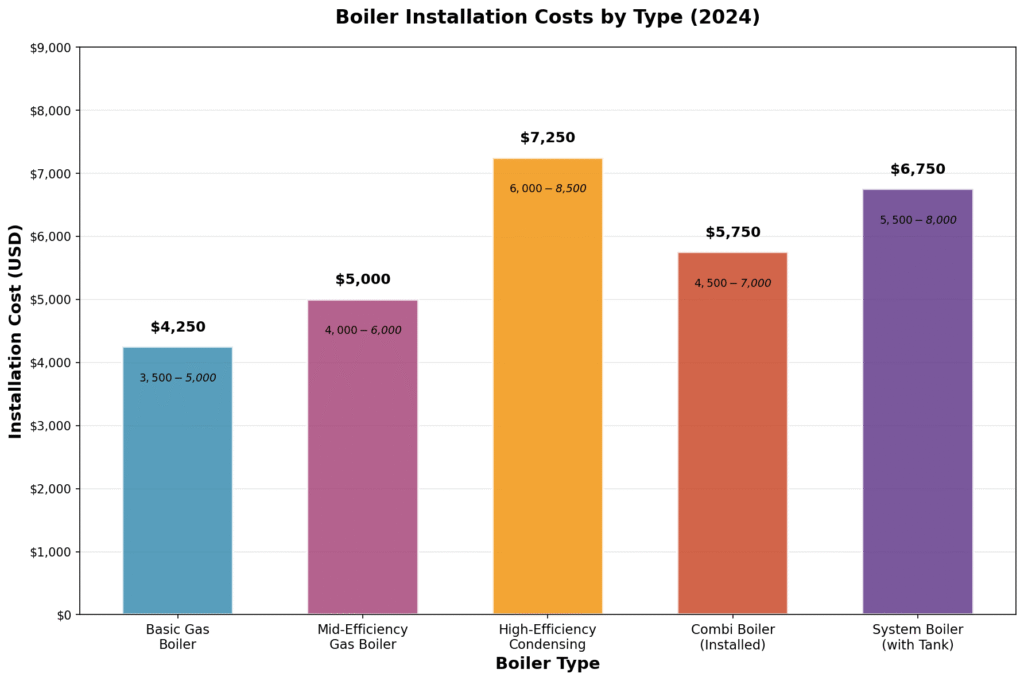
The cost of boiler installation is a significant factor for homeowners. As shown in the chart below, the price can vary widely depending on the type of boiler, its efficiency rating, and the complexity of the installation. On average, a new boiler installation costs around $5,909, with prices ranging from $3,604 to $8,446.
| Boiler Type | Estimated Installation Cost |
|---|---|
| Basic Gas Boiler | $4,250 |
| Mid-Efficiency Gas Boiler | $5,000 |
| High-Efficiency Condensing | $7,250 |
| Combi Boiler (Installed) | $5,750 |
| System Boiler (with Tank) | $6,750 |
The installation process itself is a multi-step procedure that should always be carried out by a certified professional.
- Step 1: Initial Assessment & Planning: A certified technician assesses the home’s heating needs, recommends the appropriate boiler size and type, and plans the installation.
- Step 2: Removal of Old Boiler: The old boiler is safely disconnected and removed, and the area is prepared for the new installation.
- Step 3: Preparation & Safety: The technician ensures that all necessary safety precautions are in place, including proper ventilation and access to the work area.
- Step 4: New Boiler Installation: The new boiler is carefully positioned and mounted according to the manufacturer’s specifications.
- Step 5: Connections & Testing: All necessary pipework, electrical connections, and flue components are connected, and the system is tested for leaks and proper operation.
- Step 6: Final Inspection & Commissioning: The technician performs a final inspection, commissions the boiler, and provides the homeowner with instructions on its operation and maintenance.
Boiler Maintenance: The Key to Longevity and Efficiency
Once a new boiler is installed, regular maintenance is essential to ensure its continued efficiency, safety, and longevity. An annual boiler service, performed by a qualified technician, is the cornerstone of a proactive maintenance plan. During a service, the technician will inspect and clean the boiler’s components, check for leaks, test the pressure and flue gases, and ensure that all safety devices are functioning correctly. This not only helps to prevent breakdowns but also ensures that the boiler is operating at its peak efficiency, which can save money on energy bills.
The importance of regular maintenance is underscored by the fact that many boiler warranties require an annual service to remain valid. Neglecting this crucial task can lead to costly repairs that are not covered by the warranty. Furthermore, a well-maintained boiler is a safer boiler. The combustion process in a gas boiler produces carbon monoxide, a colorless, odorless gas that can be fatal if it leaks into the home. A regular service will include a thorough check of the boiler’s flue and ventilation to ensure that there are no leaks or blockages that could lead to a carbon monoxide buildup.
A well-maintained boiler can retain its initial efficiency for many years, while a neglected boiler will gradually lose efficiency, leading to higher energy consumption and increased costs.

| Boiler Category | Average Efficiency (AFUE) |
|---|---|
| Older Systems (Pre-2000) | 63% |
| Mid-Efficiency (2000-2010) | 81.5% |
| High-Efficiency (2010+) | 87% |
| Condensing (Modern) | 94% |
In addition to an annual service, there are several simple maintenance tasks that homeowners can perform themselves to keep their boiler in good working order. These include checking the boiler’s pressure regularly and topping it up if necessary, bleeding the radiators to remove any trapped air, and ensuring that the boiler’s vents and flue are not blocked. These simple steps can help to prevent common boiler problems and ensure that the heating system is running efficiently.

Boiler Repair: Addressing Common Issues and Emergencies
Even with regular maintenance, boilers can occasionally develop faults or break down. Understanding common boiler problems and knowing when to call a professional is crucial for minimizing disruption and ensuring safety. Some of the most frequent issues include loss of pressure, strange noises (such as banging or gurgling), no hot water, or the boiler switching itself off. Many of these issues can be resolved by a qualified technician, but some may indicate a more serious underlying problem.
Loss of pressure is a common issue that homeowners can often resolve themselves by repressurizing the system according to the manufacturer’s instructions. However, if the pressure drops frequently, it could indicate a leak in the system, which requires professional attention. Strange noises from the boiler can be a sign of air in the system, a faulty pump, or even limescale buildup, particularly in hard water areas. No hot water or heating could be due to a faulty thermostat, a broken diverter valve (in combi boilers), or a problem with the pilot light or ignition system.
For any boiler issue, especially those involving gas leaks, carbon monoxide alarms, or unusual smells, it is imperative to contact a licensed, certified heating professional immediately. Attempting to repair a gas boiler without proper qualifications is extremely dangerous and unsafe. Emergency boiler repair services are available for critical breakdowns, ensuring that homes are not left without heat or hot water for extended periods, particularly during colder months.
The certification and licensing of boiler technicians are critical for ensuring safe and effective repairs. Organizations like the American Society of Mechanical Engineers (ASME) and regulatory bodies such as OSHA set standards for the design, fabrication, assembly, and inspection of boiler components. Many states and cities also have specific licensing requirements for boiler operators and repair technicians. For example, New York City requires a High Pressure Boiler Operating Engineer License for certain types of boilers. These certifications ensure that technicians have the necessary knowledge and skills to work safely and competently on complex boiler systems.
Action Plan: Steps for Homeowners
To ensure the optimal performance, longevity, and safety of your home boiler system, consider implementing the following action plan:
- Assess Your Current System: If you have an older boiler (pre-2000), consider its AFUE rating. If it’s below 80%, an upgrade to a high-efficiency condensing boiler (90%+ AFUE) could significantly reduce your energy bills and carbon footprint.
- Schedule Annual Professional Servicing: Arrange for a licensed, certified heating technician to service your boiler annually. This is critical for safety, efficiency, and often a requirement for maintaining your warranty. If your boiler is under warranty, ensure you adhere to the manufacturer’s servicing schedule.
- Understand Your Boiler Type: Familiarize yourself with whether you have a combi, system, or conventional boiler. This knowledge will help you understand its operational nuances and inform your decisions regarding maintenance and potential upgrades.
- Perform Basic Homeowner Maintenance: Regularly check your boiler’s pressure and top it up if it falls below the recommended level (typically between 15 and 22 psi). Bleed your radiators annually to release trapped air, which can improve heating efficiency. Ensure that the area around your boiler is clear and that all vents and flues are unobstructed.
- Be Alert to Warning Signs: Pay attention to any unusual noises, smells, or changes in your boiler’s performance. If you notice a persistent drop in pressure, a pilot light that keeps going out, or any signs of a gas leak (e.g., sulfur smell), contact a qualified professional immediately. If you have a carbon monoxide alarm, ensure it is working and test it regularly.
- Plan for Replacement: If your boiler is over 10-15 years old, or if repair costs exceed 50% of the cost of a new unit, start budgeting for a replacement. Research available grants or incentives for energy-efficient upgrades in your area.
- Consider Smart Controls: Install a smart thermostat to optimize your heating schedule and potentially save more on energy bills. Many modern boilers integrate seamlessly with smart home systems.
Future Outlook: The Evolution of Home Heating
The home heating landscape is undergoing a significant transformation, driven by a global push towards decarbonization and the increasing adoption of smart technologies. While gas boilers remain a popular choice for many homeowners, the future of home heating is likely to be more diverse and integrated. Hybrid heating systems, which combine a traditional boiler with a renewable energy source such as a heat pump, are becoming increasingly common. These systems can intelligently switch between the two heat sources to optimize efficiency and minimize carbon emissions.
The integration of Internet of Things (IoT) technology is also set to revolutionize the way we manage our home heating. Smart boilers, equipped with sensors and connected to the internet, can provide real-time data on their performance, enabling predictive maintenance and remote diagnostics. This can help to prevent breakdowns, extend the lifespan of the boiler, and further optimize energy consumption. Homeowners will be able to control their heating systems from their smartphones, and the boiler itself will be able to communicate with the utility company to take advantage of off-peak energy tariffs.
In the longer term, we may see a shift away from gas boilers altogether, as governments around the world look to phase out fossil fuels in favor of renewable energy sources. Hydrogen-ready boilers, which can run on natural gas but are also compatible with a future hydrogen gas grid, are already being developed. These boilers could provide a seamless transition to a low-carbon heating future. However, the widespread adoption of hydrogen for home heating will depend on significant investment in infrastructure and the development of a cost-effective and sustainable hydrogen production process.
Key Takeaways
- Efficiency is Paramount: Upgrading from an older boiler (56-70% AFUE) to a modern high-efficiency condensing boiler (90-98.5% AFUE) can cut fuel bills and carbon emissions by up to 50%.
- Installation Costs Vary: The average cost of a new boiler installation is around $5,909, but this can vary significantly based on the type of boiler, its efficiency, and the complexity of the installation.
- Maintenance is Non-Negotiable: Annual professional servicing is crucial for safety, efficiency, and maintaining your boiler’s warranty. Homeowners can also perform simple maintenance tasks like checking pressure and bleeding radiators.
- Safety First: Always use a certified professional for boiler installation, repair, and maintenance. Be aware of the signs of a gas leak or carbon monoxide and act immediately if you suspect a problem.