


Heating, ventilation, and air conditioning (HVAC) systems are the lifeblood of modern buildings, providing comfort, controlling indoor climate, and ensuring healthy air quality. In the United States, these systems account for a significant portion of energy consumption, with residential air conditioning alone making up 19% of household electricity use.[1] This comprehensive guide explores the critical aspects of HVAC systems, from their fundamental principles to the latest technological advancements, helping homeowners and business owners in Olivia, MN, and beyond make informed decisions about their heating and cooling needs.
The Importance of Efficient HVAC Systems in Today’s World
The global HVAC systems market is projected to reach $389.9 billion by 2029, growing at a CAGR of 6.7%.[2] This growth is driven by increasing demand for energy-efficient solutions, government regulations promoting sustainability, and a rising awareness of the impact of indoor air quality on health and well-being. In the United States, residential energy consumption accounts for 21% of total energy use, with HVAC systems being a primary contributor.[3] As energy costs continue to rise and environmental concerns become more pressing, investing in a high-efficiency HVAC system is no longer a luxury but a necessity for both economic and ecological reasons.
For residents of Minnesota, where temperatures can swing from hot and humid summers to frigid winters, a reliable and efficient HVAC system is crucial for maintaining a comfortable and safe indoor environment. An outdated or poorly maintained system not only leads to higher energy bills but also poses risks of breakdowns during extreme weather conditions. By understanding the different types of HVAC systems, their efficiency ratings, and proper maintenance practices, property owners can significantly reduce their energy footprint and operating costs while enhancing indoor comfort.
In-Depth Analysis of HVAC Technologies and Performance
Choosing the right HVAC system requires a thorough understanding of the available technologies, their performance metrics, and how they align with your specific needs. This section provides a detailed analysis of HVAC system types, efficiency ratings, and the benefits of upgrading to modern, energy-efficient equipment.
Types of HVAC Systems: A Comparative Overview
From traditional split systems to advanced geothermal solutions, the HVAC market offers a wide range of options to suit different property types and budgets. Understanding the pros and cons of each system is the first step toward making an informed decision.
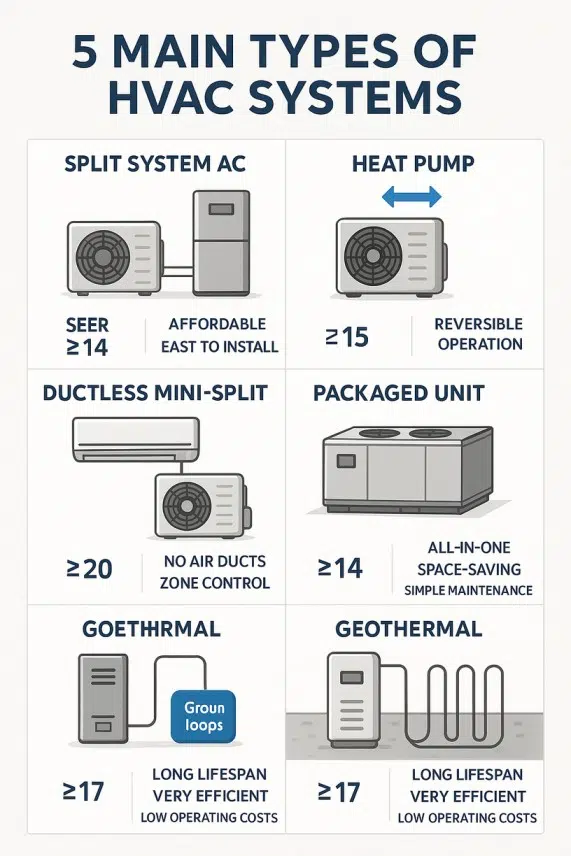
The infographic above illustrates the five primary types of HVAC systems, each with its unique features and applications. Split systems are the most common in residential settings, offering a balance of affordability and efficiency. Heat pumps provide both heating and cooling in a single unit, making them a versatile and energy-efficient choice for moderate climates. Ductless mini-splits are ideal for homes without existing ductwork or for zoning specific areas, offering high efficiency and individualized comfort control. Packaged units are all-in-one systems often used in commercial buildings or homes with limited space. Geothermal systems, while requiring a higher initial investment, offer the highest efficiency and lowest operating costs by leveraging the stable temperature of the earth.
Decoding HVAC Efficiency Ratings: SEER, EER, HSPF, and COP
Understanding HVAC efficiency ratings is crucial for comparing different models and estimating long-term energy costs. The U.S. Department of Energy (DOE) has established minimum efficiency standards, which were updated in 2023 to the new SEER2 and HSPF2 metrics, reflecting more accurate real-world performance.

System Type,SEER Rating
Standard AC (Pre-2023),13
ENERGY STAR AC (Current),15
Heat Pump (Standard),14.3
Heat Pump (High Efficiency),18
Ductless Mini-Split (Premium),20
The chart above demonstrates the significant difference in efficiency between standard and high-performance HVAC systems. Upgrading from an older system with a SEER rating of 10 to a new ENERGY STAR certified model with a SEER of 15 can reduce your cooling costs by over 30%. For heat pumps, the Heating Seasonal Performance Factor (HSPF) measures heating efficiency, with higher numbers indicating better performance. An ENERGY STAR certified heat pump must have an HSPF of 8.2 or higher.
The Economic and Environmental Impact of HVAC Energy Consumption
The energy consumed by HVAC systems has a significant impact on both household budgets and the environment. As shown in the chart below, air conditioning and heating are major contributors to electricity consumption across residential, commercial, and manufacturing sectors.

Sector,Energy_Consumption_Billion_kWh,Percentage
Residential AC,254,19
Commercial Cooling,170,14
Commercial Ventilation,213,18
Manufacturing HVAC,76,8
Other Residential,1082,41
By investing in energy-efficient HVAC systems and adopting smart usage habits, consumers can collectively reduce the strain on the power grid, lower greenhouse gas emissions, and achieve substantial cost savings. The U.S. Environmental Protection Agency (EPA) estimates that if one in ten households were to replace their older, inefficient heating and cooling systems with ENERGY STAR certified models, it would prevent 13 billion pounds of annual greenhouse gas emissions, equivalent to the emissions from 1.2 million cars.
Action Plan: A Step-by-Step Guide to Optimizing Your HVAC System
Taking control of your HVAC system’s performance and energy consumption is achievable with a proactive approach. This action plan provides a clear, step-by-step guide for homeowners and business owners to enhance efficiency, reduce costs, and extend the lifespan of their equipment.
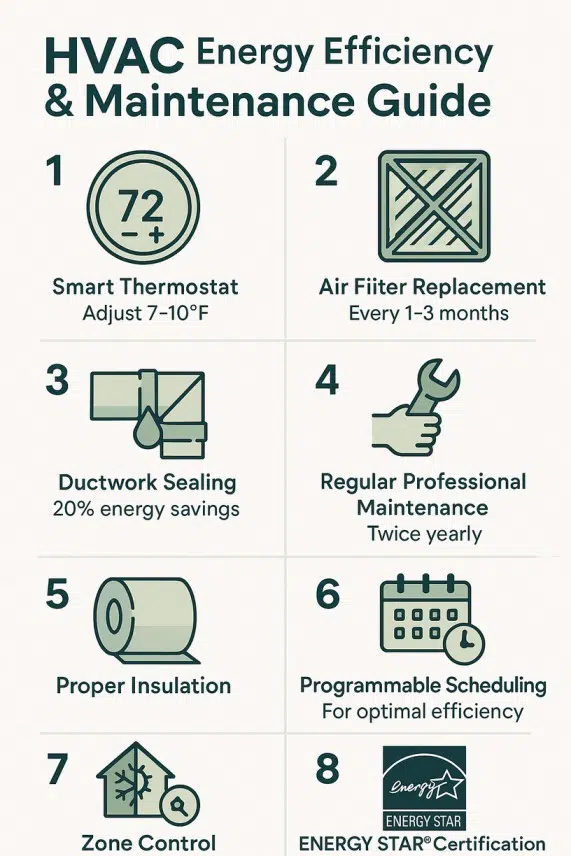
- Assess Your Current System: If your HVAC system is over 10-15 years old, it is likely operating at a much lower efficiency than modern standards. Consider a professional energy audit to identify areas for improvement and potential savings.
- Schedule Regular Maintenance: Just like a car, your HVAC system requires regular tune-ups to operate at peak performance. Schedule professional maintenance twice a year, once before the cooling season and once before the heating season. This can improve efficiency by up to 25% and prevent costly breakdowns.
- Change Air Filters Frequently: Clogged air filters restrict airflow, reduce efficiency, and can lead to system damage. Check your filters monthly and replace them every 1-3 months, or as recommended by the manufacturer.
- Seal and Insulate Ductwork: Leaky ducts can account for up to 30% of a home’s heating and cooling energy loss. Sealing and insulating your ductwork can significantly improve efficiency and comfort.
- Install a Programmable or Smart Thermostat: A smart thermostat can save you up to 10% on your heating and cooling costs by automatically adjusting the temperature when you are away or asleep.
- Consider a Zoning System: If you have rooms that are rarely used, a zoning system can save energy by allowing you to control the temperature in different areas of your home independently.
- Upgrade to an ENERGY STAR Certified System: When it’s time to replace your old HVAC unit, choose an ENERGY STAR certified model to maximize your energy savings and take advantage of available rebates and tax credits.
Future Outlook: The Next Generation of HVAC Technology
The HVAC industry is on the cusp of a technological revolution, with innovations in smart technology, renewable energy integration, and advanced materials poised to reshape the future of heating and cooling. The smart thermostat market, valued at $1.2 billion, is just the beginning. We can expect to see more interconnected systems that learn user preferences, respond to real-time grid signals, and optimize performance for maximum efficiency and comfort.
Geothermal and solar-powered HVAC systems are becoming increasingly viable options, offering the potential for near-zero energy consumption. Advances in refrigerant technology are also leading to more environmentally friendly options with lower global warming potential. As these technologies mature and become more accessible, the dream of a truly sustainable and intelligent home is becoming a reality.
Detailed System Comparison: Choosing the Right HVAC Solution
Selecting the optimal HVAC system for your property requires careful consideration of multiple factors, including climate conditions, building size, existing infrastructure, and budget constraints. Each system type offers distinct advantages and limitations that must be weighed against your specific requirements.
Split System Air Conditioners: The Traditional Choice
Split system air conditioners remain the most popular choice for residential applications, accounting for approximately 75% of new installations in the United States. These systems consist of an outdoor condensing unit and an indoor evaporator coil, connected by refrigerant lines. The outdoor unit houses the compressor, condenser coil, and fan, while the indoor unit contains the evaporator coil and is typically connected to a furnace or air handler for air distribution.
The primary advantages of split systems include their relatively low initial cost, ease of installation in homes with existing ductwork, and widespread availability of service technicians. Modern split systems can achieve SEER ratings of 14.3 or higher, meeting current DOE efficiency standards. However, these systems are limited to cooling only and require a separate heating system, which can increase overall installation and maintenance costs.
Heat Pumps: Versatile Year-Round Comfort
Heat pumps represent a significant advancement in HVAC technology, offering both heating and cooling capabilities in a single system. These units operate on the principle of heat transfer, moving thermal energy from one location to another rather than generating heat through combustion. During summer months, heat pumps function like traditional air conditioners, removing heat from indoor air and transferring it outside. In winter, the process reverses, extracting heat from outdoor air and transferring it indoors.
The efficiency of heat pumps is measured by both SEER for cooling and HSPF (Heating Seasonal Performance Factor) for heating. ENERGY STAR certified heat pumps must achieve a minimum SEER of 15 and HSPF of 8.5. The coefficient of performance (COP) is another important metric, with high-efficiency heat pumps achieving COP values of 3.0 or higher, meaning they produce three units of heat for every unit of electricity consumed.
While heat pumps offer excellent efficiency in moderate climates, their performance can decline in extremely cold conditions. However, advances in cold-climate heat pump technology have extended their effective operating range, with some models maintaining efficiency at temperatures as low as -15°F. For Minnesota residents, cold-climate heat pumps paired with backup heating systems provide an excellent balance of efficiency and reliability.
Ductless Mini-Split Systems: Precision Comfort Control
Ductless mini-split systems have gained popularity due to their flexibility, high efficiency, and ability to provide zoned comfort control. These systems consist of an outdoor condensing unit connected to one or more indoor air-handling units via refrigerant lines. Each indoor unit can be controlled independently, allowing for customized temperature settings in different rooms or zones.
The absence of ductwork eliminates the energy losses associated with air distribution, enabling mini-split systems to achieve SEER ratings of 20 or higher. This makes them particularly attractive for home additions, converted spaces, or buildings without existing ductwork. The installation process is also less invasive, requiring only a small hole in the wall for refrigerant lines rather than extensive ductwork modifications.
However, ductless systems do have limitations. The indoor units are visible and may not suit all aesthetic preferences. Additionally, the initial cost per zone can be higher than traditional systems, making them less economical for whole-house applications in larger homes. Proper sizing and placement of indoor units is critical for optimal performance and comfort.
Geothermal Systems: Harnessing Earth’s Stable Temperature
Geothermal heat pumps represent the pinnacle of HVAC efficiency, utilizing the earth’s stable underground temperature to provide heating and cooling. At depths of 6-8 feet, soil temperature remains relatively constant year-round, typically between 45-75°F depending on geographic location. Geothermal systems circulate a water-based solution through buried loops to exchange heat with the earth.
The efficiency of geothermal systems is measured by COP for heating and EER (Energy Efficiency Ratio) for cooling. High-quality geothermal systems can achieve COP values of 4.0-5.0 and EER ratings of 15-25, significantly outperforming conventional systems. The EPA estimates that geothermal systems use 25-50% less electricity than conventional heating and cooling systems.
While the initial installation cost of geothermal systems is substantially higher due to ground loop installation, the long-term operating savings and system longevity often justify the investment. Ground loops can last 50+ years, while the heat pump unit typically lasts 20-25 years. Federal tax credits and utility rebates can help offset the initial cost, making geothermal systems increasingly attractive for new construction and major renovations.
| System Type | Initial Cost | Operating Cost | Lifespan | Efficiency Rating | Best Application |
|---|---|---|---|---|---|
| Split System AC | $3,000-$7,000 | Moderate | 15-20 years | 14-18 SEER | Existing ductwork |
| Heat Pump | $4,000-$8,000 | Low-Moderate | 15-20 years | 15-20 SEER, 8-10 HSPF | Moderate climates |
| Ductless Mini-Split | $2,000-$5,000/zone | Very Low | 20-25 years | 18-30 SEER | Zoned comfort, no ducts |
| Geothermal | $15,000-$25,000 | Very Low | 25+ years | 15-25 EER, 3-5 COP | New construction, long-term |
Advanced HVAC Technologies and Smart Integration
The integration of smart technology and advanced controls is revolutionizing HVAC system operation and efficiency. Modern systems incorporate sophisticated sensors, machine learning algorithms, and connectivity features that optimize performance while providing unprecedented user control and convenience.
Smart Thermostats and Building Automation
Smart thermostats have evolved far beyond simple programmable devices, incorporating occupancy sensors, weather data integration, and learning algorithms that adapt to user preferences and schedules. These devices can reduce heating and cooling costs by 10-23% through optimized scheduling and automatic adjustments based on occupancy patterns.
Advanced building automation systems take this concept further, integrating HVAC controls with lighting, security, and other building systems. These systems can respond to real-time utility pricing signals, automatically adjusting operation to minimize costs during peak demand periods. For commercial applications, building automation can achieve energy savings of 20-30% while improving occupant comfort and system reliability.
Variable Refrigerant Flow (VRF) Systems
Variable Refrigerant Flow systems represent a significant advancement in commercial HVAC technology, offering precise temperature control and exceptional efficiency. VRF systems use advanced inverter technology to modulate refrigerant flow based on real-time demand, allowing multiple indoor units to operate at different capacities simultaneously.
The efficiency benefits of VRF systems are substantial, with some models achieving SEER ratings exceeding 20 and HSPF ratings above 10. The ability to provide simultaneous heating and cooling to different zones makes VRF systems particularly attractive for commercial buildings with varying thermal loads. Heat recovery VRF systems can transfer waste heat from cooling zones to areas requiring heating, further improving overall system efficiency.
Indoor Air Quality and Ventilation Advances
The COVID-19 pandemic has heightened awareness of indoor air quality, driving demand for advanced filtration and ventilation technologies. Modern HVAC systems increasingly incorporate HEPA filtration, UV-C sterilization, and enhanced ventilation controls to improve air quality while maintaining energy efficiency.
Energy Recovery Ventilators (ERVs) and Heat Recovery Ventilators (HRVs) allow buildings to meet ventilation requirements while minimizing energy losses. These systems can recover 70-80% of the energy from exhaust air, significantly reducing the load on heating and cooling equipment. Demand-controlled ventilation systems use CO2 sensors to adjust ventilation rates based on occupancy, optimizing air quality while minimizing energy consumption.
Maintenance Best Practices and Troubleshooting
Proper maintenance is essential for maximizing HVAC system efficiency, reliability, and lifespan. A well-maintained system not only operates more efficiently but also provides better indoor air quality and reduces the likelihood of costly emergency repairs.
Preventive Maintenance Schedules
Establishing a comprehensive preventive maintenance schedule is the foundation of HVAC system care. Professional maintenance should be performed twice annually, typically in spring before the cooling season and fall before the heating season. During these visits, technicians should inspect and clean coils, check refrigerant levels, test safety controls, calibrate thermostats, and verify proper airflow.
Between professional visits, property owners should perform regular maintenance tasks including monthly filter inspections and replacements, keeping outdoor units clear of debris, checking for unusual noises or odors, and monitoring energy consumption for unexpected increases. These simple tasks can prevent many common problems and help identify issues before they become major repairs.
Common Issues and Solutions
Understanding common HVAC problems and their solutions can help property owners address minor issues quickly and know when to call for professional service. Reduced airflow is often caused by dirty filters, blocked vents, or ductwork issues. Uneven temperatures may indicate ductwork problems, thermostat issues, or system sizing problems. Unusual noises can signal mechanical problems, loose components, or refrigerant issues.
Energy consumption increases without corresponding comfort improvements often indicate declining system efficiency due to dirty coils, low refrigerant levels, or aging components. Regular monitoring of energy bills and system performance can help identify these issues early, allowing for timely intervention before major problems develop.
Regional Considerations for Minnesota HVAC Systems
Minnesota’s continental climate presents unique challenges for HVAC systems, with temperature extremes ranging from sub-zero winters to hot, humid summers. Understanding these regional factors is crucial for selecting and operating HVAC systems effectively in the Olivia, MN area and throughout the state.
Climate-Specific System Requirements
Minnesota’s heating degree days (HDD) typically range from 7,000-9,000 annually, indicating substantial heating requirements. This makes heating system efficiency and reliability paramount for comfort and cost control. Cold-climate heat pumps have become increasingly viable options, with advanced models maintaining efficiency at temperatures well below freezing.
The state’s cooling degree days (CDD) range from 600-1,200 annually, requiring adequate cooling capacity for summer comfort. However, the relatively short cooling season means that oversizing cooling equipment can lead to poor humidity control and reduced efficiency. Proper system sizing based on detailed load calculations is essential for optimal performance.
Energy Efficiency Programs and Incentives
Minnesota offers various energy efficiency programs and incentives to encourage HVAC system upgrades. Xcel Energy, the state’s largest utility, provides rebates for ENERGY STAR certified equipment, smart thermostats, and ductwork improvements. The state’s Conservation Improvement Program (CIP) requires utilities to invest in energy efficiency programs, providing additional opportunities for cost savings.
Federal tax credits are also available for qualifying HVAC equipment, including 30% credits for geothermal systems and various credits for high-efficiency heat pumps and air conditioners. These incentives can significantly reduce the net cost of system upgrades, improving the return on investment for energy-efficient equipment.
Cost-Benefit Analysis of HVAC Upgrades
Evaluating the financial impact of HVAC system upgrades requires consideration of initial costs, operating savings, maintenance expenses, and system lifespan. A comprehensive cost-benefit analysis helps property owners make informed decisions about when and how to upgrade their systems.
Calculating Return on Investment
The payback period for HVAC upgrades varies significantly based on system type, efficiency improvements, local energy costs, and usage patterns. Upgrading from a 10 SEER air conditioner to a 16 SEER model typically pays for itself in 8-12 years through energy savings. Heat pump upgrades often have shorter payback periods due to their dual heating and cooling capabilities.
Geothermal systems, despite higher initial costs, often provide the best long-term value due to their exceptional efficiency and longevity. With federal tax credits and utility rebates, geothermal systems can achieve payback periods of 10-15 years while providing decades of low-cost operation.
Financing Options and Considerations
Various financing options are available for HVAC system upgrades, including manufacturer financing programs, utility on-bill financing, and home improvement loans. Some programs offer zero-interest financing for qualifying energy-efficient equipment, making upgrades more accessible to homeowners.
Property owners should also consider the impact of HVAC upgrades on property values. Energy-efficient systems can increase home values by 5-10%, partially offsetting upgrade costs. Additionally, modern, efficient systems are increasingly expected by home buyers, making upgrades a valuable investment for future resale.
Environmental Impact and Sustainability
The environmental impact of HVAC systems extends beyond energy consumption to include refrigerant selection, system longevity, and end-of-life disposal considerations. Understanding these factors helps property owners make environmentally responsible choices while meeting comfort requirements.
Refrigerant Technology and Environmental Concerns
The HVAC industry is transitioning away from high global warming potential (GWP) refrigerants toward more environmentally friendly alternatives. The phase-down of hydrofluorocarbon (HFC) refrigerants under the American Innovation and Manufacturing (AIM) Act is driving adoption of lower-GWP alternatives such as R-32 and R-454B.
These newer refrigerants not only reduce environmental impact but often provide improved efficiency and performance. Property owners should consider refrigerant type when selecting new equipment, as future refrigerant availability and costs may impact long-term operating expenses.
Lifecycle Assessment and Sustainability
A comprehensive sustainability assessment considers the entire lifecycle of HVAC equipment, from manufacturing and installation through operation and disposal. High-efficiency, long-lasting equipment typically provides the best environmental performance despite potentially higher initial environmental costs.
Proper system sizing, installation, and maintenance are crucial for minimizing environmental impact. Oversized systems waste energy and resources, while poor installation can significantly reduce efficiency and lifespan. Regular maintenance ensures optimal performance throughout the system’s life and proper refrigerant handling prevents environmental releases.
Conclusion: Making Informed HVAC Decisions
Selecting and maintaining an HVAC system is one of the most important decisions property owners make, affecting comfort, energy costs, and environmental impact for decades. The key to success lies in understanding your specific needs, evaluating available options objectively, and working with qualified professionals throughout the process.
For residents of Olivia, MN, and surrounding areas, the combination of extreme weather conditions and available incentive programs creates unique opportunities for HVAC system optimization. Whether upgrading an aging system or designing a new installation, focusing on efficiency, reliability, and proper sizing will provide the best long-term value.
As technology continues to advance and environmental concerns become increasingly important, the HVAC industry will continue evolving toward more efficient, sustainable, and intelligent solutions. Staying informed about these developments and working with knowledgeable professionals ensures that your HVAC investment will provide optimal performance and value for years to come.
Key Takeaways for Homeowners and Businesses
- Efficiency is Key: Upgrading to an ENERGY STAR certified HVAC system can reduce your energy consumption by 20-50%, leading to significant cost savings and a smaller environmental footprint.
- Maintenance Matters: Regular professional maintenance and frequent filter changes are the most effective ways to keep your HVAC system running efficiently and prevent costly repairs.
- Smart Technology Pays Off: Investing in a smart thermostat and considering a zoning system can provide both convenience and substantial energy savings.
- The Future is Green: The HVAC industry is moving toward more sustainable and intelligent solutions. Keep an eye on emerging technologies like geothermal and solar-powered systems when planning for future upgrades.
References
- U.S. Energy Information Administration (EIA) – How much electricity is used for air conditioning in the United States?
- Markets and Markets – HVAC System Market Report
- U.S. Department of Energy (DOE) – U.S. Residential Building Stock Analysis
- ENERGY STAR – Air-Source Heat Pumps
- Trane – DOE HVAC Energy Efficiency Standards: The Facts