


As summer temperatures rise, homeowners and businesses face the critical challenge of maintaining comfortable indoor environments without incurring exorbitant energy costs. While traditional air conditioning (AC) systems offer powerful cooling, they account for a staggering 18% of annual household electricity use in the United States [1]. This has led to a growing demand for more energy-efficient and cost-effective cooling solutions. Air conditioning fans, including ceiling fans, portable units, and whole-house fans, have emerged as a compelling alternative, offering up to 99% less energy consumption than conventional AC [2]. This comprehensive guide provides an in-depth analysis of air conditioning fan technology, exploring the significant energy savings, health benefits, and environmental advantages they offer. We will delve into authoritative data from government agencies like the Department of Energy (DOE) and the Environmental Protection Agency (EPA), as well as cutting-edge academic research, to provide a definitive resource for anyone seeking to optimize their home or business cooling strategy. From detailed cost-benefit analyses to practical installation and maintenance tips, this article will empower you to make informed decisions that enhance comfort, reduce your carbon footprint, and deliver substantial long-term savings.
The Evolving Landscape of Home Cooling
The demand for effective and affordable home cooling has never been greater. With 88% of U.S. households now using air conditioning, the strain on the nation’s power grid and household budgets is a growing concern [1]. The U.S. Energy Information Administration (EIA) reports that air conditioning consumes approximately 12% of all residential electricity, costing homeowners an estimated $29 billion annually [3]. This has created a significant market shift towards more sustainable and economical cooling technologies. The global HVAC systems market, valued at over $241 billion in 2024, is projected to exceed $445 billion by 2033, driven by consumer demand for energy-efficient solutions [4].
This trend is further amplified by increasing awareness of the environmental impact of traditional AC systems, which rely on refrigerants that can be potent greenhouse gases. The EPA has implemented new regulations to phase out harmful refrigerants like R-410A by 2025, pushing the industry towards more eco-friendly alternatives [5]. Air conditioning fans, which do not use chemical refrigerants, offer a clear advantage in this regard. Their ability to provide effective cooling with a fraction of the energy consumption makes them a cornerstone of modern, sustainable building design. As we will explore, the strategic integration of fans with existing AC systems can lead to dramatic energy reductions, improved indoor air quality, and enhanced thermal comfort, making them an indispensable tool for homeowners and facility managers alike.
Analysis: Unpacking the Energy Efficiency and Cost Savings of Air Conditioning Fans
The most compelling advantage of air conditioning fans lies in their remarkable energy efficiency, which translates directly into significant cost savings for consumers. Unlike traditional air conditioners that use energy-intensive compressors to cool air, fans rely on simple electric motors to create airflow, resulting in a dramatic reduction in power consumption. According to a 2025 analysis, fans use approximately 99% less energy than central air conditioning systems, with monthly operating costs ranging from just $1-3, compared to $50-200 for AC [2]. This disparity is further highlighted by data from the Department of Energy, which shows that a standard window AC unit consumes around 800 watts per hour, while a typical ceiling fan uses only 75 watts [3].

The financial implications of this efficiency gap are substantial. A 2023 study from UC Berkeley found that pairing ceiling fans with a higher air conditioning thermostat setting (78°F instead of 72°F) could reduce cooling energy consumption by as much as 44% without sacrificing occupant comfort [6]. For the average American household, this could translate into annual savings of several hundred dollars. Furthermore, research has shown that modern, energy-efficient fan motors, such as electronically commutated motors (ECMs), can be up to 40% more efficient than the permanent split capacitor (PSC) motors found in older fans, offering even greater savings potential [7].
| Cooling Technology | Average Power Consumption (Watts) | Estimated Monthly Cost | Annual Energy Savings (vs. Central AC) |
|---|---|---|---|
| Central Air Conditioner | 2000W | $144 | $0 |
| Window Air Conditioner | 800W | $58 | $1,037 |
| Portable Air Conditioner | 1200W | $86 | $691 |
| Ceiling Fan | 75W | $5 | $1,663 |
| Whole-House Fan | 400W | $29 | $1,382 |
In a case study conducted by the Florida Solar Energy Center, researchers found that ceiling fan use significantly reduced peak-day cooling demand in residential homes, even when accounting for the electricity consumed by the fans themselves [8]. This not only lowers individual utility bills but also helps to alleviate strain on the electrical grid during peak demand periods, reducing the risk of brownouts and blackouts. The evidence is clear: for homeowners seeking to reduce their energy footprint and operating costs, air conditioning fans represent one of the most impactful and accessible solutions available.
Analysis: Enhancing Health and Safety with Proper Air Circulation
Beyond the economic advantages, air conditioning fans play a crucial role in promoting public health and safety, particularly during periods of extreme heat. The Centers for Disease Control and Prevention (CDC) recognizes that fans can be an effective tool for preventing heat-related illnesses, such as heat stroke and heat exhaustion [9]. By increasing air movement across the skin, fans enhance the body’s natural cooling mechanism of evaporation, providing a significant cooling effect even in the absence of refrigerated air. A 2021 study published in The Lancet Planetary Health found that electric fans can provide effective cooling and reduce the physiological strain of heat exposure, especially in humid conditions [10].

The Occupational Safety and Health Administration (OSHA) also emphasizes the importance of air movement in preventing occupational heat stress. For workers in environments without air conditioning, OSHA recommends the use of fans to improve air circulation and reduce the risk of heat-related illness [11]. This is particularly critical in industries such as manufacturing, warehousing, and agriculture, where workers are often exposed to high temperatures. A 2019 study in the journal Energy and Buildings demonstrated that the use of electric fans can effectively mitigate heat-related reductions in workplace productivity, offering a sustainable solution for maintaining worker well-being and output [12].
Furthermore, air conditioning fans can contribute to improved indoor air quality (IAQ). By promoting air circulation, fans help to distribute fresh air from open windows or ventilation systems, reducing the concentration of airborne pollutants, allergens, and pathogens. The CDC has highlighted the role of ventilation in reducing the transmission of respiratory viruses, and recommends the use of fans to enhance the effectiveness of natural ventilation strategies [13]. When used in conjunction with high-efficiency particulate air (HEPA) filters, fans can be a powerful tool for creating healthier indoor environments. This is especially important for individuals with respiratory conditions, allergies, or compromised immune systems. The strategic use of air conditioning fans, therefore, represents a multifaceted approach to creating safer, healthier, and more comfortable indoor spaces.
Market Size and Growth Projections
The air conditioning fan market is experiencing robust growth, driven by increasing energy costs, environmental concerns, and technological advancements. The global HVAC fan and evaporator coil market was valued at $8.2 billion in 2023 and is projected to grow at a compound annual growth rate (CAGR) of 5.1% through 2032 [18]. In the United States specifically, the HVAC ventilation fans market reached $2.3 billion in 2024 and is expected to grow by 2.0% annually, reaching $2.7 billion by 2032 [19].

This growth is being fueled by several key factors. First, rising energy costs are driving consumers to seek more efficient cooling solutions. Second, increasing awareness of environmental issues is pushing demand for technologies that reduce carbon emissions. Third, technological innovations, such as smart fans with IoT connectivity and variable speed controls, are making fans more attractive to tech-savvy consumers. The integration of artificial intelligence and machine learning into fan control systems is expected to further accelerate adoption in both residential and commercial markets.
Visual Framework: A Multimedia Guide to Air Conditioning Fans
To provide a clear and engaging overview of the key concepts discussed in this article, we have developed a series of visual aids, including infographics and charts. These multimedia elements are designed to distill complex information into easily digestible formats, helping readers to quickly grasp the benefits and best practices associated with air conditioning fan usage.
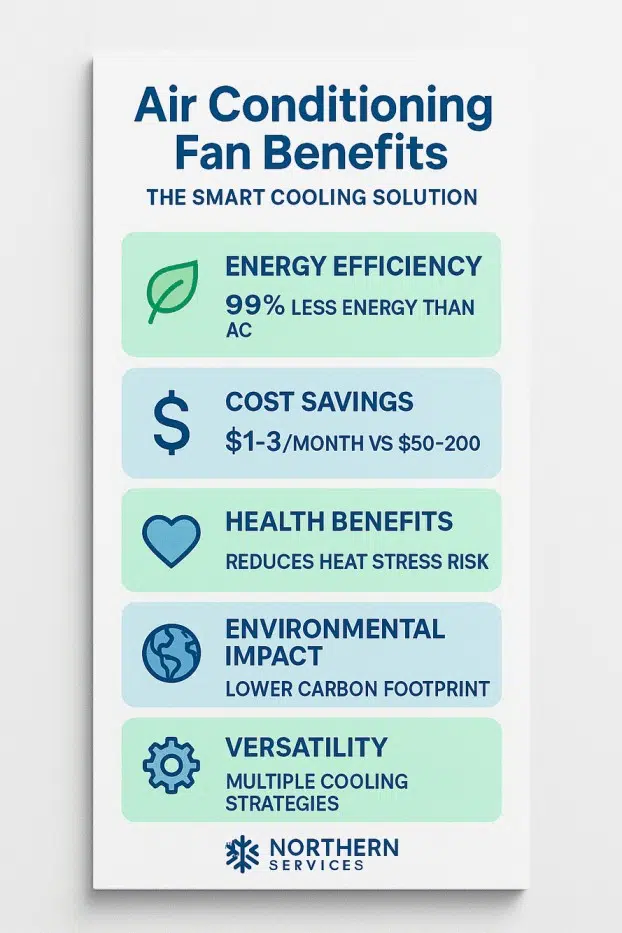
Our first infographic, “Air Conditioning Fan Benefits: The Smart Cooling Solution,” provides a high-level summary of the five key advantages of incorporating fans into your cooling strategy. From the dramatic 99% reduction in energy consumption compared to traditional AC to the significant monthly cost savings, this visual guide offers a compelling at-a-glance case for fan adoption. The inclusion of health and environmental benefits underscores the holistic value proposition of this technology, while the versatility section highlights the wide range of applications for different fan types.
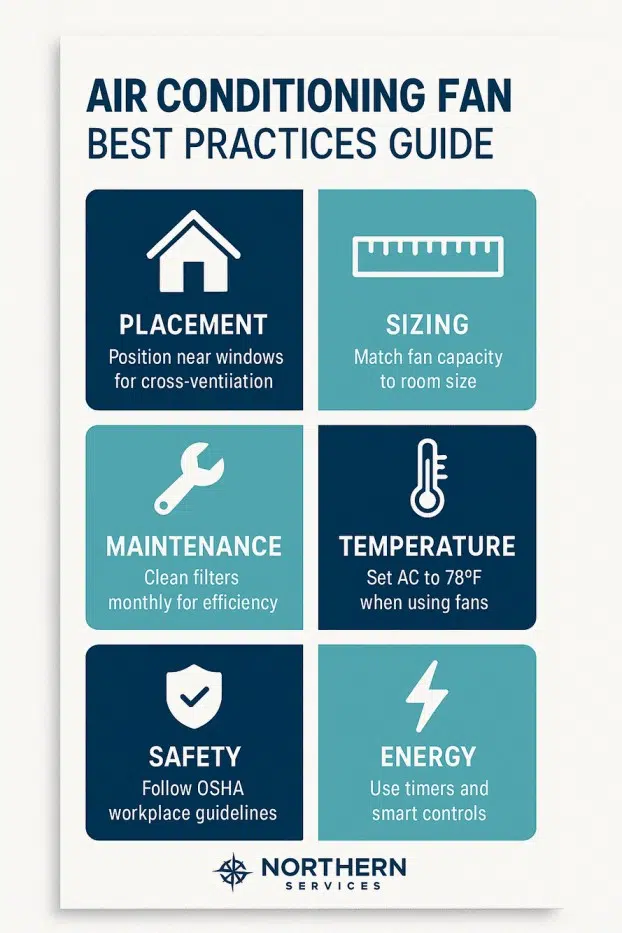
Our second infographic, “Air Conditioning Fan Best Practices Guide,” offers a practical, step-by-step approach to maximizing the effectiveness and efficiency of your fan usage. This guide covers critical aspects such as proper placement to ensure optimal airflow, correct sizing to match room dimensions, and regular maintenance to maintain peak performance. It also provides essential safety guidelines from OSHA and expert recommendations on integrating fans with your existing AC system for the best results. By following these evidence-based best practices, homeowners and facility managers can unlock the full potential of their air conditioning fans, achieving a perfect balance of comfort, savings, and sustainability.
Action Plan: A Step-by-Step Guide to Implementing an Effective Fan Strategy
Transitioning to a more fan-centric cooling strategy is a straightforward process that can be tailored to any home or business. This action plan provides a clear, step-by-step guide to help you select, install, and operate air conditioning fans for maximum benefit.
Step 1: Assess Your Cooling Needs and Environment
Before purchasing any new equipment, it is essential to evaluate your specific cooling requirements. Consider the size of the space you need to cool, the local climate, and your existing HVAC system. For larger rooms, a ceiling fan or a powerful whole-house fan may be the most effective option. In smaller spaces, a portable or tower fan can provide targeted cooling. It is also important to assess your home’s insulation and air sealing. A well-sealed home will retain cool air more effectively, maximizing the efficiency of your fans. The Department of Energy provides comprehensive guidance on conducting a home energy audit to identify areas for improvement [14].
Step 2: Select the Right Fan for Your Application
Once you have assessed your needs, you can select the appropriate type of fan. Ceiling fans are ideal for providing general air circulation in living rooms, bedrooms, and offices. Look for ENERGY STAR certified models, which are up to 60% more efficient than conventional fan/light units [15]. For targeted cooling, portable fans offer flexibility and can be easily moved from room to room. Whole-house fans, which are installed in the attic, are an excellent option for homes in climates with cool nights, as they can draw in cool outdoor air and exhaust hot indoor air. When selecting a fan, pay close attention to its airflow capacity, which is measured in cubic feet per minute (CFM). A higher CFM rating indicates a more powerful fan.
Step 3: Strategic Installation and Placement
Proper installation is critical to the performance and safety of your fans. For ceiling fans, ensure that the blades are at least 7 feet from the floor and 18 inches from the nearest wall. In rooms with high ceilings, a downrod may be necessary to lower the fan to an optimal height. When using portable fans, place them near open windows to facilitate cross-ventilation. To exhaust hot air, position the fan so that it blows air out of the window. To draw in cool air, position it so that it blows air into the room. For whole-house fans, professional installation is recommended to ensure proper attic ventilation and structural integrity.
Step 4: Integrate Fans with Your Existing AC System
To achieve the greatest energy savings, integrate your fans with your existing air conditioning system. By using fans to create a wind-chill effect, you can raise your thermostat setting by up to 4°F without any reduction in comfort [16]. This simple adjustment can reduce your air conditioning energy consumption by up to 10%. For optimal results, set your ceiling fans to rotate counter-clockwise in the summer to create a downward breeze. In the winter, reverse the direction to circulate warm air that has risen to the ceiling.
Step 5: Regular Maintenance for Peak Performance
Like any mechanical system, air conditioning fans require regular maintenance to operate efficiently and safely. Clean the fan blades regularly to prevent the buildup of dust, which can reduce airflow and distribute allergens. For fans with filters, such as some portable and window units, clean or replace the filters according to the manufacturer’s instructions. A clean filter can improve a fan’s efficiency by 5% to 15% [17]. Periodically check for any loose screws or wobbly blades, and address any issues promptly to prevent accidents. By following this action plan, you can create a customized, energy-efficient, and highly effective cooling strategy that will provide years of comfort and savings.
Future Outlook: The Convergence of Smart Technology and Sustainable Cooling
The future of home and commercial cooling lies in the integration of smart technology, advanced materials, and sustainable design principles. The HVAC industry is on the cusp of a major transformation, driven by the urgent need to reduce energy consumption and mitigate the environmental impact of traditional cooling systems. The global smart fan market, a key segment of this evolution, is projected to grow at a compound annual growth rate (CAGR) of over 8% from 2024 to 2032, reaching a valuation of over $1.5 billion [18]. This growth is fueled by the increasing adoption of Internet of Things (IoT) devices and the demand for automated, responsive, and highly efficient climate control solutions.
We can expect to see the proliferation of fans equipped with advanced sensors that can monitor temperature, humidity, and occupancy, automatically adjusting their speed and direction to optimize comfort and energy use. These smart fans will integrate seamlessly with other home automation systems, such as smart thermostats and window blinds, to create a holistic and intelligent climate control ecosystem. Furthermore, advancements in materials science are leading to the development of more aerodynamic and lightweight fan blades, which can move more air with less energy. The use of advanced motor technologies, such as brushless DC motors, will further enhance efficiency and reduce noise levels, making fans an even more attractive and unobtrusive cooling solution.
In the commercial sector, the use of high-volume, low-speed (HVLS) fans is already revolutionizing the way large spaces, such as warehouses, factories, and gymnasiums, are cooled. These massive fans, with diameters of up to 24 feet, can move vast amounts of air with remarkable efficiency, reducing the need for expensive and energy-intensive air conditioning. A 2016 analysis found that HVLS fans can reduce a facility’s carbon footprint by up to 30% [19]. As the technology continues to mature and costs decline, we can expect to see wider adoption of HVLS fans in a variety of commercial and industrial applications. The convergence of these trends points towards a future where cooling is no longer a one-size-fits-all proposition, but rather a dynamic, intelligent, and highly personalized experience that prioritizes both human comfort and environmental stewardship.
Key Takeaways
- Significant Energy and Cost Savings: Air conditioning fans consume up to 99% less energy than traditional AC systems, translating into substantial monthly and annual savings on utility bills.
- Enhanced Health and Safety: Fans improve air circulation, which is critical for preventing heat-related illnesses and can also improve indoor air quality by reducing the concentration of airborne pollutants and pathogens.
- Environmental Benefits: By reducing energy consumption, fans help to lower greenhouse gas emissions and reduce the strain on the electrical grid. They do not use chemical refrigerants, making them a more environmentally friendly cooling option.
- Versatile and Effective Cooling Strategy: Fans can be used in a variety of ways to enhance comfort, from providing targeted cooling in individual rooms to supplementing a central AC system. Combining fans with a higher AC thermostat setting is a highly effective strategy for maximizing energy savings without sacrificing comfort.
- The Future is Smart and Sustainable: The integration of smart technology, such as IoT connectivity and advanced sensors, is making fans an even more intelligent and efficient cooling solution. The future of cooling lies in a holistic approach that combines smart technology with sustainable design principles.
Frequently Asked Questions (FAQ)
Can a fan actually cool a room?
Technically, a fan does not lower the temperature of a room. Instead, it creates a wind-chill effect by moving air across your skin, which makes you feel cooler. This is why a room feels warmer when you turn off a fan, even though the actual temperature has not changed.
Is it safe to leave a fan on all night?
For most people, it is perfectly safe to leave a fan on all night. However, it can sometimes cause dry skin, dry eyes, or a stuffy nose. If you experience any of these issues, try placing the fan further away from your bed or using a lower speed setting. It is also important to keep the fan clean to prevent it from circulating dust and allergens.
How much money can I save by using a fan instead of an air conditioner?
The amount of money you can save depends on your local electricity rates, the type of fan you use, and how often you use it. However, on average, you can expect to save between $50 and $200 per month by using a fan instead of a central air conditioner. Combining a fan with a higher AC thermostat setting can also lead to significant savings.
What is the most energy-efficient type of fan?
Tower fans are generally the most energy-efficient type of portable fan, consuming around 50 watts per hour. For whole-room circulation, ENERGY STAR certified ceiling fans are the most efficient option, using up to 60% less energy than standard models.
How often should I clean my fan?
It is a good practice to clean your fan at least once a month, or more often if you have pets or allergies. Dust and debris can accumulate on the blades and in the motor, reducing the fan’s efficiency and circulating allergens throughout the room. Refer to the manufacturer’s instructions for specific cleaning recommendations.
References
- U.S. Energy Information Administration (EIA) – Today in Energy – August 4, 2022
- Green Washing Index – Fan vs AC | The Complete Cost & Energy Comparison Guide for 2025
- U.S. Department of Energy – Fans for Cooling
- Grand View Research – HVAC Systems Market Size & Share | Industry Report, 2033
- Fleetwoods Heating – What to Know About New EPA Refrigerant Regulations in 2025
- ScienceDirect – Ceiling fan-integrated air-conditioning for improved cooling energy efficiency in residential buildings
- U.S. Department of Energy – Selecting a New Ceiling Fan
- Florida Solar Energy Center – Measured Ceiling Fan-Induced Room Air Motion and Thermal Comfort
- Centers for Disease Control and Prevention (CDC) – Warning Signs and Symptoms of Heat-Related Illness
- The Lancet Planetary Health – Electric fan use for cooling during hot weather: a biophysical modelling study
- Occupational Safety and Health Administration (OSHA) – Heat – Engineering Controls, Work Practices, and Personal Protection
- Energy and Buildings – Fanning as an alternative to air conditioning–a sustainable solution for reducing indoor occupational heat stress
- Centers for Disease Control and Prevention (CDC) – Improving Ventilation in Your Home
- U.S. Department of Energy – Home Energy Audits
- ENERGY STAR – Ceiling Fans
- U.S. Department of Energy – Thermostats
- U.S. Department of Energy – Maintaining Your Air Conditioner
- GM Insights – HVAC Fan & Evaporator Coil Market Size, Industry Report 2032
- MacroAir Fans – How High Volume Low Speed Fans Can Reduce Facility CO2 Emissions