


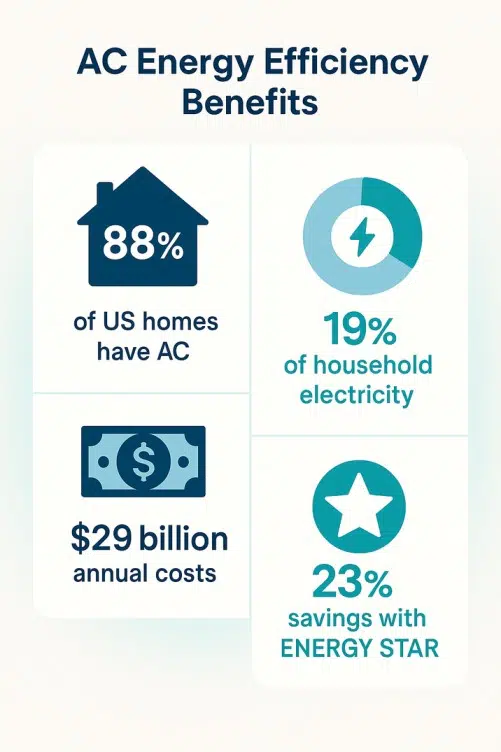
Air conditioning is a significant expense for many homeowners, with the U.S. Department of Energy reporting that 88% of American homes have AC, accounting for nearly 19% of all household electricity consumption. This translates to a staggering $29 billion in annual energy costs for homeowners. However, by implementing proven energy-saving strategies and upgrading to more efficient equipment, it’s possible to reduce air conditioning energy consumption by 20-50%. This comprehensive guide will explore the most effective methods for improving your AC’s energy efficiency, from understanding energy ratings and proper system maintenance to leveraging smart technology and making informed purchasing decisions. By the end of this article, you will have a clear roadmap to significantly lower your cooling costs while maintaining a comfortable home environment.
Context: The Growing Importance of AC Energy Efficiency
The demand for residential and commercial cooling has surged over the past few decades, driven by rising global temperatures and increased urbanization. This has placed a significant strain on power grids, particularly during peak summer months, and has contributed to a substantial increase in greenhouse gas emissions. According to the U.S. Energy Information Administration (EIA), air conditioning is now one of the largest uses of electricity in U.S. homes and commercial buildings, with residential AC alone consuming 254 billion kilowatt-hours (kWh) of electricity in 2020. This escalating energy consumption not only has a significant environmental impact but also translates into higher utility bills for consumers. As energy prices continue to rise, homeowners and businesses are increasingly seeking ways to reduce their cooling costs without sacrificing comfort. This has led to a greater focus on AC energy efficiency, with governments, utility companies, and manufacturers all playing a role in promoting energy-saving technologies and practices. Furthermore, regulatory bodies like the Department of Energy (DOE) and the Environmental Protection Agency (EPA) have established more stringent energy efficiency standards for air conditioning equipment, pushing the industry towards greater innovation and sustainability. The development of higher SEER (Seasonal Energy Efficiency Ratio) ratings, the promotion of ENERGY STAR certified products, and the growing adoption of smart thermostats and ductless mini-split systems are all part of a broader effort to address the challenges of rising energy consumption and its environmental consequences. For homeowners, understanding these trends and the available technologies is the first step towards making informed decisions that can lead to substantial long-term savings and a reduced carbon footprint.
Analysis Section 1: Understanding AC Energy Consumption
A deep understanding of how and when your air conditioner consumes energy is the foundation of any effective cost-reduction strategy. As previously noted, the EIA reports that air conditioning accounts for a significant portion of household electricity usage, but this consumption is not uniform throughout the year. It fluctuates dramatically with the seasons, peaking in the hot summer months. The chart below illustrates a typical annual energy consumption pattern for a U.S. household, highlighting the substantial increase in electricity usage during June, July, and August.

Month,Energy_Usage_kWh
Jan,45
Feb,52
Mar,89
Apr,156
May,298
Jun,445
Jul,512
Aug,498
Sep,367
Oct,198
Nov,78
Dec,48
The type and size of your air conditioning unit also play a crucial role in its energy consumption. Central air conditioners, while effective at cooling an entire house, are the most energy-intensive, whereas room air conditioners and ductless mini-split systems offer more targeted and often more efficient cooling solutions. The following table provides a general overview of energy consumption for different types of air conditioners.
| AC Type | Typical Size (BTU/hr) | Average Power Consumption (Watts) | Estimated Monthly Energy Use (kWh) |
|---|---|---|---|
| Room Air Conditioner (Small) | 5,000 – 8,000 | 500 – 800 | 150 – 240 |
| Room Air Conditioner (Large) | 10,000 – 15,000 | 900 – 1,500 | 270 – 450 |
| Ductless Mini-Split | 9,000 – 24,000 | 700 – 2,000 | 210 – 600 |
| Central Air Conditioner | 24,000 – 60,000 | 3,000 – 5,000 | 900 – 1,500 |
The environmental impact of this energy consumption is substantial. The Department of Energy estimates that air conditioning in the U.S. is responsible for over 100 million metric tons of carbon dioxide emissions annually. To put this in perspective, that’s equivalent to the annual emissions of over 22 million cars. The infographic below provides a visual breakdown of the key statistics related to AC energy consumption and its impact.
Analysis Section 2: ENERGY STAR and Efficiency Standards
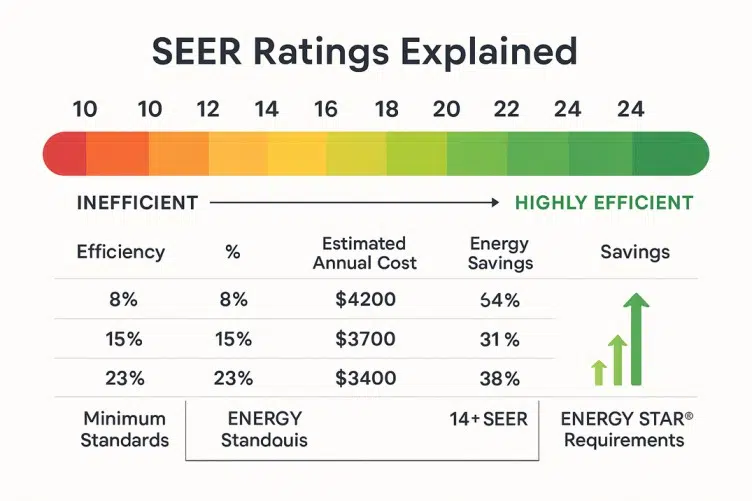
To help consumers make more informed decisions and to drive the industry towards greater energy efficiency, the U.S. Environmental Protection Agency (EPA) established the ENERGY STAR program. An ENERGY STAR certified air conditioner uses approximately 23% less energy than a standard model, which can translate into significant savings on your utility bills. The program sets strict energy efficiency guidelines that manufacturers must meet to earn the ENERGY STAR label. These guidelines are periodically updated to reflect advances in technology and to continue pushing the market towards higher efficiency. The primary metric used to measure the efficiency of central air conditioners is the Seasonal Energy Efficiency Ratio (SEER). The higher the SEER rating, the more efficient the unit. As of 2023, the Department of Energy has implemented new, more stringent efficiency standards, introducing the SEER2 rating system, which is designed to better reflect real-world operating conditions. The chart below illustrates the relationship between SEER ratings, annual operating costs, and potential energy savings.

SEER_Rating,Annual_Cost_USD,Annual_Savings_vs_10SEER
10,1200,0
13,923,277
16,750,450
18,667,533
20,600,600
22,545,655
24,500,700
The evolution of SEER standards has had a significant impact on the energy efficiency of air conditioning systems. The minimum SEER rating for new central air conditioners is now 13 or 14, depending on the region, a significant improvement from the 10 SEER standard of the early 2000s. Upgrading from an older 10 SEER unit to a modern 16 SEER unit can result in annual savings of up to $450, depending on your climate and usage patterns. The infographic below provides a visual explanation of SEER ratings and their impact on energy efficiency and cost savings.
Analysis Section 3: Proper Sizing and Installation
Choosing the right size air conditioner for your home is just as important as selecting a high-efficiency model. An oversized unit will cool the space too quickly and then shut off, a process known as short-cycling. This not only wastes energy but also fails to adequately remove humidity from the air, leaving you with a cool but clammy environment. On the other hand, an undersized unit will run continuously without ever reaching the desired temperature, leading to excessive energy consumption and unnecessary wear and tear on the system. A professional HVAC contractor can perform a load calculation to determine the precise cooling needs of your home, taking into account factors such as square footage, ceiling height, insulation levels, window types, and local climate. A general rule of thumb is that an air conditioner needs about 20 BTUs (British Thermal Units) of cooling capacity for each square foot of living space. The table below provides some general guidelines for AC sizing based on room type.
| Room Type | Typical Square Footage | Recommended BTU/hr |
|---|---|---|
| Small Bedroom | 100 – 150 | 5,000 – 6,000 |
| Large Bedroom / Small Living Room | 150 – 250 | 6,000 – 8,000 |
| Medium Living Room / Small Apartment | 250 – 400 | 8,000 – 12,000 |
| Large Living Room / Small House | 400 – 650 | 12,000 – 15,000 |
| Large Open Area / Small House | 650 – 1,000 | 15,000 – 18,000 |
Proper installation is also critical to ensuring that your air conditioner operates at peak efficiency. A poorly installed unit can suffer from a variety of problems, including refrigerant leaks, improper airflow, and ductwork issues, all of which can significantly reduce its efficiency and lifespan. It is highly recommended that you have your air conditioner installed by a qualified HVAC professional who will ensure that it is properly sized, charged with the correct amount of refrigerant, and connected to a well-designed and sealed duct system. The infographic below provides a checklist of key considerations for a professional AC installation.
Analysis Section 4: Maintenance and Optimization
Regular maintenance is essential for keeping your air conditioner running efficiently and for extending its lifespan. A neglected unit can lose 5% of its overall efficiency each year due to the accumulation of dirt and debris on the coils and filters. This not only increases your energy bills but also reduces the unit’s cooling capacity and can lead to costly repairs. The American Society of Heating, Refrigerating and Air-Conditioning Engineers (ASHRAE) has established comprehensive standards for the inspection and maintenance of commercial and residential HVAC systems. These standards provide a framework for ensuring that your air conditioner is properly cared for throughout its operational life. Simple tasks like regularly cleaning or replacing your air filters can have a significant impact on your AC’s efficiency. A clogged filter restricts airflow, forcing the system to work harder and consume more energy. The chart below illustrates the impact of different maintenance levels on AC efficiency and operating costs.

Maintenance_Level,Efficiency_Retention_Percent,Annual_Cost_USD
No Maintenance,65,1538
Basic Maintenance,85,1176
Regular Maintenance,95,1053
Professional Maintenance,98,1020
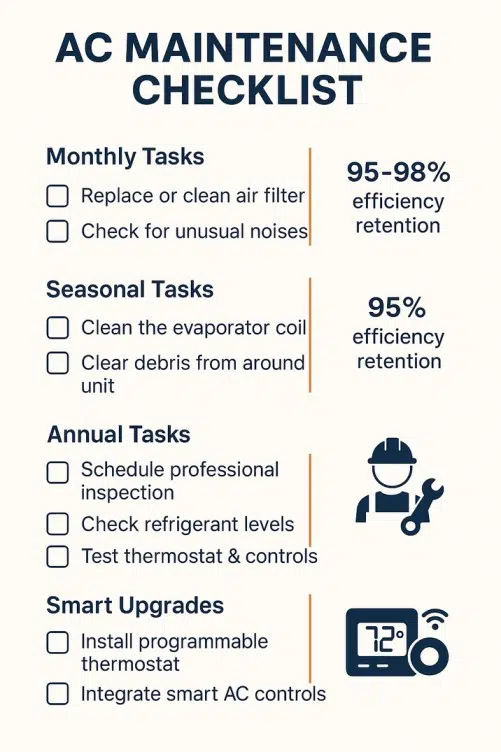
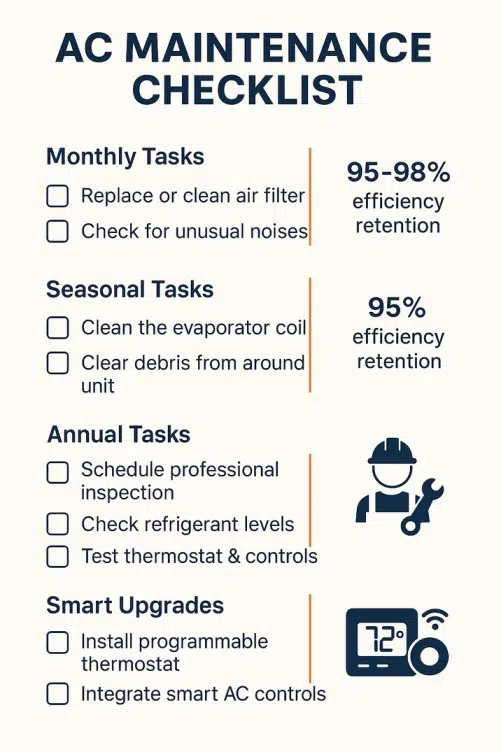
In addition to regular maintenance, there are several optimization strategies you can employ to further improve your AC’s energy efficiency. Installing a programmable or smart thermostat allows you to set different temperatures for different times of the day, so you’re not wasting energy cooling your home when you’re not there. Smart thermostats can even learn your schedule and preferences and automatically adjust the temperature to maximize comfort and savings. Sealing air leaks around windows, doors, and ductwork can also have a significant impact on your cooling costs. The infographic below provides a comprehensive checklist of DIY and professional maintenance tasks to keep your AC running at peak performance.
Action Plan: Your Roadmap to a More Efficient Home
Now that you have a comprehensive understanding of the factors that influence AC energy efficiency, it’s time to put that knowledge into action. This step-by-step action plan will guide you through the process of improving your home’s cooling efficiency, from simple DIY tasks to more significant upgrades. By following this plan, you can create a more comfortable and energy-efficient home while significantly reducing your cooling costs.
Step 1: Assess Your Current Situation (DIY)
- Review your energy bills: Identify your peak usage months and track your energy consumption over time.
- Inspect your AC unit: Check for any obvious signs of damage or neglect, such as dirty filters or blocked airflow.
- Identify air leaks: Use the incense stick test or a thermal leak detector to find and seal air leaks around windows, doors, and ductwork.
Step 2: Implement Low-Cost/No-Cost Strategies (DIY)
- Clean or replace your air filters: This is the single most important maintenance task you can perform to improve your AC’s efficiency.
- Use a programmable or smart thermostat: Set it to a higher temperature when you’re away from home and a lower temperature when you’re there.
- Use ceiling fans: Fans can make a room feel several degrees cooler, allowing you to raise the thermostat setting without sacrificing comfort.
- Block out the sun: Use blinds, curtains, or awnings to block direct sunlight from entering your home, especially during the hottest part of the day.
Step 3: Schedule a Professional Tune-Up (Professional)
- Hire a qualified HVAC technician: Have your AC unit professionally inspected and tuned up at least once a year.
- Ensure proper refrigerant levels: An undercharged or overcharged system will not operate efficiently.
- Have your ductwork inspected: Leaky ducts can account for up to 30% of cooling energy loss.
Step 4: Consider Long-Term Upgrades (Professional)
- Upgrade to an ENERGY STAR certified unit: If your AC is more than 10 years old, upgrading to a new, high-efficiency model can save you up to 20% on your cooling costs.
- Consider a ductless mini-split system: If you’re adding a new room or have a home without ductwork, a ductless system can be a highly efficient and flexible cooling solution.
- Improve your home’s insulation: Adding insulation to your attic, walls, and crawl spaces can significantly reduce your cooling needs.
Future Outlook: The Next Generation of Cooling Technology
The world of air conditioning is constantly evolving, with new technologies and innovations emerging that promise even greater energy efficiency and environmental sustainability. The next generation of cooling systems will be smarter, more connected, and more environmentally friendly than ever before. One of the most significant trends is the development of new refrigerants with lower global warming potential (GWP). The industry is currently transitioning away from hydrofluorocarbons (HFCs) to new, low-carbon A2L refrigerants, and researchers are exploring the use of natural refrigerants like CO2 and ammonia, which have a near-zero GWP. Another key trend is the growing integration of smart technology into HVAC systems. Smart thermostats are already becoming commonplace, but the future will see even more sophisticated controls that can learn your habits, respond to real-time energy pricing, and even diagnose their own maintenance needs. The rise of the smart grid will also play a crucial role in the future of cooling, allowing utilities to better manage peak demand and providing homeowners with new opportunities to save money by shifting their energy usage to off-peak hours. Finally, the adoption of heat pumps is expected to continue to grow, as they offer a highly efficient and all-in-one solution for both heating and cooling. As these technologies become more mainstream, we can expect to see a significant reduction in the energy consumption and environmental impact of air conditioning, making our homes and businesses more comfortable, affordable, and sustainable.
Key Takeaways
- Significant Savings Potential: By implementing a combination of maintenance, upgrades, and smart usage, homeowners can reduce their air conditioning energy consumption by 20-50%, saving hundreds of dollars annually.
- ENERGY STAR is Key: Choosing an ENERGY STAR certified air conditioner can reduce your cooling costs by up to 23% compared to a standard model, while also significantly reducing your carbon footprint.
- Maintenance Matters: Regular maintenance, including cleaning filters and having your system professionally tuned up, can prevent a 5% annual loss in efficiency and extend the life of your unit.
- Sizing is Crucial: A properly sized air conditioner is essential for both comfort and efficiency. An oversized or undersized unit will waste energy and fail to properly dehumidify your home.
References
- U.S. Department of Energy. (n.d.). Air Conditioning. Energy Saver.
- U.S. Energy Information Administration. (2024, March 15). How much electricity is used for air conditioning in the United States?
- U.S. Environmental Protection Agency. (n.d.). Room Air Conditioners. ENERGY STAR.
- ASHRAE. (n.d.). ASHRAE Standards and Guidelines.
Frequently Asked Questions
How much can I save by upgrading to an ENERGY STAR certified air conditioner?
According to the EPA, ENERGY STAR certified air conditioners use approximately 23% less energy than standard models. For a typical household spending $1,200 annually on cooling, this translates to savings of about $276 per year. Over the 15-year lifespan of an air conditioner, this amounts to over $4,000 in energy savings, which often exceeds the initial cost difference between a standard and ENERGY STAR certified unit.
What is the difference between SEER and SEER2 ratings?
SEER2 is the updated efficiency rating system introduced by the Department of Energy in 2023. While SEER (Seasonal Energy Efficiency Ratio) has been the standard for decades, SEER2 provides a more accurate representation of real-world operating conditions by incorporating higher external static pressure in its testing methodology. This change better reflects the actual performance of air conditioners when installed in typical residential ductwork systems. The minimum SEER2 requirements are slightly lower than equivalent SEER ratings due to this more stringent testing.
How often should I replace my air conditioner filters?
The frequency of filter replacement depends on several factors, including the type of filter, your home’s air quality, and usage patterns. Standard 1-inch fiberglass filters should be replaced monthly during peak cooling season. Higher-efficiency pleated filters can typically last 2-3 months. However, homes with pets, smokers, or residents with allergies may need more frequent replacements. A good rule of thumb is to check your filter monthly and replace it when it appears dirty or clogged.
Is it worth upgrading from a 10-year-old air conditioner?
If your air conditioner is 10 years old or older, upgrading to a new ENERGY STAR certified model is likely a wise investment. Older units typically have SEER ratings of 10-13, while new units must meet minimum standards of 13-14 SEER, with high-efficiency models reaching 20+ SEER. The energy savings alone can often justify the upgrade cost, especially if your current unit requires frequent repairs. Additionally, newer units offer improved comfort features, better humidity control, and enhanced reliability.
What are the benefits of ductless mini-split systems?
Ductless mini-split systems offer several advantages over traditional central air conditioning. They provide zone-based cooling, allowing you to cool only occupied areas and set different temperatures for different rooms. This targeted approach can result in 20-40% energy savings compared to central systems. Mini-splits also eliminate ductwork losses, which can account for up to 30% of cooling energy in traditional systems. They’re ideal for home additions, rooms without existing ductwork, or homes where installing ducts would be impractical.
How can smart thermostats help reduce cooling costs?
Smart thermostats can reduce cooling costs through several mechanisms. They learn your schedule and preferences, automatically adjusting temperatures when you’re away. Many models can be controlled remotely via smartphone apps, allowing you to adjust settings before arriving home. Some smart thermostats can also respond to real-time electricity pricing, shifting cooling to off-peak hours when rates are lower. Studies show that smart thermostats can reduce cooling costs by 10-15% through optimized scheduling and usage patterns.
Case Studies: Real-World Energy Savings
Case Study 1: Suburban Home Retrofit in Phoenix, Arizona
A 2,400 square foot home in Phoenix replaced a 15-year-old 10 SEER central air conditioner with a new 18 SEER ENERGY STAR certified unit. The homeowners also upgraded to a smart thermostat and sealed ductwork leaks identified during the installation. Prior to the upgrade, their summer electricity bills averaged $380 per month. After the improvements, their average summer bills dropped to $245 per month, representing a 35% reduction in cooling costs. The total project cost was $8,500, and with annual savings of $1,620 during the cooling season, the payback period was approximately 5.2 years. However, it’s important to note that Phoenix’s extreme climate and high electricity rates contributed to these substantial savings. Homeowners in milder climates may see more modest results.
Case Study 2: Ductless Mini-Split Installation in Portland, Oregon
A Portland homeowner added a 1,200 square foot addition to their home and chose to install a ductless mini-split system rather than extending their existing central air system. The 18 SEER mini-split system cost $4,200 installed, compared to an estimated $7,800 to extend the existing ductwork and upgrade the central system. During the first summer of operation, the mini-split consumed 40% less energy than projected for a traditional ducted system serving the same space. The homeowner particularly appreciated the ability to cool only the addition when the main house wasn’t occupied, further reducing energy consumption. One limitation noted was the need for regular cleaning of the indoor unit’s filters and the aesthetic impact of the indoor wall-mounted units.
Case Study 3: Comprehensive Efficiency Upgrade in Houston, Texas
A Houston family implemented a comprehensive efficiency strategy for their 3,200 square foot home. They upgraded from a 12 SEER system to a 20 SEER heat pump, installed a smart thermostat, added attic insulation, sealed air leaks, and upgraded to high-performance windows. Their pre-upgrade cooling costs averaged $285 per month during summer. Post-upgrade, their bills averaged $165 per month, a 42% reduction. The total investment was $18,500, with annual cooling season savings of $1,440. While the payback period was longer at 12.8 years, the homeowners valued the improved comfort, reduced environmental impact, and increased home value. This case illustrates that while comprehensive upgrades can deliver substantial savings, the economics depend heavily on local energy costs and climate conditions.
Advanced Optimization Strategies
Thermal Envelope Improvements
Beyond the air conditioning system itself, improving your home’s thermal envelope can significantly reduce cooling loads and energy consumption. The thermal envelope includes all the barriers between conditioned and unconditioned spaces: walls, roof, windows, doors, and foundation. Upgrading insulation in attics, walls, and crawl spaces can reduce cooling loads by 10-40%, depending on the existing insulation levels. High-performance windows with low-E coatings and proper orientation can minimize solar heat gain while maintaining natural light. Air sealing, which involves identifying and closing gaps where conditioned air can escape, is often the most cost-effective improvement, with payback periods of 2-5 years in most climates.
Passive Cooling Strategies
Passive cooling strategies can complement mechanical air conditioning to reduce overall energy consumption. Strategic landscaping with shade trees can reduce cooling loads by up to 25% by blocking solar radiation from reaching your home’s exterior surfaces. However, trees take years to mature, and their effectiveness depends on proper species selection and placement. Reflective roofing materials can reduce attic temperatures by 20-30°F, significantly reducing the cooling load on upper floors. Light-colored exterior surfaces reflect more solar radiation than dark surfaces, though the aesthetic impact may limit this strategy’s applicability. Natural ventilation strategies, such as whole-house fans or strategically placed windows, can provide cooling during mild weather without operating the air conditioner, though their effectiveness is limited in hot, humid climates.