


Deciding whether to repair or replace a heat pump is a critical decision for homeowners, with significant implications for both budget and home comfort. With the average heat pump repair cost ranging from $160 to $650 [1], it can be tempting to opt for a quick fix. However, data from the U.S. Department of Energy suggests that replacing a heat pump older than 10 years with an ENERGY STAR certified model can reduce heating and cooling costs by up to 20% annually [2]. This guide provides a comprehensive analysis of the factors to consider, from repair costs and system age to energy efficiency and long-term value, helping you make an informed and cost-effective choice.
Why This Decision Matters More Than Ever
The decision to repair or replace a heat pump has become increasingly complex and critical for homeowners in recent years. Several converging factors, from rising energy costs and evolving efficiency standards to growing environmental concerns, have elevated this choice beyond a simple matter of immediate cost. Understanding this broader context is essential for making a decision that is not only financially sound but also future-proof.
One of the most significant drivers is the escalating cost of energy. As residential electricity prices continue to climb, the efficiency of a home’s heating and cooling system has a direct and substantial impact on monthly utility bills. An older, inefficient heat pump can consume significantly more energy to maintain a comfortable temperature, leading to hundreds of dollars in wasted energy costs each year. The U.S. Department of Energy (DOE) highlights that heating and cooling account for about 55% of the energy used in a typical American home, making it the largest energy expense for most households [2]. This underscores the financial incentive for homeowners to invest in high-efficiency equipment that can deliver long-term savings.
Furthermore, the regulatory landscape is continuously evolving to promote greater energy efficiency and environmental responsibility. The DOE and the Environmental Protection Agency (EPA) periodically update minimum efficiency standards for HVAC equipment, including heat pumps. For instance, as of 2023, new standards require higher Seasonal Energy Efficiency Ratios (SEER) for air conditioners and heat pumps [3]. While homeowners are not required to replace existing systems that don’t meet these new standards, it’s a crucial consideration when a major repair or replacement is on the table. Investing in a new, compliant system ensures that the home’s HVAC infrastructure is aligned with current and future energy goals, potentially increasing its resale value and avoiding the need for premature upgrades down the line.
The stakeholders in this decision extend beyond the homeowner. HVAC contractors and technicians play a vital role in providing accurate assessments and transparent recommendations. Their expertise is crucial for diagnosing complex issues, estimating repair costs, and providing a clear picture of the potential benefits of a new system. For these professionals, the challenge lies in balancing the immediate needs of the customer with the long-term advantages of a more efficient and reliable system. Additionally, utility companies and government agencies are key stakeholders, offering rebates, tax credits, and other incentives to encourage the adoption of high-efficiency heat pumps. These programs can significantly offset the upfront cost of a new system, making it a more accessible option for many homeowners.
Finally, the constraints of this decision are multifaceted. The primary constraint for most homeowners is the upfront cost of a new heat pump, which can range from $5,700 to $8,000 or more for a typical installation [4]. While financing options and incentives can help mitigate this cost, it remains a significant investment. Another constraint is the availability of qualified technicians and the time required for installation, which can be a concern during peak heating or cooling seasons. For homes with older ductwork or inadequate insulation, a new heat pump installation may also require additional upgrades to ensure optimal performance, adding to the overall cost and complexity of the project. Navigating these constraints while weighing the long-term benefits of a new system is the central challenge for homeowners facing the repair vs. replacement dilemma.
Key Factors in the Repair vs. Replacement Decision
The decision to repair or replace a heat pump is rarely straightforward, involving a careful evaluation of several interconnected factors. Beyond the immediate financial implications, homeowners must consider the age and efficiency of their current system, the frequency and cost of repairs, and the long-term benefits of investing in new technology. This section delves into these critical elements, providing a framework for making an informed choice.
System Age and Expected Lifespan
One of the primary indicators for considering replacement is the age of the heat pump. According to ENERGY STAR guidelines, heat pumps and air conditioners that are more than 10 years old should be considered for replacement [1]. While a well-maintained unit might exceed this age, its efficiency likely diminishes over time, leading to higher energy consumption and increased operating costs. Furnaces and boilers have a slightly longer lifespan, with replacement recommended after 15 years [1].
The expected lifespan of a heat pump varies by type. Air-source heat pumps typically last between 10 to 15 years, while geothermal heat pumps, with their underground loop systems, can last significantly longer—up to 24 years for indoor components and over 50 years for the ground loop itself [2]. This disparity in longevity is a crucial factor in the long-term cost-benefit analysis, as a geothermal system, despite its higher upfront cost, offers a much longer period of efficient operation.

label,repair_recommended,replace_recommended
0-5 Years,95,5
6-10 Years,75,25
11-15 Years,40,60
16+ Years,15,85
Repair Frequency and Cost
A frequently malfunctioning heat pump is a clear signal that replacement might be more economical in the long run. While minor repairs are inevitable, a pattern of recurring breakdowns, especially for the same issue, indicates an underlying problem that may not be worth continually fixing. The average heat pump repair cost ranges from $160 to $650, but major component failures can quickly escalate these costs [4]. For instance, replacing a compressor can cost anywhere from $650 to $2,400, while a refrigerant leak repair might be $300 to $1,200 [4].
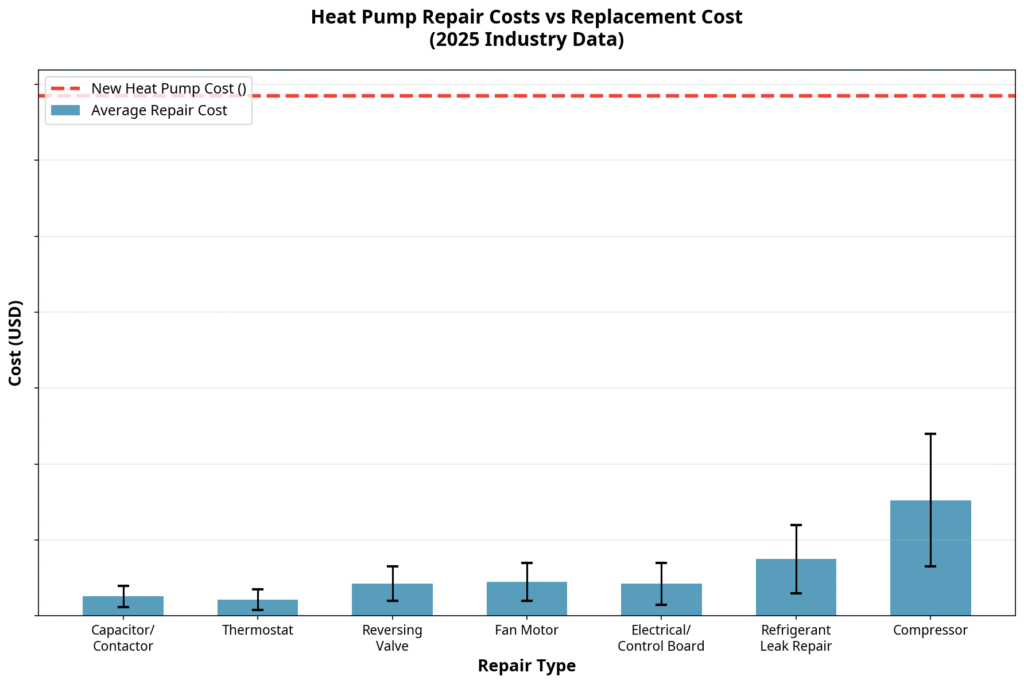
label,low_cost,high_cost,average_cost
Capacitor/Contactor,120,400,260
Thermostat,80,350,215
Reversing Valve,200,650,425
Fan Motor,200,700,450
Electrical/Control Board,150,700,425
Refrigerant Leak Repair,300,1200,750
Compressor,650,2400,1525
New Heat Pump System,5700,8000,6850
A widely accepted industry guideline, often referred to as the “50% rule,” suggests that if the cost of a repair is more than half the cost of a new system, replacement is the more financially sound option [5]. This rule of thumb helps homeowners avoid sinking money into an aging unit that is likely to experience further issues. For example, if a new heat pump system costs $7,000, and a repair is estimated at $3,500 or more, replacement becomes the more logical choice, especially if the system is already over 10 years old.
Energy Efficiency and Operating Costs
The efficiency of a heat pump is a critical factor in the repair vs. replacement decision, as it directly impacts long-term operating costs. Heat pump efficiency is measured by the Seasonal Energy Efficiency Ratio (SEER) for cooling and the Heating Seasonal Performance Factor (HSPF) for heating. The higher these ratings, the more efficient the unit. An older heat pump might have a SEER rating of 10 or less, while new standard models have a minimum SEER of 14.3, and high-efficiency models can reach a SEER of 20 or more [3].

label,seer_rating,annual_cost
10+ Year Old Heat Pump,10,1200
Standard New Heat Pump,14.3,850
Energy Star Heat Pump,16,750
High Efficiency Heat Pump,20,600
Upgrading to a more efficient system can lead to significant energy savings. According to the DOE, replacing an older heat pump with an ENERGY STAR certified model can reduce heating and cooling costs by up to 20% [2]. For a typical 2,000 sq ft home, this could translate to annual savings of several hundred dollars, helping to offset the upfront cost of the new system over time. The NREL has also found that air-source heat pumps are cost-effective without subsidies in 65 million U.S. homes, but efficiency is key to avoiding bill increases [6].
Warranty Coverage
Warranty coverage is another important consideration. Most new heat pumps come with a manufacturer’s warranty that covers parts for a specified period, typically 5 to 10 years. Some manufacturers offer extended warranties that can provide additional peace of mind. If a major component fails while the system is still under warranty, the repair cost may be significantly reduced, making repair a more attractive option. However, it’s important to note that warranties typically do not cover labor costs, which can still be substantial. Once the warranty has expired, the homeowner is responsible for the full cost of any repairs, which can make replacement a more appealing choice, especially for older systems.
The Decision-Making Process: A Step-by-Step Guide
Navigating the repair vs. replacement decision can be overwhelming, but a structured approach can help clarify the best course of action. This step-by-step guide, accompanied by a visual flowchart, breaks down the process into manageable steps, empowering homeowners to make a confident and well-informed choice.
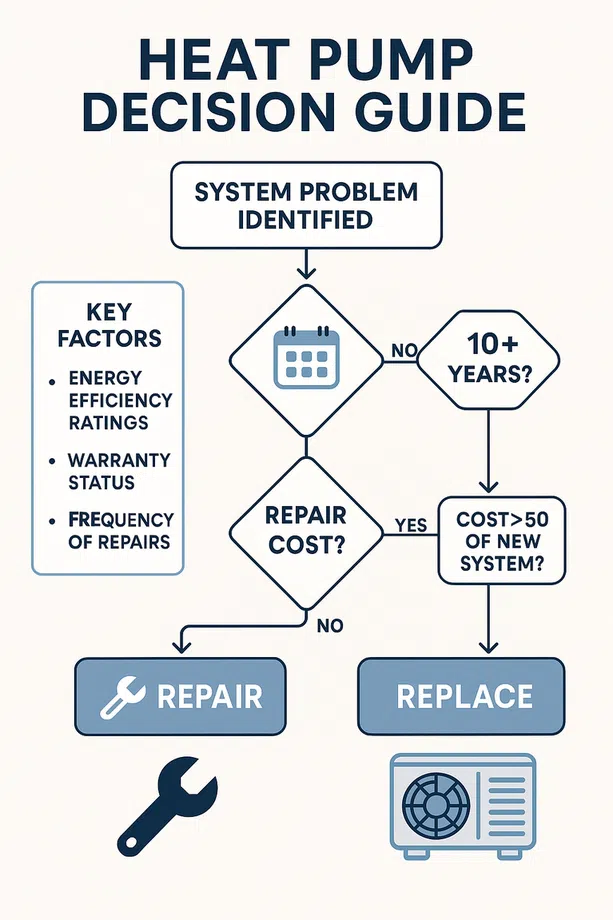
Step 1: Assess the Initial Problem and Get a Professional Diagnosis
When your heat pump malfunctions, the first step is to get a clear understanding of the problem. While some issues, like a tripped breaker or a dirty filter, can be resolved with simple troubleshooting, most problems require a professional diagnosis from a qualified HVAC technician. A technician can accurately identify the root cause of the issue, determine the extent of the damage, and provide a detailed estimate for the repair. This professional assessment is the foundation of the decision-making process, providing the critical information needed to weigh your options.
Step 2: Evaluate the Age and Condition of Your System
With the diagnosis in hand, the next step is to consider the age and overall condition of your heat pump. As previously discussed, if your system is over 10 years old, replacement should be a serious consideration, even if the repair is relatively minor. An older system is more likely to experience further breakdowns, and its efficiency is likely to be significantly lower than that of a new model. If your system is relatively new and has been well-maintained, a repair is often the more logical choice, especially if the issue is an isolated one.
Step 3: Analyze the Repair Cost in Relation to Replacement Cost
This is where the “50% rule” comes into play. Compare the estimated repair cost to the cost of a new heat pump system. If the repair cost is more than half the cost of a new unit, replacement is generally the more financially prudent option. For example, if a new system costs $7,000, and the repair is quoted at $3,800, you would be investing a significant amount of money into an older system with a limited lifespan and no warranty. In this scenario, the additional investment for a new, efficient, and warrantied system is often justified.
Step 4: Consider Energy Efficiency and Long-Term Savings
Look beyond the immediate cost and consider the long-term financial implications of your decision. A new, high-efficiency heat pump can generate substantial energy savings over its lifespan, helping to offset the upfront investment. Ask your HVAC contractor to provide an estimate of the potential energy savings from a new system compared to your current one. You can also use online calculators or consult with your utility company to get a better sense of the long-term financial benefits of an upgrade. These savings, combined with any available rebates or tax credits, can make replacement a more attractive option than it might initially appear.
Step 5: Factor in Warranty Coverage and Future Repairs
Finally, consider the peace of mind that comes with a new system and a comprehensive warranty. A new heat pump is less likely to experience breakdowns in the near future, and if it does, the repairs will likely be covered by the manufacturer’s warranty. An older, out-of-warranty system, on the other hand, leaves you vulnerable to the full cost of any future repairs, which can be unpredictable and financially burdensome. This risk of future costs should be factored into your decision, as it can significantly impact the total cost of ownership over time.
Conclusion: Making the Right Choice for Your Home and Budget
The decision to repair or replace a heat pump is a significant one, with long-term implications for your home’s comfort, energy consumption, and finances. By carefully evaluating the age and condition of your system, the cost and frequency of repairs, the potential for energy savings, and the peace of mind that comes with a new warranty, you can make a choice that is both financially sound and future-proof. While a repair might seem like the more affordable option in the short term, a new, high-efficiency heat pump can deliver substantial long-term savings and improved home comfort, making it a wise investment for many homeowners.
Call to Action
If you’re facing a heat pump repair or replacement decision, don’t navigate it alone. The experts at Northern Services Today are here to help. Our certified HVAC technicians can provide a comprehensive system diagnosis, a transparent and detailed estimate, and expert guidance to help you make the right choice for your home and budget. We offer a wide range of high-efficiency heat pump systems from leading manufacturers, as well as professional installation and maintenance services to ensure your system operates at peak performance for years to come. Contact us today to schedule a consultation and take the first step toward a more comfortable and energy-efficient home.
References
- ENERGY STAR. (n.d.). When is it Time to Replace?
- U.S. Department of Energy. (n.d.). Heat Pump Systems.
- U.S. Department of Energy. (2023). Biden-Harris Administration Finalizes Stronger Energy Efficiency Standards for Central Air Conditioners and Heat Pumps.
- Angi. (2025). How Much Does Heat Pump Repair Cost? [2025 Data].
- Forbes. (2024). How Much Does Heat Pump Maintenance, Service And Repair Cost?
- NREL. (2024). Where are Today’s Residential Heat Pump Technologies Cost-Effective?